

A sensitive, respectful burial… 175 years later
Proper rite for old remains 'reconciliation in action'
Advertisement
Read this article for free:
or
Already have an account? Log in here »
To continue reading, please subscribe:

Digital Subscription
One year of digital access for only $205*
- Enjoy unlimited reading on winnipegfreepress.com
- Read the E-Edition, our digital replica newspaper
- Access News Break, our award-winning app
- Play interactive puzzles
*First annual payment billed as $205.00 + GST for one year. This annual subscription will automatically renew at $233.00 + GST every 52 weeks (10% off the regular annual price of $259.35). Offer available to new and qualified returning subscribers only. Cancel any time.
To continue reading, please subscribe:
Add Free Press access to your Brandon Sun subscription for only an additional
$1 for the first 4 weeks*
- Enjoy unlimited reading on winnipegfreepress.com
- Read the E-Edition, our digital replica newspaper
- Access News Break, our award-winning app
- Play interactive puzzles
*Your next Brandon Sun subscription payment will increase by $1.00 and you will be charged $17.95 plus GST for four weeks. After four weeks, your payment will increase to $24.95 plus GST every four weeks.
Read unlimited articles for free today:
or
Already have an account? Log in here »
Hey there, time traveller!
This article was published 10/12/2016 (3558 days ago), so information in it may no longer be current.
Almost two centuries ago, an indigenous man died near the Red River Settlement.
Elders laid him to rest with his stone pipe, a clay pottery bowl and beadwork tucked inside a birchbark shroud. He was buried with honour, facing east and overlooking the Red River in what would later be called East Selkirk.
At the time, the gravesite was in or near the area known as the St. Peters Reserve, where Chief Peguis settled his people after the Selkirk Treaty.
In the decades that followed, there would be violent skirmishes between white settlers and area Métis over land rights. Manitoba would enter Confederation as the first province in Western Canada, and Peguis’s people would lose their home on the Red River.
Through the turbulent 19th and 20th centuries, the man’s remains lay undisturbed until a few weeks ago, when time and nature — the Red River can rise and fall as much as a metre overnight — exposed his grave.
On Oct. 22, a particularly mild Saturday, a local resident glanced over at the riverbank and spotted a skull, with bits of birchbark sticking out of the riverbank. RCMP responded to the 911 call that human remains had been found near the junction of highways 212 and 204.
The resident reported what RCMP would later record and share with a select few: the bank beneath had collapsed, tree roots embraced the grave and the whole thing jutted out, tilting precariously in mid-air.
Officers taped off the riverbank as a potential crime scene. News stories circulated, and relatives of missing people held their collective breath, wondering if they’d get a call similar to the one the Bricker family received in the summer when the remains of their son Reid, were found close by.
The officers who examined the site saw the birchbark and the other burial items and realized the significance was historic, not criminal.
They placed a private call for an indigenous elder to come out and hold a ceremonial smudge, a cleansing ritual involving the smoke from cedar, sage and sweetgrass that precedes all indigenous ceremonial rites.
Police also called the province’s historic resources branch.
Extensive investigations revealed the remains were much older than anyone realized.
Reluctant to disclose much to the public, a provincial spokesman confirmed the remains dated back to the 1840s. The story disappeared from local news pages.
At the same time, officials canvassed nearby indigenous communities for someone to claim the remains. Brokenhead First Nation Chief Jim Bear stepped up.
“Who knows? He may have been my cousin,” said Bear, who saw the location. “It was just a matter of time before (the remains) may have fallen into the river. We never would have known.”
Bear spent the next few weeks working with the province, searching for a new safe place for an interment and arranging for indigenous elders to conduct it as close to the original rites as possible, despite the gap of 175 years and the sustained, often brutal attempts to assimilate Canada’s First Nations people.
Simultaneously, Bear started a conversation among Assembly of Manitoba Chiefs elders about designing a protocol to guide future such discoveries, and he opened discussions with the Rural Municipality of St. Clements to erect a marker at the site of the original grave, in case others are exposed.
“There’s something that’s come out of this… because I wasn’t sure who to phone, what’s the proper protocol and even though a smudge had been done, I wanted to know more,” Bear said.
Ojibwa elder Harry Bone took Bear’s call, and now he’s at work with AMC elder and former grand chief Dennis White Bird, consulting Cree, Ojibwa and Dakota elders to design such a protocol. Both Bear and Bone commended the RCMP on the way they conducted the investigation; the smudge was a surprisingly touching gesture.
“We know this is going to happen, there’s going to be other things found,” Bone said.
Past discoveries haven’t always gone smoothly.
Bone was among the elders when early excavation at the Canadian Museum for Human Rights site at The Forks uncovered indigenous pipes and artifacts. Provincial laws that govern archeological digs temporarily halted construction.
In 2013, museum officials confirmed some 400,000 artifacts had been unearthed at the site, reinforcing the long-held belief that the confluence of the Red and the Assiniboine rivers had been an indigenous meeting place for millennia.
“When these things happen, it’s not just an ordinary smudging and prayer,” Bone said.
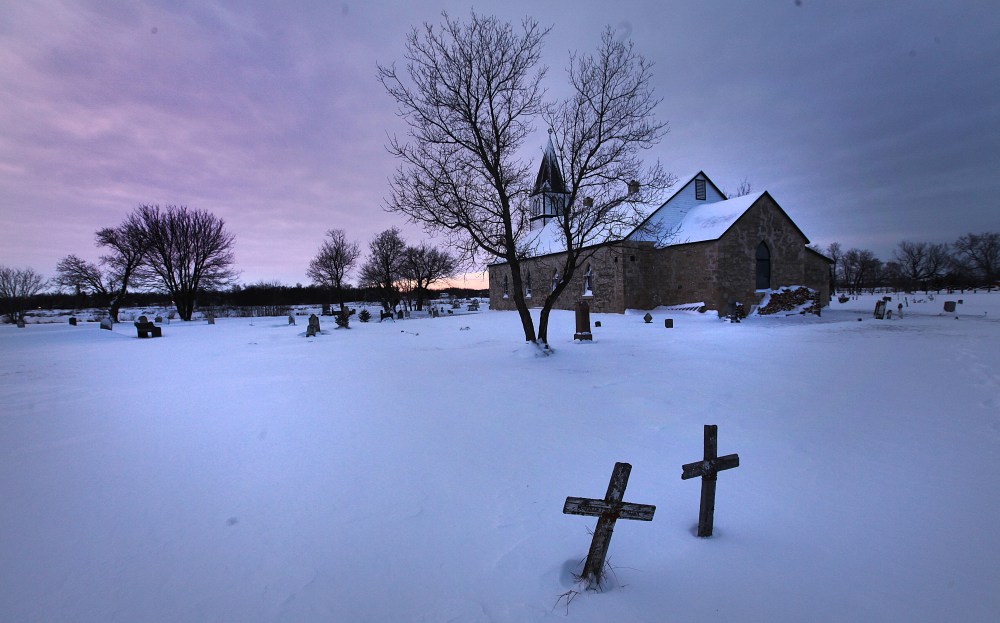
A small gathering assembled privately recently at St. Peter Dynevor, the old stone church in East Selkirk and a provincial historic site, for the interment of remains discovered in October. RCMP officers, spiritual elders from Peguis, provincial and municipal officials, and the church’s Cree-born Anglican Rev. Vincent Solomon attended.
“As part of the reconciliation and healing process, it was nice to have both (spiritual elders and Christian clergy),” Bear said.
The historic resources branch offered a touching gesture — a wooden box lined with what remained of the original birchbark shroud.
“I wish I saw it,” Bear said. Ironically, the man who arranged it missed the funeral. “I was sick that day, and I was also at the legislature for my uncle getting his plaque.”
The reburial was held the same day the legislature officially marked Aboriginal Veterans Day Nov. 8 by honouring Bear’s uncle, Canadian war hero Sgt. Tommy Prince from Brokenhead. Both are descended from Chief Peguis.
Elders laid the man back to rest for a second time in an unmarked grave.
“There was just something about it, how everything was done,” said St. Clement Mayor Debbie Fiebelkorn, who was also at the ceremony. “Respect, that’s the right word.” Fittingly, she said, a solitary eagle soared across the sky to the west as the smudge, pipe smoke and drum rites faded.
“From those that found him, from those who were doing the reburial, from the province, the RCMP — right from beginning to end, he was respected by all,” an emotional Fiebelkorn said weeks later.
Bear said the events this fall have touched him, too.
“I wanted to make sure the proper protocols were covered, and I’m really pleased with the result. The proper respect was shown, and to me, that’s good… It was reconciliation in action.”
alexandra.paul@freepress.mb.ca
