

Altona police employ body cameras
Chief says visual record promotes best behaviour

Advertisement
Read this article for free:
or
Already have an account? Log in here »
To continue reading, please subscribe:

Digital Subscription
One year of digital access for only $205*
- Enjoy unlimited reading on winnipegfreepress.com
- Read the E-Edition, our digital replica newspaper
- Access News Break, our award-winning app
- Play interactive puzzles
*First annual payment billed as $205.00 + GST for one year. This annual subscription will automatically renew at $233.00 + GST every 52 weeks (10% off the regular annual price of $259.35). Offer available to new and qualified returning subscribers only. Cancel any time.
To continue reading, please subscribe:
Add Free Press access to your Brandon Sun subscription for only an additional
$1 for the first 4 weeks*
- Enjoy unlimited reading on winnipegfreepress.com
- Read the E-Edition, our digital replica newspaper
- Access News Break, our award-winning app
- Play interactive puzzles
*Your next Brandon Sun subscription payment will increase by $1.00 and you will be charged $17.95 plus GST for four weeks. After four weeks, your payment will increase to $24.95 plus GST every four weeks.
Read unlimited articles for free today:
or
Already have an account? Log in here »
Hey there, time traveller!
This article was published 24/02/2021 (2039 days ago), so information in it may no longer be current.
In a bid to increase public trust and better protect officers, the Altona Police Service has equipped front-line officers with cellphones that act as body cameras.
In October, the police service in the town of 4,200 people, began testing Visual Labs software on officers’ smartphones, which can record video of police interactions, gather still images and track officers’ locations.
The change became permanent for six front-line officers in January.
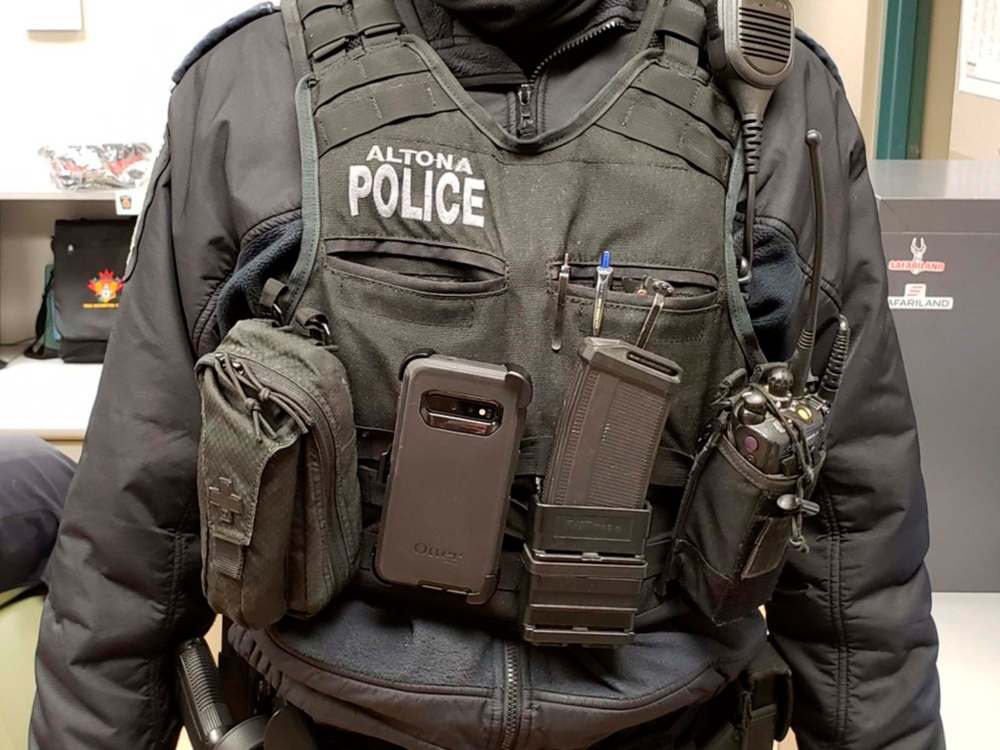
Police Chief Perry Batchelor said the visual record taken from an officer’s point of view has the potential to keep both police and citizens on their best behaviour.
“Sometimes you’ve got someone who is upset and they act differently when they are recorded,” said Batchelor. “Cameras are everywhere, so it is good to have the officer’s perspective and understand why the officer is doing what they’re doing.”
He expects the change will benefit the public through increased transparency.
“If the police are prepared to release body-worn camera video in all situations where it’s appropriate… you would hope it would increase the public’s trust in the police service,” he said.
Batchelor said he expects the cameras will also quickly address some complaints that could otherwise take thousands of dollars to investigate. For example, he said a theft claim against police was recently disproved when video showed the suspect didn’t have the item in question when he was arrested.
Batchelor said the software costs about $60 per month per device, or about $4,500 annually, since the app was added to department cellphones.
The videos transfer automatically when an officer returns to the police department and connects to its Wi-Fi.
Meanwhile, the policy dictates the circumstances under which officers should record video, including whenever they expect to arrest a suspect or read someone their rights and whenever use of force is possible.
They are also expected to tell members of the public they are being recorded, whenever they can safely do so.
“The policy is a guide and if you have a serious policy breach, then there is potential for disciplinary action,” said Batchelor.
The guidelines list circumstances where video recordings should be avoided, including to protect police tactics or a citizen’s privacy.
Overall, however, the police chief said video has been recorded very often.
“Our officers are turning their cameras on at pretty much every contact,” said Batchelor.
The app is also capable of letting the police chief connect to a livestream video feed from a body camera, in cases where an officer faces a sudden threat, said Alexander Popof, Visual Labs’ chief operating officer.
“It has real-time positional awareness so that if someone was authorized, like a chief of police, they could look at a map at any time of day or night … and see exactly where their officers are,” said Popof. “That’s especially important if there was ever a foot pursuit or the officer stepped away from a vehicle.”
Popof noted the price for the app also tends to be cheaper than adding separate cameras.
Last year, the Winnipeg Police Service estimated such a system could cost as much as $10 million to implement for its more than 1,300 officers.
While WPS had planned a body-cam pilot project in 2015, the effort was cancelled because of its price.

Coun. Markus Chambers, chairman of the Winnipeg Police Board, noted even the unit price noted by Altona would result in a much greater total tab for Winnipeg.
“Cost still is largely the barrier to us having body cameras,” said Chambers.
He said any move to add body cameras here could also face opposition from some Winnipeggers.
joyanne.pursaga@freepress.mb.ca
Twitter: @joyanne_pursaga
Joyanne is city hall reporter for the Winnipeg Free Press. A reporter since 2004, she began covering politics exclusively in 2012, writing on city hall and the Manitoba Legislature for the Winnipeg Sun before joining the Free Press in early 2020. Read more about Joyanne.
Every piece of reporting Joyanne produces is reviewed by an editing team before it is posted online or published in print — part of the Free Press‘s tradition, since 1872, of producing reliable independent journalism. Read more about Free Press’s history and mandate, and learn how our newsroom operates.
Our newsroom depends on a growing audience of readers to power our journalism. If you are not a paid reader, please consider becoming a subscriber.
Our newsroom depends on its audience of readers to power our journalism. Thank you for your support.
Joyanne is city hall reporter for the Winnipeg Free Press. A reporter since 2004, she began covering politics exclusively in 2012, writing on city hall and the Manitoba Legislature for the Winnipeg Sun before joining the Free Press in early 2020. Read more about Joyanne.
Every piece of reporting Joyanne produces is reviewed by an editing team before it is posted online or published in print — part of the Free Press‘s tradition, since 1872, of producing reliable independent journalism. Read more about Free Press’s history and mandate, and learn how our newsroom operates.
Our newsroom depends on a growing audience of readers to power our journalism. If you are not a paid reader, please consider becoming a subscriber.
Our newsroom depends on its audience of readers to power our journalism. Thank you for your support.
Advertisement Advertise With Us
Advertisement Advertise With Us