

Face value: students develop safer masks for kids

Advertisement
Read this article for free:
or
Already have an account? Log in here »
To continue reading, please subscribe:
Monthly Digital Subscription
$1 per week for 24 weeks*
- Enjoy unlimited reading on winnipegfreepress.com
- Read the E-Edition, our digital replica newspaper
- Access News Break, our award-winning app
- Play interactive puzzles
*Billed as $4.00 plus GST every four weeks. After 24 weeks, price increases to the regular rate of $19.95 plus GST every four weeks. Offer available to new and qualified returning subscribers only. Cancel any time.
Monthly Digital Subscription
$4.99/week*
- Enjoy unlimited reading on winnipegfreepress.com
- Read the E-Edition, our digital replica newspaper
- Access News Break, our award-winning app
- Play interactive puzzles
*Billed as $19.95 plus GST every four weeks. Cancel any time.
To continue reading, please subscribe:
Add Free Press access to your Brandon Sun subscription for only an additional
$1 for the first 4 weeks*
*Your next subscription payment will increase by $1.00 and you will be charged $16.99 plus GST for four weeks. After four weeks, your payment will increase to $23.99 plus GST every four weeks.
Read unlimited articles for free today:
or
Already have an account? Log in here »
Hey there, time traveller!
This article was published 19/05/2021 (1799 days ago), so information in it may no longer be current.
Fed up with wearing cloth masks that are uncomfortable and fall off easily, the Turk twins set out to find a safe alternative for students.
Miriam and Ruth Turk made researching the effectiveness of masks their Grade 4 science fair mission this year.
The eight-year-olds — who are enrolled in homeschool, but are expected to join their peers in class this fall — were among dozens of students who took part in the 50th annual Manitoba Schools Science Symposium this spring.
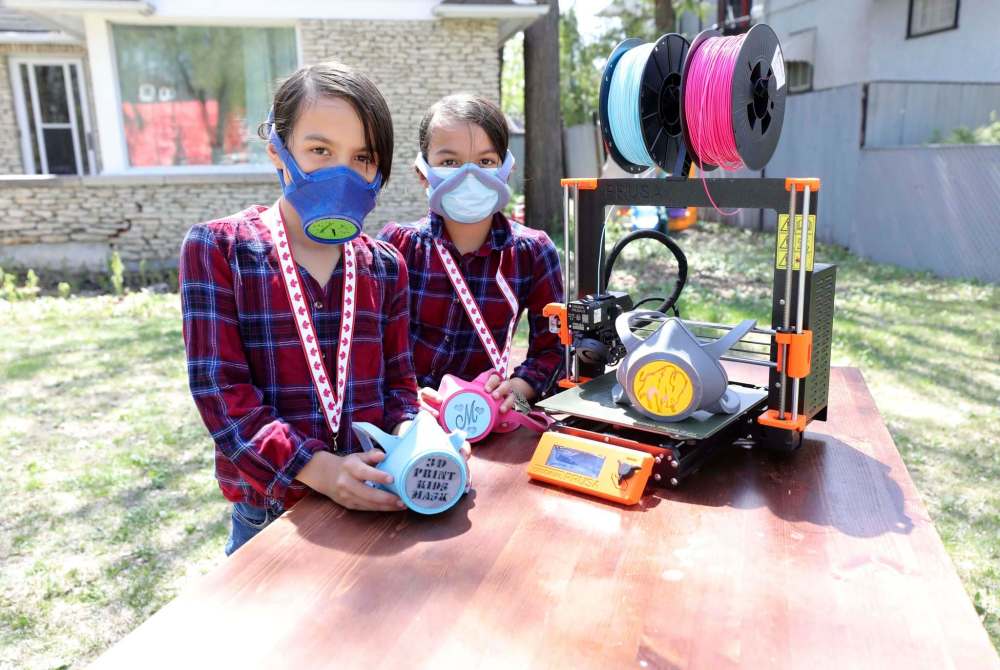
“Our favourite part of working on this project was making the mask and adding the pigment and glitter — because it’s like baking a cake,” said Ruth.
The Turks’ award-winning project started with polling 47 pupils about their mask-wearing experiences. The twins created silicone masks and face-fitters in an oven, with help from a plastic surgeon who shared his mask pattern and mentored them to create kid-friendly versions.
They designed and produced custom filters using a 3D printer, to complete the prototypes before using a respirator fit test to measure their masks’ effectiveness against other personal protective equipment, including an N95 and reusable cloth masks made of polyester and cotton.
Their experiment, which involved measuring alcohol particles inside various masks and comparing them to alcohol particles in the outside air, found their prototypes provided similar protection to a disposable N95 mask.
“A reusable cloth mask with a filter stops droplets and is a good protection against the COVID-19 virus, but (particles) still get in from the top, the bottom and the sides,” said Miriam, noting a seal is key when it comes to masking.
Their silicone prototypes are easy to wash, do not fall off easily, fit comfortably, reduce single-use waste, and protect kids “in a fun and stylish way,” according to the presentation they prepared for the symposium — the first to be held online.
Following an abrupt cancellation of last year’s event, organizers created a virtual format for 2021. The event, which typically draws 500 students, only had 65 student participants this year, but the chairperson said there was no shortage of outstanding research on everything from the dangers of nuclear power to how dynamic warm-ups affect hockey players’ performance.
Andrika Tittenberger said the Turks’ project was rare because it was about a COVID-19-related question. Most students chose other scientific subjects, likely because they needed an escape from the pandemic, said Tittenberger.
At the senior years level, students from Shaftesbury High collected numerous awards.
Leon Spivak’s project looked at the adverse effects of vape juice on lung epithelial cells. Spivak, a 2020 graduate who presented at this year’s symposium, took particular interest in studying a harmful compound used in creating cinnamon-flavoured juice.
“There are definitely a lot of nicotine-addicted high schoolers out there now. It kind of snowballed quite a bit over the years (I was in high school),” the 18-year-old said, adding the popularity is concerning, given his research found cinnamaldehyde damages cells found in human airways.
Also representing Shaftesbury, Jessica Walker was recognized for her research on farm animal welfare, which involved seeking out strangers at the mall who were willing to visit her family-run animal sanctuary, the Little Red Barn in Winnipeg. “I wanted to see if I could actually teach empathy and compassion towards farm animals to help bridge the (dietary) disconnect that exists in urban populations,” said Walker, 15.

She split the participants into groups: 20 would visit her sanctuary and interact with animals, 20 would only be provided with educational materials on animal welfare issues, 20 would participate in the two above, and 20 would be a control group.
Those who both spent time with rescues and read about animal welfare reported significant changes, including reducing meat consumption and trying things like “meatless Mondays,” in a survey distributed six months after their visits to the sanctuary in early 2020.
Ten students, Walker included, were selected to represent Manitoba at the Canadawide science fair this week.
maggie.macintosh@freepress.mb.ca
Twitter: @macintoshmaggie
Maggie Macintosh
Education reporter
Maggie Macintosh reports on education for the Free Press. Originally from Hamilton, Ont., she first reported for the Free Press in 2017. Read more about Maggie.
Funding for the Free Press education reporter comes from the Government of Canada through the Local Journalism Initiative.
Every piece of reporting Maggie produces is reviewed by an editing team before it is posted online or published in print — part of the Free Press‘s tradition, since 1872, of producing reliable independent journalism. Read more about Free Press’s history and mandate, and learn how our newsroom operates.
Our newsroom depends on a growing audience of readers to power our journalism. If you are not a paid reader, please consider becoming a subscriber.
Our newsroom depends on its audience of readers to power our journalism. Thank you for your support.
Maggie Macintosh
Education reporter
Maggie Macintosh reports on education for the Free Press. Originally from Hamilton, Ont., she first reported for the Free Press in 2017. Read more about Maggie.
Funding for the Free Press education reporter comes from the Government of Canada through the Local Journalism Initiative.
Every piece of reporting Maggie produces is reviewed by an editing team before it is posted online or published in print — part of the Free Press‘s tradition, since 1872, of producing reliable independent journalism. Read more about Free Press’s history and mandate, and learn how our newsroom operates.
Our newsroom depends on a growing audience of readers to power our journalism. If you are not a paid reader, please consider becoming a subscriber.
Our newsroom depends on its audience of readers to power our journalism. Thank you for your support.
Advertisement Advertise With Us
Advertisement Advertise With Us
History
Updated on Wednesday, May 19, 2021 6:29 AM CDT: removes period in deck
Updated on Wednesday, May 19, 2021 6:40 AM CDT: Replaces photo
Updated on Wednesday, May 19, 2021 7:56 AM CDT: Removes period in deck