

First Nations elections proceed despite pandemic

Advertisement
Read this article for free:
or
Already have an account? Log in here »
To continue reading, please subscribe:
Monthly Digital Subscription
$1 per week for 24 weeks*
- Enjoy unlimited reading on winnipegfreepress.com
- Read the E-Edition, our digital replica newspaper
- Access News Break, our award-winning app
- Play interactive puzzles
*Billed as $4.00 plus GST every four weeks. After 24 weeks, price increases to the regular rate of $19.95 plus GST every four weeks. Offer available to new and qualified returning subscribers only. Cancel any time.
Monthly Digital Subscription
$4.99/week*
- Enjoy unlimited reading on winnipegfreepress.com
- Read the E-Edition, our digital replica newspaper
- Access News Break, our award-winning app
- Play interactive puzzles
*Billed as $19.95 plus GST every four weeks. Cancel any time.
To continue reading, please subscribe:
Add Free Press access to your Brandon Sun subscription for only an additional
$1 for the first 4 weeks*
*Your next subscription payment will increase by $1.00 and you will be charged $16.99 plus GST for four weeks. After four weeks, your payment will increase to $23.99 plus GST every four weeks.
Read unlimited articles for free today:
or
Already have an account? Log in here »
Hey there, time traveller!
This article was published 07/04/2020 (2207 days ago), so information in it may no longer be current.
In 1918, the United States held midterm elections during a devastating flu pandemic that killed an estimated 50 million people worldwide.
State authorities temporarily lifted bans on quarantine measures to allow politicians to campaign. Voters lined up for hours, wearing face masks outside polling booths. Bans were imposed on the public posting of results to discourage gatherings.
Voter turnout was low (40 per cent, or 10 percentage points lower than in the 1914 election) as many stayed home. The turnout was also hampered by the ongoing First World War.
While there was no debate about the legitimacy of the election results, legal scholar Jason Marisam wrote in a 2010 article for Election Law Journal, court challenges occurred for months after, underlining the reality that “one way to ensure the integrity of an election is to postpone the election until more normal conditions return.”
More than 100 years later, the world seems to have learned, leading to countless postponements of elections because of the COVID-19 pandemic.
In England, more than 100 municipal elections have been postponed for a year.
In Sri Lanka, parliamentary elections have been postponed indefinitely, a controversial decision during a constitutional crisis.
In the U.S., many states and territories have postponed their presidential nominating contests. Wisconsin held its primary Tuesday, the day after the state Supreme Court blocked the governor’s order to postpone the vote.
In Canada, municipal or school board elections and byelections in New Brunswick, Ontario, and Winnipeg have been postponed.
No one, it appears, wants or needs to go to the polls during a pandemic. And yet, First Nations elections must go on.
On April 18, Brokenhead Ojibway Nation, which most Manitobans know as the home of South Beach Casino, will hold an election for chief and four band councillors.
For the first three weeks of the COVID-19 pandemic, the federal government ordered all First Nations elections to take place as scheduled.
Under the Indian Act, the terms of chiefs and councils are fixed and cannot be extended. If a First Nation has no leadership, federal officials place it under “third-party management” (usually an accountancy firm) — a legislative black hole where basic services are administered, budgets are stringent, and band council resolutions cannot be passed.
Escaping from “third party” also hampers leadership for years. No government anywhere can or should operate in this fashion.
Indigenous Services Minister Marc Miller announced March 27 the federal government “does not recommend” First Nations proceed with elections during the novel coronavirus crisis.
This is fine, but there’s a problem.
In a letter to Brokenhead Ojibway Nation, Stephen Traynor, the regional director of Indigenous Services Canada, says terms of chief and council cannot be extended, but “the council must designate a person to whom the necessary authorities have been delegated to ensure the continuity of the delivery of essential services and programs.”
So, instead of having a third-party manager administer the First Nation, the community can choose its own.
Chief and council could, in theory, appoint themselves, but would the community see them as legitimate?
So, Brokenhead really has no choice. Nor do two other First Nations in Manitoba with upcoming elections: Rolling River and O-Chi-Chak-Ko-Sipi.
“We’ve consulted Brokenhead’s lawyers and are going to do everything we can to make sure this election is safe,” said Burke Ratte, electoral officer for the Brokenhead election. Ratte has already administered elections during the COVID-19 pandemic (for Red Pheasant Cree Nation in Saskatchewan, March 20) and is a citizen of Brokenhead.
The election is expected to be a battle between Chief Deborah Smith and the previous chief, Jim Bear.
Ratte said he expects 300 to 400 voters to show up at the polls on April 18, but hopes many choose the mail-in ballot option (with 1,215 mailed to Brokenhead citizens).
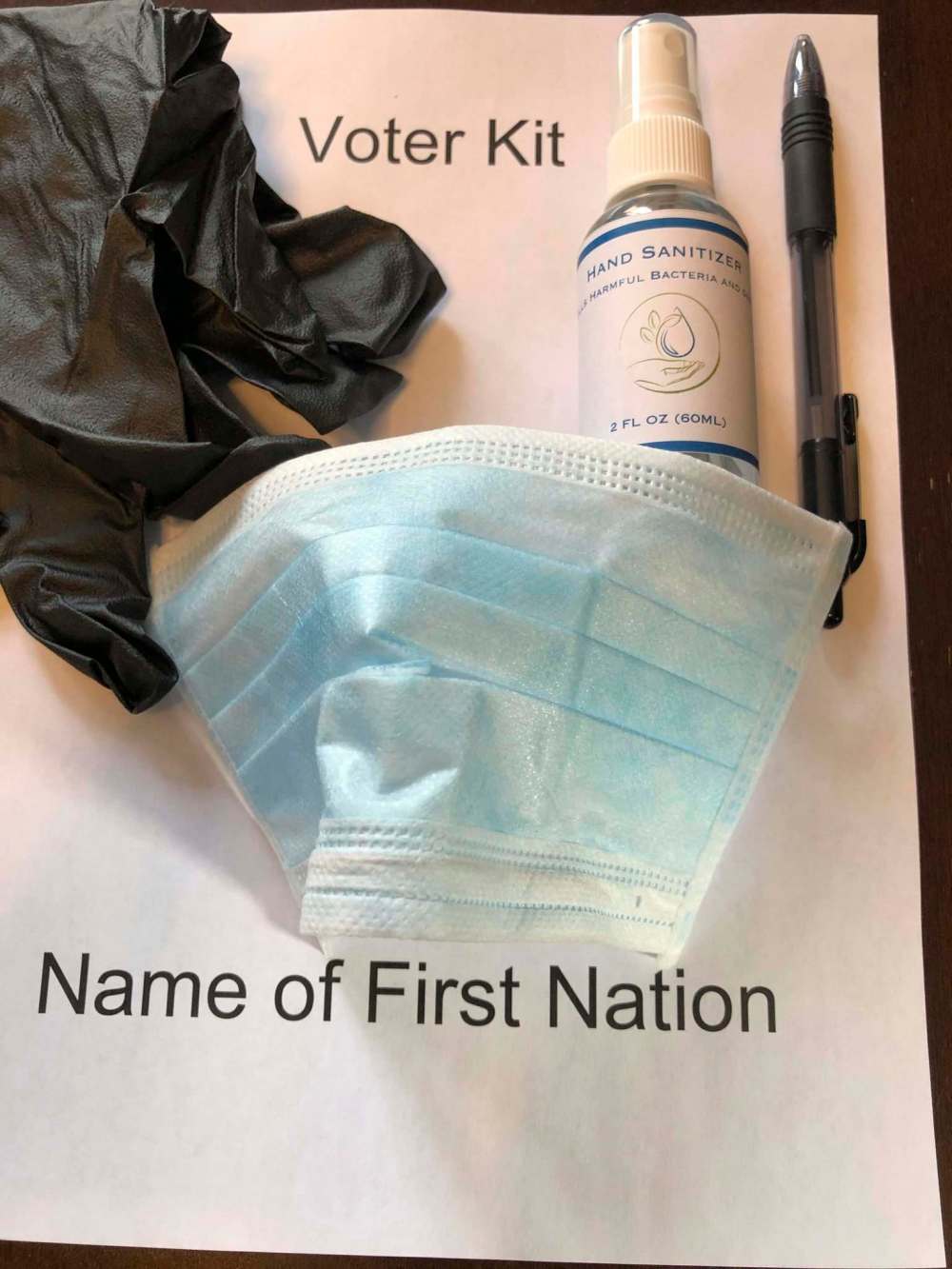
“We will have masks for every voter, gloves, and a small sanitizer bottle,” he said. “We have security, and every polling desk will be protected by a Plexiglass shield. Polls will be wiped down after each use, and every voter will use their own pen — which they must take home or throw away.”

Provincial guidelines of no gatherings of more than 10 people will lead to increased wait times. This election will cost “approximately three times” what previous Brokenhead elections cost.
This is what Indigenous government looks like under Canada’s Indian Act.
Hold the vote and risk lives.
Don’t hold the vote, and give up your life.
niigaan.sinclair@freepress.mb.ca
Letter on election postponement
Niigaan Sinclair is Anishinaabe and is a columnist at the Winnipeg Free Press.
Our newsroom depends on a growing audience of readers to power our journalism. If you are not a paid reader, please consider becoming a subscriber.
Our newsroom depends on its audience of readers to power our journalism. Thank you for your support.
Niigaan Sinclair is Anishinaabe and is a columnist at the Winnipeg Free Press.
Our newsroom depends on a growing audience of readers to power our journalism. If you are not a paid reader, please consider becoming a subscriber.
Our newsroom depends on its audience of readers to power our journalism. Thank you for your support.
Advertisement Advertise With Us
Advertisement Advertise With Us