

History in real-time
Virtual tour of CMHR gets students thinking

Advertisement
Read this article for free:
or
Already have an account? Log in here »
To continue reading, please subscribe:

Digital Subscription
One year of digital access for only $205*
- Enjoy unlimited reading on winnipegfreepress.com
- Read the E-Edition, our digital replica newspaper
- Access News Break, our award-winning app
- Play interactive puzzles
*First annual payment billed as $205.00 + GST for one year. This annual subscription will automatically renew at $233.00 + GST every 52 weeks (10% off the regular annual price of $259.35). Offer available to new and qualified returning subscribers only. Cancel any time.
To continue reading, please subscribe:
Add Free Press access to your Brandon Sun subscription for only an additional
$1 for the first 4 weeks*
- Enjoy unlimited reading on winnipegfreepress.com
- Read the E-Edition, our digital replica newspaper
- Access News Break, our award-winning app
- Play interactive puzzles
*Your next Brandon Sun subscription payment will increase by $1.00 and you will be charged $17.95 plus GST for four weeks. After four weeks, your payment will increase to $24.95 plus GST every four weeks.
Read unlimited articles for free today:
or
Already have an account? Log in here »
Hey there, time traveller!
This article was published 28/01/2021 (2063 days ago), so information in it may no longer be current.
Nathalie Beerman’s ninth-graders took a trip to the Canadian Museum for Human Rights last week — but despite attending school more than 400 kilometres northwest of the tourist attraction, no school bus shuttle was necessary.
The students at Goose Lake High in Roblin didn’t even have to leave their desks to tour exhibitions about human rights atrocities and observe thought-provoking pieces of artwork in the Manitoba capital.
A growing number of teachers is taking advantage of virtual field trips this year, as COVID-19 protocols ban educational outings to galleries, museums, and science centres.
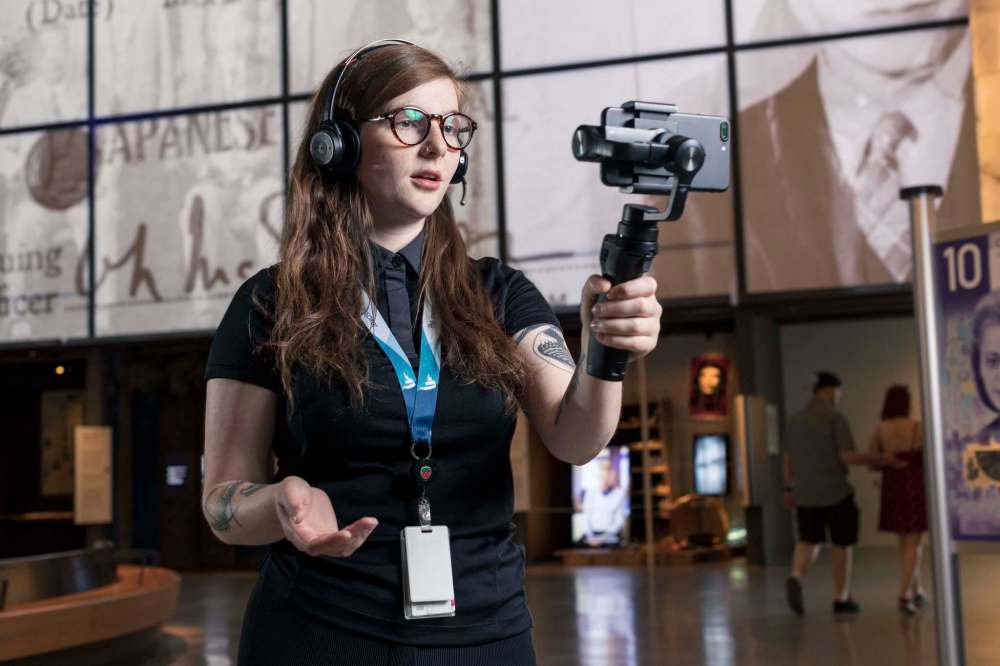
Since September, upwards of 2,300 students from Manitoba, Saskatchewan, Alberta, Ontario, British Columbia and the United States have participated in guided tours and real-time lessons hosted by the museum.
Goose Lake High doesn’t typically send Grade 9 students to the museum because it’s a 10-hour round-trip, taking into account bathroom breaks, and overnight excursions are often organized for older students, so Beerman said a virtual visit made perfect sense.
“Teaching’s been very hard (during the pandemic). I know it’s been very, very hard on the kids, too, so this was a nice opportunity to do something different and be connected to… a community outside of Roblin,” she said.
Last week’s live 45-minute video tour of the museum complemented what Beerman’s students have been learning in social studies about the Holocaust, residential schools and the legacy of civil rights activist Viola Desmond, whose portrait accompanies the museum on the $10 note.
Beerman said the tour prompted discussion among students — especially after they learned about recent events, including the 2013 activism of a Black student in the United States who spoke out against her school’s segregated prom.
“These short trips are really big conversation starters,” said Graham Lowes, a former Winnipeg teacher who developed the museum’s virtual field trips and now works there as a digital education specialist. “It’s not just to see the museum, but it’s to start thinking about what are human rights and what do they mean to me.”
The virtual programs originally launched in fall 2019, but the pandemic has resulted in an uptick of interest, Lowes said, with four to five field trips taking place daily.
The museum restarted tours this month; public health orders shuttered operations in late October.
Run by guides who use an iPhone, camera stabilizer and videoconferencing platform to take students on a tour of artifacts, the virtual field trips focus on everything from museum highlights to the Canadian Charter of Rights and Freedoms.
The 30- to 60-minute-long sessions are free for Canadian students.
Grade 9 student Francheska Pechay and her classmates at Maples Collegiate took a virtual trip during the post-winter break remote period. Pechay, 14, called the lesson a “refresher” on basic human rights.
She said she has since put visiting the museum in person on her bucket list.

While the social aspect of field trips, as well as the ability to explore Winnipeg, was missing from the online outing, Maples Collegiate teacher Jason Allard said it allowed for a break in the repetitive remote learning schedule.
“You’re not going to replace the excitement of going on a field trip with a virtual meeting,” said Allard, who typically plans a social studies trip to the museum and The Forks walking tour every semester.
“That being said, I don’t think it has to be one or the other. It’s an interesting lesson. It’s interesting to have an outside voice walk you through a lesson, someone who’s even seen as an authority. There is value in that.”
maggie.macintosh@freepress.mb.ca
Twitter: @macintoshmaggie
Maggie Macintosh
Education reporter
Maggie Macintosh reports on education for the Free Press. Originally from Hamilton, Ont., she first reported for the Free Press in 2017. Read more about Maggie.
Funding for the Free Press education reporter comes from the Government of Canada through the Local Journalism Initiative.
Every piece of reporting Maggie produces is reviewed by an editing team before it is posted online or published in print — part of the Free Press‘s tradition, since 1872, of producing reliable independent journalism. Read more about Free Press’s history and mandate, and learn how our newsroom operates.
Our newsroom depends on a growing audience of readers to power our journalism. If you are not a paid reader, please consider becoming a subscriber.
Our newsroom depends on its audience of readers to power our journalism. Thank you for your support.
Maggie Macintosh
Education reporter
Maggie Macintosh reports on education for the Free Press. Originally from Hamilton, Ont., she first reported for the Free Press in 2017. Read more about Maggie.
Funding for the Free Press education reporter comes from the Government of Canada through the Local Journalism Initiative.
Every piece of reporting Maggie produces is reviewed by an editing team before it is posted online or published in print — part of the Free Press‘s tradition, since 1872, of producing reliable independent journalism. Read more about Free Press’s history and mandate, and learn how our newsroom operates.
Our newsroom depends on a growing audience of readers to power our journalism. If you are not a paid reader, please consider becoming a subscriber.
Our newsroom depends on its audience of readers to power our journalism. Thank you for your support.
Advertisement Advertise With Us
Advertisement Advertise With Us
History
Updated on Thursday, January 28, 2021 3:28 PM CST: Fixes mistake, changes "are" to "is" in sentence.