

‘It was such a wasted opportunity’
Low-income housing advocates disappointed by demolition of empty military homes

Advertisement
Read this article for free:
or
Already have an account? Log in here »
To continue reading, please subscribe:
Monthly Digital Subscription
$1 per week for 24 weeks*
- Enjoy unlimited reading on winnipegfreepress.com
- Read the E-Edition, our digital replica newspaper
- Access News Break, our award-winning app
- Play interactive puzzles
*Billed as $4.00 plus GST every four weeks. After 24 weeks, price increases to the regular rate of $19.95 plus GST every four weeks. Offer available to new and qualified returning subscribers only. Cancel any time.
Monthly Digital Subscription
$4.99/week*
- Enjoy unlimited reading on winnipegfreepress.com
- Read the E-Edition, our digital replica newspaper
- Access News Break, our award-winning app
- Play interactive puzzles
*Billed as $19.95 plus GST every four weeks. Cancel any time.
To continue reading, please subscribe:
Add Free Press access to your Brandon Sun subscription for only an additional
$1 for the first 4 weeks*
*Your next subscription payment will increase by $1.00 and you will be charged $16.99 plus GST for four weeks. After four weeks, your payment will increase to $23.99 plus GST every four weeks.
Read unlimited articles for free today:
or
Already have an account? Log in here »
Hey there, time traveller!
This article was published 24/01/2018 (3009 days ago), so information in it may no longer be current.
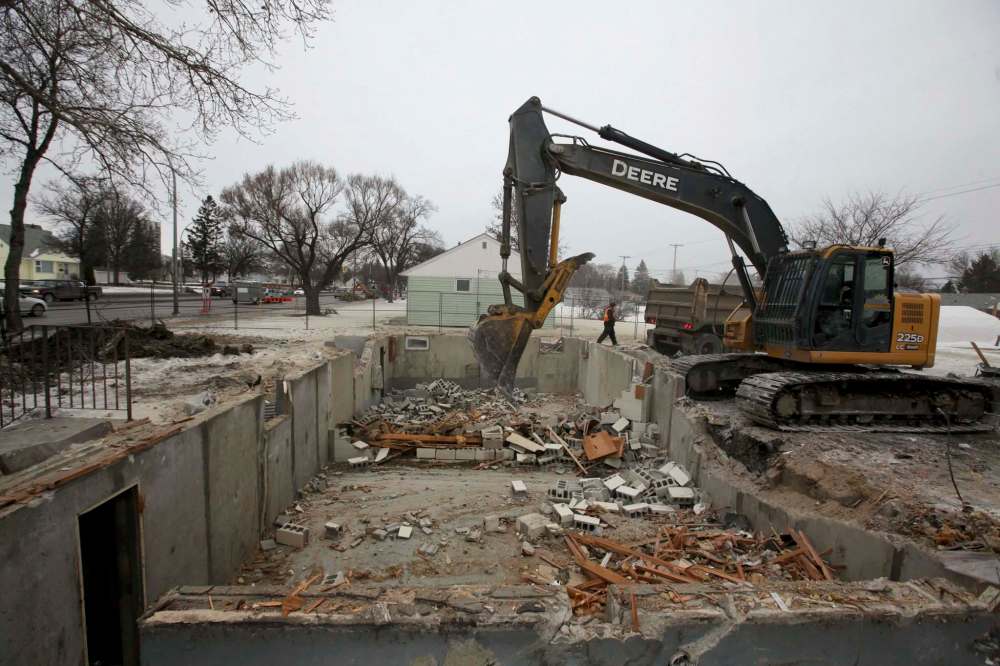
More than a dozen homes on Kenaston Boulevard, that housed members of the military, are being demolished — but it doesn’t mean motorists will soon be driving on a widened Route 90.
And a group that formed to protest outside the houses more than a decade ago, asking that they be used by low-income families instead of sitting empty, is disappointed they are being demolished.
Local Coun. Marty Morantz (Charleswood — Tuxedo — Whyte Ridge), who is also chairman of the civic infrastructure renewal and public works committee, said the demolitions are being done solely by the federal government and the city has no input on it at all.
Morantz said that while the city has been looking at options for widening Route 90 for a few years — and this year plans to develop a more detailed design for the widening from Taylor Avenue and Ness Avenue — the current house razing is not part of it.
“It is a completely separate matter,” he said on Tuesday.
“The land is under federal jurisdiction and the city has no say on this land.”
Last year, the Department of National Defence (DND) budgeted up to $400,000 to demolish military homes along Kenaston, Corydon Avenue and Tuxedo Avenue.
The military said at the time it had 558 homes in Winnipeg, but it only needed 480 housing units in the city.
A statement this week from DND said 18 residential housing units would meet the wrecking ball now, and in the next few months.
“17 Wing Winnipeg no longer requires the 18 (residential housing units),” the statement said.
“They are in poor condition and it is not economically feasible to reinvest in these units to make them suitable for occupancy.
“This will allow DND to continue to better meet the needs of Canadian Armed Forces members posted in Winnipeg.”
The statement didn’t say whether the demolition is also to make way for the city to widen Kenaston, but in a statement last February to the Free Press, an unnamed military official said the houses to be demolished in 2018 were “to permit the eventual road widening by the City of Winnipeg.”
The houses are also some of the same ones that protesters were asking to be turned into housing for low-income families back in 2006.
Those protesters later joined other groups to create the Right to Housing Coalition.
Kirsten Bernas, who chairs the coalition’s provincial working group, said while the DND houses are disappearing, the housing challenge for low-income families is still there.
“It is a huge disappointment,” Bernas said. “Especially in a place we have long advocated to open up for housing to people and to see it now just being demolished is disappointing.
“It was such a wasted opportunity.”

Bernas admitted the housing “wasn’t low income housing in the first place, but this is an example of an opportunity to create a space for low-income housing to be built.”
The housing was not part of the years-long battle for the former Kapyong Barracks property further south on Kenaston between the federal government and Treaty 1 First Nations. The federal government declared the property surplus in 2007, but when it tried to sell it to its Crown corporation developer, a lawsuit by the First Nations ground the process to a halt.
Federal courts later sided with the First Nations and, just before the last federal election, the Conservative government didn’t appeal the decision. Talks are still going on between the federal government and the First Nations.
kevin.rollason@freepress.mb.ca
Kevin Rollason is a general assignment reporter at the Free Press. He graduated from Western University with a Masters of Journalism in 1985 and worked at the Winnipeg Sun until 1988, when he joined the Free Press. He has served as the Free Press’s city hall and law courts reporter and has won several awards, including a National Newspaper Award. Read more about Kevin.
Every piece of reporting Kevin produces is reviewed by an editing team before it is posted online or published in print — part of the Free Press‘s tradition, since 1872, of producing reliable independent journalism. Read more about Free Press’s history and mandate, and learn how our newsroom operates.
Our newsroom depends on a growing audience of readers to power our journalism. If you are not a paid reader, please consider becoming a subscriber.
Our newsroom depends on its audience of readers to power our journalism. Thank you for your support.
Kevin Rollason is a general assignment reporter at the Free Press. He graduated from Western University with a Masters of Journalism in 1985 and worked at the Winnipeg Sun until 1988, when he joined the Free Press. He has served as the Free Press’s city hall and law courts reporter and has won several awards, including a National Newspaper Award. Read more about Kevin.
Every piece of reporting Kevin produces is reviewed by an editing team before it is posted online or published in print — part of the Free Press‘s tradition, since 1872, of producing reliable independent journalism. Read more about Free Press’s history and mandate, and learn how our newsroom operates.
Our newsroom depends on a growing audience of readers to power our journalism. If you are not a paid reader, please consider becoming a subscriber.
Our newsroom depends on its audience of readers to power our journalism. Thank you for your support.
Advertisement Advertise With Us
Advertisement Advertise With Us