

Musical memorial to ’72 plane crash marks lost potential

Advertisement
Read this article for free:
or
Already have an account? Log in here »
To continue reading, please subscribe:

Digital Subscription
One year of digital access for only $205*
- Enjoy unlimited reading on winnipegfreepress.com
- Read the E-Edition, our digital replica newspaper
- Access News Break, our award-winning app
- Play interactive puzzles
*First annual payment billed as $205.00 + GST for one year. This annual subscription will automatically renew at $233.00 + GST every 52 weeks (10% off the regular annual price of $259.35). Offer available to new and qualified returning subscribers only. Cancel any time.
To continue reading, please subscribe:
Add Free Press access to your Brandon Sun subscription for only an additional
$1 for the first 4 weeks*
- Enjoy unlimited reading on winnipegfreepress.com
- Read the E-Edition, our digital replica newspaper
- Access News Break, our award-winning app
- Play interactive puzzles
*Your next Brandon Sun subscription payment will increase by $1.00 and you will be charged $17.95 plus GST for four weeks. After four weeks, your payment will increase to $24.95 plus GST every four weeks.
Read unlimited articles for free today:
or
Already have an account? Log in here »
Hey there, time traveller!
This article was published 26/10/2021 (1789 days ago), so information in it may no longer be current.
The tragic loss of a former student, who was living in Portage la Prairie to attend residential school and died on her way home in a plane crash in 1972, prompted Gary Wallace to pick up his acoustic guitar and strum.
Nearly 50 years later, in the wake of the inaugural National Day for Truth and Reconciliation, the former high school teacher dusted off an old tape to play Iona Weenusk — a folk ballad he wrote decades ago in the young woman’s memory.
“When I listen to it, it almost makes me cry. It’s very emotional. I haven’t played it for many, many years, but it’s emotional. I was really touched, hearing it again,” said Wallace, who recorded the song on a reel-to-reel tape recorder decades ago.
Weenusk was a talented writer and aspiring nurse from Bunibonibee Cree Nation. She was living in Portage la Prairie in the late 1960s and early ’70s to complete her studies because she could not obtain a Grade 12 education in her home community (then known as Oxford House).
The 21-year-old was among eight First Nations students from the North who boarded a flight that never made it to its destination June 24, 1972.
Iona, as well as Ethel Grieves, who attended school in Portage, and six others who were studying in Stonewall — Margaret Robinson, Mary Rita Canada, Rosalie Balfour, Wilkie Muskego and siblings Roy and Deborah Sinclair — were slated to reunite with their respective families for summer break.
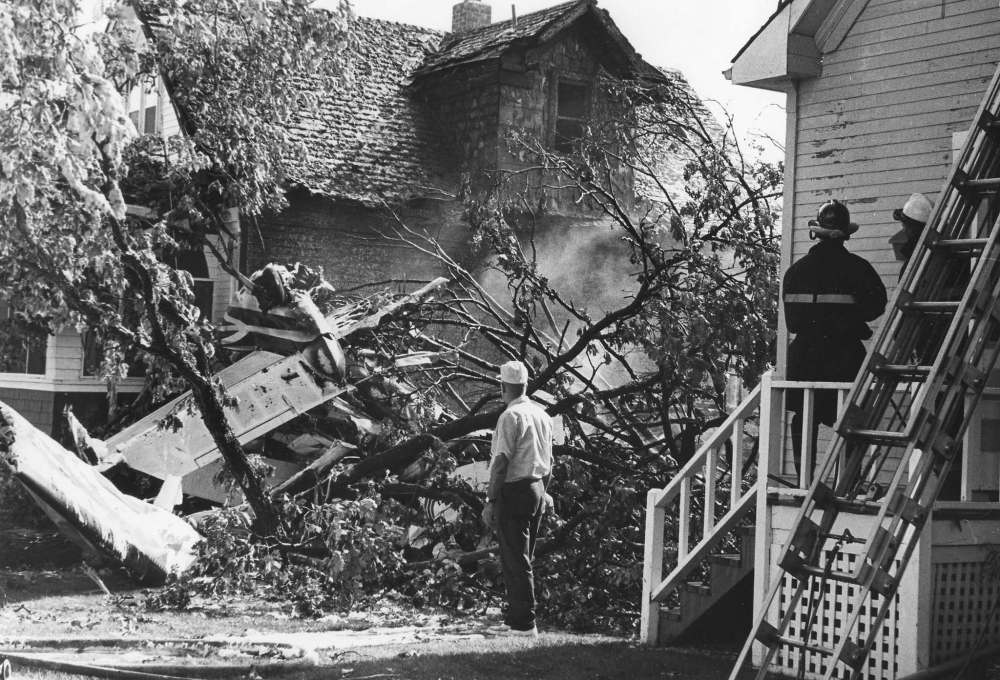
Not long after the Beechcraft Model 18 took off, it reportedly experienced an engine malfunction and “dropped like a pancake,” into a vacant lot between two houses on Linwood Street in west Winnipeg. Everyone aboard the aircraft died.
“(Weenusk’s mother) Rosie knew something was wrong. She felt the dread in her heart when the plane didn’t come in when it was supposed to arrive,” Iona’s family said in a written statement.
The family said they later learned of the crash on the radio, but it would take three days for all of the bodies to be returned to the community. The entire community mourned the loss that summer — and continues to do so, the Weenusks wrote.
Wallace, who taught mathematics and chemistry and ran a folk music club at Portage Collegiate Institute from 1967 to ’70, mourned the loss of his student in his own way.
The 77-year-old recalls feeling sorrowful and drawn to write something about Weenusk, who had attended classes both at the residential school and nearby public high school.
“I remember she was quiet, but sometimes, teachers like quiet people. She was a good student, conscientious and quiet and reserved,” he said.
She is described as a soft-spoken girl with hair as “black like midnight, like winters in her land,” in his lyrics. Another line indicates she seemed “so lonely” and far away from home.
Weenusk herself wrote about her experience with adjusting to city life after leaving her reserve in an award-winning essay published in the Free Press on Dec. 16, 1971. The newspaper established an award in her honour after her death.
In her piece, entitled Two Different Worlds, she described difficulty learning how to express herself in English because Cree was her first language, the extreme homesickness she experienced and general culture shock.
Combined, she wrote, all the challenges during those dark, transitional times led her to consider “life not worth living.”
“I hated the roars of the city and its continuous traffic. I could not find a corner all my own; everywhere I turned there were buildings, automobiles and people. So many times I seriously considered quitting school even though I was determined to go on,” she wrote.
“My ambition had always been to go through high school and in some way become of help to my people. These thoughts kept me here.”
The personal essay culminates with words of encouragement to other Indigenous students who felt as she did during her first years living away from home.
Weenusk wrote she hoped they, too, would find people willing to help, understand and accept them.
maggie.macintosh@freepress.mb.ca
Twitter: @macintoshmaggie
Maggie Macintosh
Education reporter
Maggie Macintosh reports on education for the Free Press. Originally from Hamilton, Ont., she first reported for the Free Press in 2017. Read more about Maggie.
Funding for the Free Press education reporter comes from the Government of Canada through the Local Journalism Initiative.
Every piece of reporting Maggie produces is reviewed by an editing team before it is posted online or published in print — part of the Free Press‘s tradition, since 1872, of producing reliable independent journalism. Read more about Free Press’s history and mandate, and learn how our newsroom operates.
Our newsroom depends on a growing audience of readers to power our journalism. If you are not a paid reader, please consider becoming a subscriber.
Our newsroom depends on its audience of readers to power our journalism. Thank you for your support.
Eight youths on way home from residential school killed in 1972 plane crash

Posted:
The cloudless blue sky above Bunibonibee Cree Nation is what Sarah McKay remembers most vividly about June 24, 1972.
Maggie Macintosh
Education reporter
Maggie Macintosh reports on education for the Free Press. Originally from Hamilton, Ont., she first reported for the Free Press in 2017. Read more about Maggie.
Funding for the Free Press education reporter comes from the Government of Canada through the Local Journalism Initiative.
Every piece of reporting Maggie produces is reviewed by an editing team before it is posted online or published in print — part of the Free Press‘s tradition, since 1872, of producing reliable independent journalism. Read more about Free Press’s history and mandate, and learn how our newsroom operates.
Our newsroom depends on a growing audience of readers to power our journalism. If you are not a paid reader, please consider becoming a subscriber.
Our newsroom depends on its audience of readers to power our journalism. Thank you for your support.
Advertisement Advertise With Us
Advertisement Advertise With Us
History
Updated on Tuesday, October 26, 2021 10:58 AM CDT: Adds embed code for SoundCloud