

Parched province
Fire warnings, (maybe) fewer mosquitoes: Manitoba records fourth-driest April

Advertisement
Read this article for free:
or
Already have an account? Log in here »
To continue reading, please subscribe:
Monthly Digital Subscription
$1 per week for 24 weeks*
- Enjoy unlimited reading on winnipegfreepress.com
- Read the E-Edition, our digital replica newspaper
- Access News Break, our award-winning app
- Play interactive puzzles
*Billed as $4.00 plus GST every four weeks. After 24 weeks, price increases to the regular rate of $19.95 plus GST every four weeks. Offer available to new and qualified returning subscribers only. Cancel any time.
Monthly Digital Subscription
$4.99/week*
- Enjoy unlimited reading on winnipegfreepress.com
- Read the E-Edition, our digital replica newspaper
- Access News Break, our award-winning app
- Play interactive puzzles
*Billed as $19.95 plus GST every four weeks. Cancel any time.
To continue reading, please subscribe:
Add Free Press access to your Brandon Sun subscription for only an additional
$1 for the first 4 weeks*
*Your next subscription payment will increase by $1.00 and you will be charged $16.99 plus GST for four weeks. After four weeks, your payment will increase to $23.99 plus GST every four weeks.
Read unlimited articles for free today:
or
Already have an account? Log in here »
Hey there, time traveller!
This article was published 30/04/2018 (2913 days ago), so information in it may no longer be current.
April showers bring May flowers… but the tap seems to have been turned off for this year’s precipitation.
With only 1.7 millimetres of precipitation falling during the last 30 days — in a month that normally sees an average of 30 mm drop down from the skies or melt from the snow — 2018 marks one of the driest Aprils on record.
To make matters worse, a dry fall and below-normal snow accumulation has resulted in a virtual drought in Winnipeg and southern Manitoba.
According to Environment Canada records, there have been only three drier April months in Winnipeg: 1980, with only a trace amount of precipitation, and 0.8 mm in both 1987 and 1988.
The next-driest Aprils were: 1949 with 2 mm, and 1876 with 2.5 mm.
“It’s extremely dry,” said Natalie Hasell, an Environment Canada meteorologist. “And this isn’t just for Winnipeg. Winnipeg is not the only place where we see it is extremely dry. A whole swath of Manitoba has recorded less than 2.5 mm of precipitation — and some other areas are less than 10 (mm).”
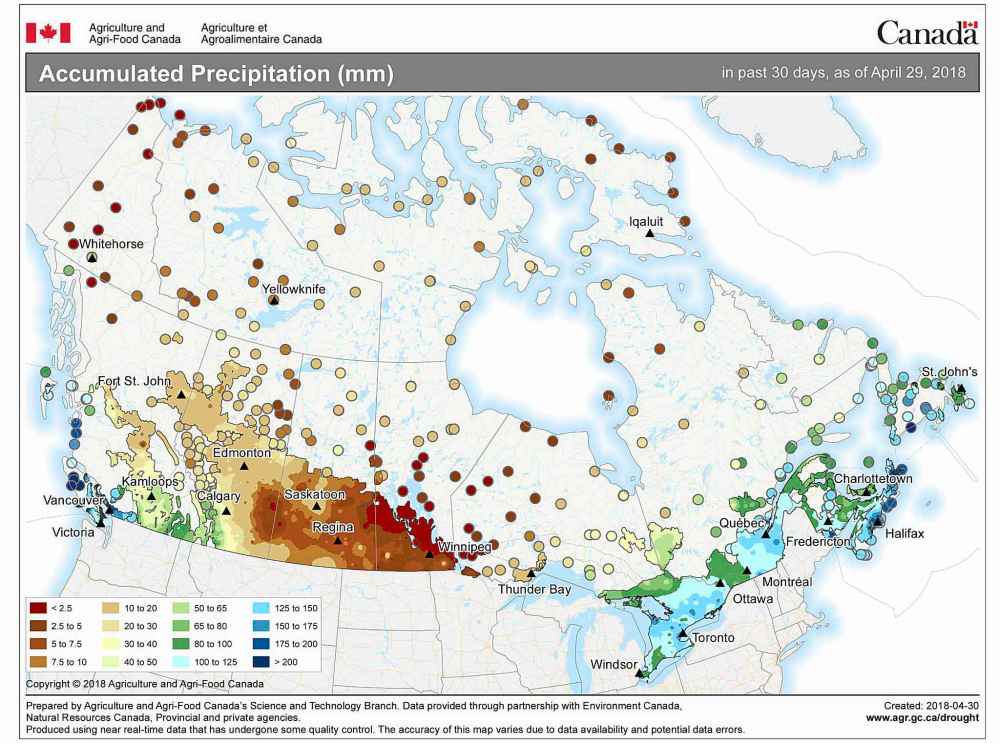
Hasell pointed to maps created by Agriculture and Agri-Food Canada: from the entire Manitoba border with the United States, north to The Pas in the west, through the entire Interlake region, and in the southeast (including Whiteshell and Nopiming provincial parks), areas have received from less than 2.5 mm of rain in the last 30 days to 7.5 mm, at most.
The lack of moisture has been notable for months, she said.
“The area is 60 to 85 per cent of normal,” she said. “It has been dry from Sept. 1 (2017) to April 29 in southern Manitoba. The only reason we’re talking about flooding in the Red River is because North Dakota and Minnesota had more precipitation than we did.
“The wettest month here is statistically in June, that’s when we have thunderstorms. But what we ultimately get is really unclear now,” Hasell said. “This is a good reminder there are things changing here, and this might be part of it.”
The dry conditions have already sparked more than two dozen forest fires in recent days.
Several rural municipalities, including the RMs of Armstrong and Gimli in the Interlake, have enacted burning-restriction bans, while the province’s Sustainable Development department has cancelled burning permits and put backcountry travel restrictions in place in much of southeast Manitoba.
Gary Friesen, the department’s manager of the provincial wildfire program, said burning on agricultural fields is not allowed at this time.
“It is a dry time of year, and it is a dangerous time,” he said.
Friesen said the province is currently battling an eight-kilometres-long fire near Badger, in the RM of Piney, which started over the weekend.
“It is two kilometres from the community and it is not out,” Friesen said. “The crews are still working on it and bringing in heavy equipment.
“Eastern Manitoba is definitely where we are seeing the brunt of the dry conditions. We went into the fall dry because of the lack of rain and then compounded it with a lack of snow, and then spring rains didn’t come.”
Friesen said the province has two water bombers in action and three helicopters to combat fires at this time.
“The water bombers were able to get water for the fire around Badger at Brereton Lake. The helicopters need a smaller area for their buckets.”
How the city fights fires off the water grid
After a busy working weekend, Winnipeg firefighters showed off two of their most valuable resources when it comes to putting out flames — a mobile “wildland” unit and a 3,500-gallon water tanker.
The wildland unit is parked at Station No. 26 (1525 Dakota St.), while the tanker stands by at Station No. 23 (880 Dalhousie Dr.). Both are set up in the south end of the city because nearby areas lie beyond the water district, meaning they don’t have fire hydrants readily available.
After a busy working weekend, Winnipeg firefighters showed off two of their most valuable resources when it comes to putting out flames — a mobile “wildland” unit and a 3,500-gallon water tanker.
The wildland unit is parked at Station No. 26 (1525 Dakota St.), while the tanker stands by at Station No. 23 (880 Dalhousie Dr.). Both are set up in the south end of the city because nearby areas lie beyond the water district, meaning they don’t have fire hydrants readily available.
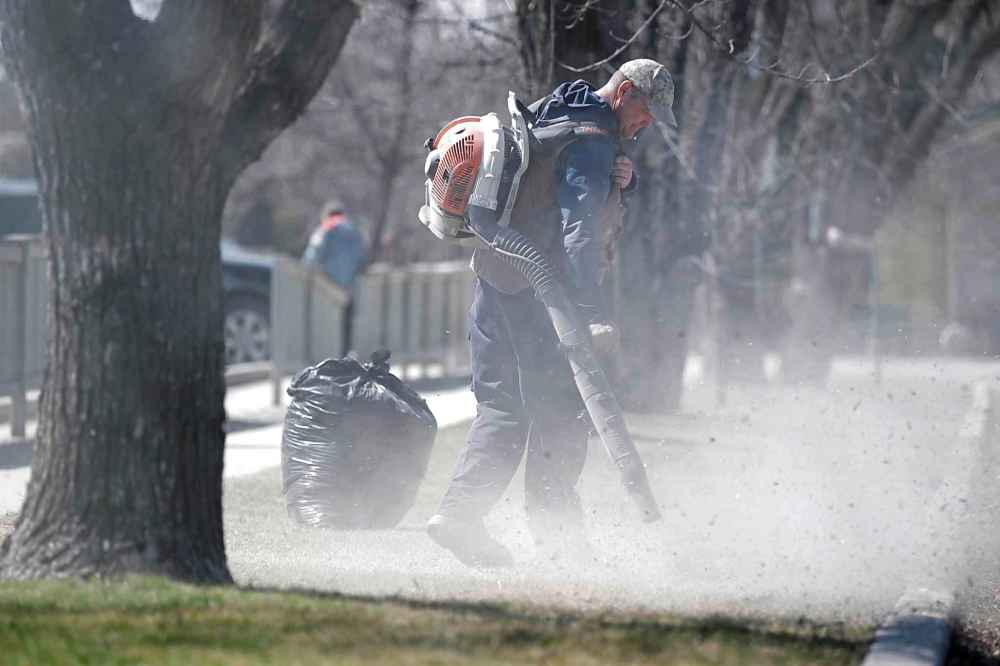
The wildland unit contains multiple lightweight hoses, portable pumps, waterhose backpacks, shovels, saws, brooms, sprinkler kits, an ATV, and about five leaf blowers to “blow the fire back on itself and actually extinguish the fire along the perimeter,” explained Scott Wilkinson, senior academy officer with the Winnipeg Fire Paramedic Service training academy.
About 30 to 50 firefighters would typically be sent to a scene where the wildland unit is dispatched during a severe wildfire, Wilkinson said.
“You have to put a lot of manpower on scene to try and get it under control before it grows,” he said.
Assistant fire chief Mark Reshaur said the City of Winnipeg has 167 firefighters on duty per shift, a healthy amount that rarely requires crews put in overtime.
Reshaur said no overtime was required over the weekend, despite four significant fires popping up Sunday: one each on Dugald Road and Pembina Highway, and in Charleswood and the RM of Springfield.
“The wildfires were made much more significant by the very dry, windy conditions that we’re experiencing right now. The fires did not result in any injuries or property loss fortunately. And the cause of the fires remains under investigation,” he said, before reminding the public that burning permits are temporarily suspended whenever winds exceed 25 kilometres per hour.
Reshaur also cautioned people to be sure to properly stamp out cigarettes, push woodpiles further away from their homes, get rid of dead leaves or plants on their properties, keep grass trim and clean under decks, porches and stairs.
“Let’s hope by taking all these measures together it will reduce the capacity of a fire to spread into their yards and threaten their homes,” he said.
— Jessica Botelho-Urbanski
As far as farmers are concerned, a provincial spokeswoman said they should be fine for now because the soil conditions in agricultural fields are currently “at adequate or average levels.”
However, she said, “A dry April and low snow accumulation means more precipitation is needed to ensure the surface layers of the soil will have enough moisture for plant roots in the early stages of growth. Snow has only a minimal effect on snow moisture because the soil is frozen and most will end up as runoff, so any moisture currently in the soil is mostly from last fall.”
The province will begin posting its weekly crop report starting May 7.
Meanwhile, a City of Winnipeg spokesman said the lack of rain won’t effect the city’s urban canopy of trees, shouldn’t hurt athletic fields, and — some good news — it is a bonus for reducing the expected number of mosquitos.
Ken Allen of the public works department said: “The trees that are native to our region are tolerant of a wide variety of conditions at this time of year and are typically resilient.”
However, “If homeowners notice the soil around their trees is overly dry, they can apply water around the tree’s active root zone… It is too soon to see any impacts of the lower precipitation this month.”

Allen said the city’s athletic fields are quickly drying out and the grass is starting to appear.
“The fields look good at this point, with some evidence of cracks due to dry conditions,” he said. “Without rain in the future forecast we could experience field conditions which will require additional top dressing to fill cracks.”
As for mosquitos, Allen said the current conditions are great for reducing future numbers.
“The drier-than-normal conditions has resulted in less standing water, which will allow the crews to treat all the known sites before the mosquito larvae would have emerged as adult mosquitoes,” he said. “This will result in a very low emergence of the spring mosquito species in the next few weeks.”
kevin.rollason@freepress.mb.ca
Kevin Rollason is a general assignment reporter at the Free Press. He graduated from Western University with a Masters of Journalism in 1985 and worked at the Winnipeg Sun until 1988, when he joined the Free Press. He has served as the Free Press’s city hall and law courts reporter and has won several awards, including a National Newspaper Award. Read more about Kevin.
Every piece of reporting Kevin produces is reviewed by an editing team before it is posted online or published in print — part of the Free Press‘s tradition, since 1872, of producing reliable independent journalism. Read more about Free Press’s history and mandate, and learn how our newsroom operates.
Our newsroom depends on a growing audience of readers to power our journalism. If you are not a paid reader, please consider becoming a subscriber.
Our newsroom depends on its audience of readers to power our journalism. Thank you for your support.
Kevin Rollason is a general assignment reporter at the Free Press. He graduated from Western University with a Masters of Journalism in 1985 and worked at the Winnipeg Sun until 1988, when he joined the Free Press. He has served as the Free Press’s city hall and law courts reporter and has won several awards, including a National Newspaper Award. Read more about Kevin.
Every piece of reporting Kevin produces is reviewed by an editing team before it is posted online or published in print — part of the Free Press‘s tradition, since 1872, of producing reliable independent journalism. Read more about Free Press’s history and mandate, and learn how our newsroom operates.
Our newsroom depends on a growing audience of readers to power our journalism. If you are not a paid reader, please consider becoming a subscriber.
Our newsroom depends on its audience of readers to power our journalism. Thank you for your support.
Advertisement Advertise With Us
Advertisement Advertise With Us