

Proposed WSD cuts to therapy services draws fire
School division board argues services should be funded by Manitoba Health

Advertisement
Read this article for free:
or
Already have an account? Log in here »
To continue reading, please subscribe:
Monthly Digital Subscription
$1 per week for 24 weeks*
- Enjoy unlimited reading on winnipegfreepress.com
- Read the E-Edition, our digital replica newspaper
- Access News Break, our award-winning app
- Play interactive puzzles
*Billed as $4.00 plus GST every four weeks. After 24 weeks, price increases to the regular rate of $19.95 plus GST every four weeks. Offer available to new and qualified returning subscribers only. Cancel any time.
Monthly Digital Subscription
$4.99/week*
- Enjoy unlimited reading on winnipegfreepress.com
- Read the E-Edition, our digital replica newspaper
- Access News Break, our award-winning app
- Play interactive puzzles
*Billed as $19.95 plus GST every four weeks. Cancel any time.
To continue reading, please subscribe:
Add Free Press access to your Brandon Sun subscription for only an additional
$1 for the first 4 weeks*
*Your next subscription payment will increase by $1.00 and you will be charged $16.99 plus GST for four weeks. After four weeks, your payment will increase to $23.99 plus GST every four weeks.
Read unlimited articles for free today:
or
Already have an account? Log in here »
Hey there, time traveller!
This article was published 23/02/2021 (1891 days ago), so information in it may no longer be current.
If Manitoba’s largest school division stops funding occupational therapy and physiotherapy services, some parents say their children will no longer have reason to attend class.
Students with disabilities can access specialists through the Winnipeg School Division, free of charge — but that may not be the case next year, should the WSD board of trustees approve its 2021-22 draft budget.
The board has proposed cuts to its police-in-schools program and therapy services, among other line items, to find $5 million in savings, after its provincial funding was reduced.
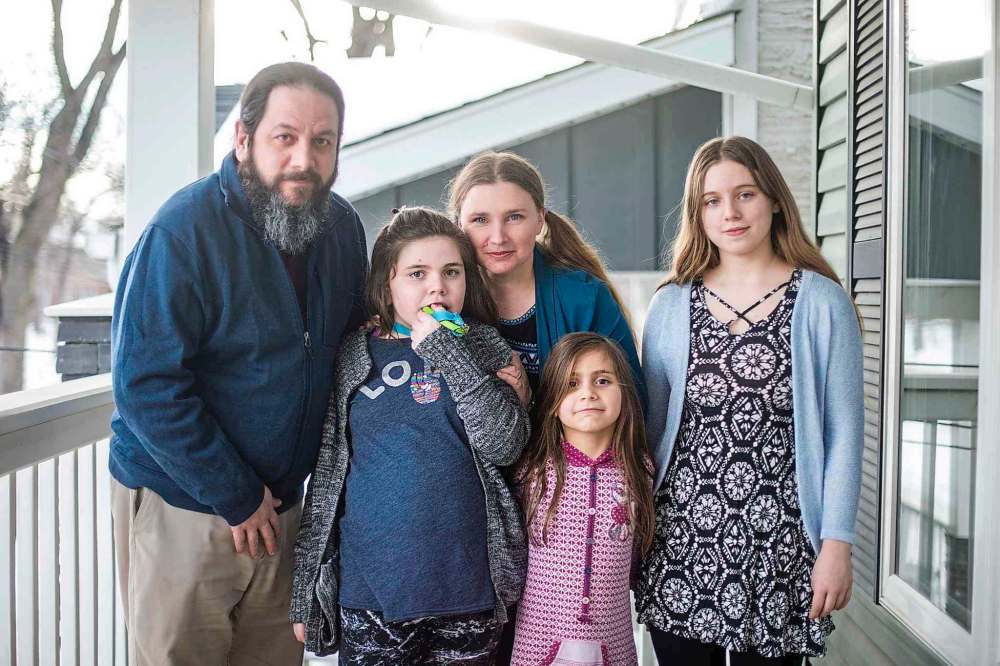
As far as Carrie Costello is concerned, an end to in-school therapy, which costs the division approximately $667,000 per year, would make the classroom a lot less welcoming for her fourth grader.
Costello’s middle child, Alejandra, who has a seizure disorder and a profound intellectual disability, and receives both occupational therapy and physiotherapy, as well as speech pathology support, at school.
Specialists work in teams with her teachers, educational assistants and parents to draw up her individual education plan, help with everything from goal-setting to stretching exercises, and provide updates to the family.
“Math and reading aren’t on her radar yet. Trying to get a jacket on and shoes on, by herself, is. That involves lots of little steps,” said Costello, a mother of three and member of WSD’s inclusion support committee.
“If nobody knows these little steps… then why would she go to school?”
Teachers are not experts in educating students with diverse needs to climb stairs independently, handling tantrums, or adapting phys-ed equipment so all students can participate, she added.
Chris Broughton, chairman of the board finance committee, has said proposed reductions should be funded by other areas of government. Therapy services are valuable, Broughton said in a news release published earlier this month, but they should be funded by Manitoba Health — and WSD will be “pursuing that option.”
A spokesperson for the education minister said in a statement Monday the province hopes the division will adjust its draft budget to “find efficiencies in a bloated bureaucracy.”
WSD has yet to bring forward discussions with Manitoba Health about the therapy programs, the spokesperson added.
“They’re playing cat-and-mouse with the province and my vulnerable kid gets to be a pawn,” said David Lobson, whose daughter attends a special education program at Grant Park High School.
Lobson said the primary reason his 18-year-old, who has cerebral palsy, goes to school is to access physiotherapy to help ease constant pain.
He was unable to sign up to speak in opposition to axing the services at the Monday board meeting, since all delegation spots were full, with eight of 10 people registered to discuss therapy cuts.

Division spokeswoman Radean Carter said WSD has also received numerous written submissions on the subject, which will be reviewed before trustees finalize next year’s budget.
Sarah Kelso, who signed up as a delegation, said she wants trustees to understand these services are not about health care but rather, inclusion support for students — her child included.
“(These specialists) work closely with a classroom teacher and EA to assess physical safety, identify adaptations, and modify learning activities to ensure inclusion,” she said.
maggie.macintosh@freepress.mb.ca
Twitter: @macintoshmaggie
Maggie Macintosh
Education reporter
Maggie Macintosh reports on education for the Free Press. Originally from Hamilton, Ont., she first reported for the Free Press in 2017. Read more about Maggie.
Funding for the Free Press education reporter comes from the Government of Canada through the Local Journalism Initiative.
Every piece of reporting Maggie produces is reviewed by an editing team before it is posted online or published in print — part of the Free Press‘s tradition, since 1872, of producing reliable independent journalism. Read more about Free Press’s history and mandate, and learn how our newsroom operates.
Our newsroom depends on a growing audience of readers to power our journalism. If you are not a paid reader, please consider becoming a subscriber.
Our newsroom depends on its audience of readers to power our journalism. Thank you for your support.
Maggie Macintosh
Education reporter
Maggie Macintosh reports on education for the Free Press. Originally from Hamilton, Ont., she first reported for the Free Press in 2017. Read more about Maggie.
Funding for the Free Press education reporter comes from the Government of Canada through the Local Journalism Initiative.
Every piece of reporting Maggie produces is reviewed by an editing team before it is posted online or published in print — part of the Free Press‘s tradition, since 1872, of producing reliable independent journalism. Read more about Free Press’s history and mandate, and learn how our newsroom operates.
Our newsroom depends on a growing audience of readers to power our journalism. If you are not a paid reader, please consider becoming a subscriber.
Our newsroom depends on its audience of readers to power our journalism. Thank you for your support.
Advertisement Advertise With Us
Advertisement Advertise With Us
History
Updated on Tuesday, February 23, 2021 6:52 AM CST: Changes photo