

Reworked health aide program rolls out
Updated course gets first class

Advertisement
Read this article for free:
or
Already have an account? Log in here »
To continue reading, please subscribe:

Digital Subscription
One year of digital access for only $205*
- Enjoy unlimited reading on winnipegfreepress.com
- Read the E-Edition, our digital replica newspaper
- Access News Break, our award-winning app
- Play interactive puzzles
*First annual payment billed as $205.00 + GST for one year. This annual subscription will automatically renew at $233.00 + GST every 52 weeks (10% off the regular annual price of $259.35). Offer available to new and qualified returning subscribers only. Cancel any time.
To continue reading, please subscribe:
Add Free Press access to your Brandon Sun subscription for only an additional
$1 for the first 4 weeks*
- Enjoy unlimited reading on winnipegfreepress.com
- Read the E-Edition, our digital replica newspaper
- Access News Break, our award-winning app
- Play interactive puzzles
*Your next Brandon Sun subscription payment will increase by $1.00 and you will be charged $17.95 plus GST for four weeks. After four weeks, your payment will increase to $24.95 plus GST every four weeks.
Read unlimited articles for free today:
or
Already have an account? Log in here »
Hey there, time traveller!
This article was published 02/12/2021 (1776 days ago), so information in it may no longer be current.
A health-care aide program at the Manitoba Institute of Trades and Technology has been remodelled to address a chronic nursing shortage and the related challenges — among them, burnout — industry professionals have faced over the last 20 months.
In September, the post-secondary institute based in Winnipeg welcomed its first cohort of students into an updated certificate course that aims to better equip graduates with skills required to meet patient needs.
The syllabus now includes a revamped communications class, a requirement to complete a course on mental health, and a final standardized test that focuses on patient safety.
It has also been shortened to eight months (from 10) so students can enter the workplace faster to meet the high demand for aides, which has only increased since the COVID-19 pandemic was declared.
“We’re responding to a need in terms of a smoother and quicker transition into jobs,” said Karen Dyck, lead instructor of the health-care aide and personal support worker certificate at MITT (formerly known as the health-care aide and unit clerk program).
Dyck, a registered nurse, said the revised program’s goal is to ensure students are exceptional communicators and confident in all of their skills by the time they graduate so they can succeed and support both co-workers and patients in the field.
“They work super closely with the nurses. Having a good health-care aide can make the difference between a good shift and a bad shift,” she said.
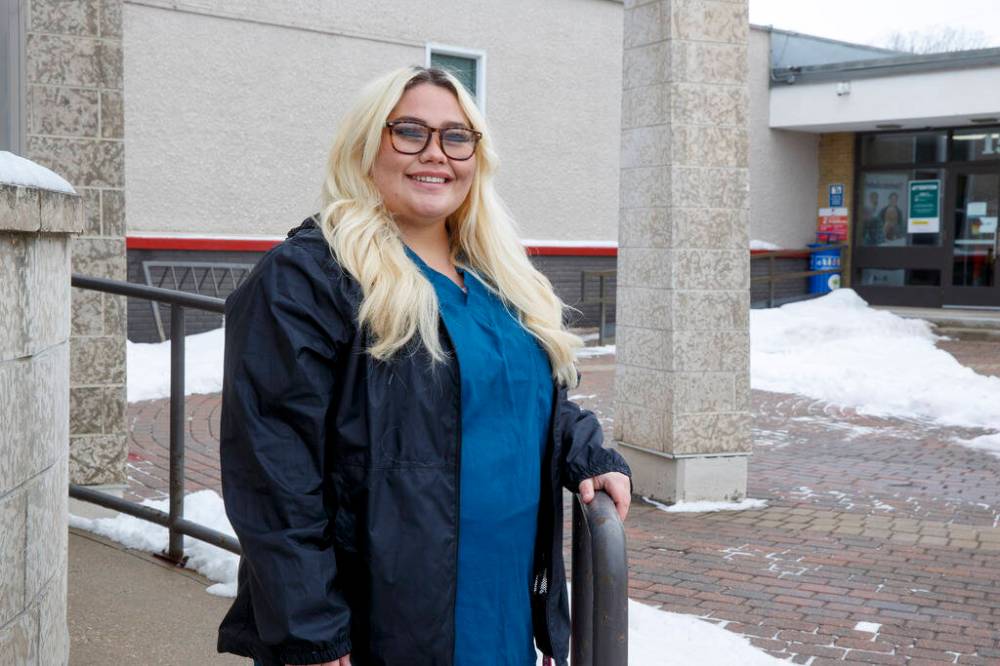
Keyirra Payjack is among the 18 students who make up the inaugural cohort at MITT.
“We’re living in such an isolated time right now in history, with the pandemic and everything, and it’s a very scary time for everyone — especially for those in need of medical care, so I wanted to be able to help people who can’t necessarily help themselves right now,” said the 24-year-old, adding her personal struggle with mental health only reinforced her passion to help people.
So far, Payjack has been learning about medical terminology, foundational support worker skills, and how-to be mindful of cultural differences, biases and stereotypes in providing care.
In the coming months, she and her peers will learn practical skills in a simulation lab with mannequins, before beginning placements.

Every graduate is required to complete 320 practicum hours in total, which will now be split evenly between an initial stint in a long-term care setting and a follow-up placement at an acute care facility — whether that is in the emergency department at St. Boniface Hospital or elsewhere.
Growing life expectancy, chronic illnesses, and an influx of patients because of the pandemic has heightened the need for the professionals, said Dyck, noting health-care aides can work everywhere from personal homes to emergency departments.
There were 2,393 health-care aides employed in Winnipeg hospitals, as of the end of October. The Winnipeg Regional Health Authority could not immediately provide data on current job vacancies Wednesday.
Meantime, recent data obtained by the Free Press show almost 23 per cent all emergency and critical care nurse positions in Winnipeg were vacant in October.
maggie.macintosh@freepress.mb.ca
Maggie Macintosh
Education reporter
Maggie Macintosh reports on education for the Free Press. Originally from Hamilton, Ont., she first reported for the Free Press in 2017. Read more about Maggie.
Funding for the Free Press education reporter comes from the Government of Canada through the Local Journalism Initiative.
Every piece of reporting Maggie produces is reviewed by an editing team before it is posted online or published in print — part of the Free Press‘s tradition, since 1872, of producing reliable independent journalism. Read more about Free Press’s history and mandate, and learn how our newsroom operates.
Our newsroom depends on a growing audience of readers to power our journalism. If you are not a paid reader, please consider becoming a subscriber.
Our newsroom depends on its audience of readers to power our journalism. Thank you for your support.
Maggie Macintosh
Education reporter
Maggie Macintosh reports on education for the Free Press. Originally from Hamilton, Ont., she first reported for the Free Press in 2017. Read more about Maggie.
Funding for the Free Press education reporter comes from the Government of Canada through the Local Journalism Initiative.
Every piece of reporting Maggie produces is reviewed by an editing team before it is posted online or published in print — part of the Free Press‘s tradition, since 1872, of producing reliable independent journalism. Read more about Free Press’s history and mandate, and learn how our newsroom operates.
Our newsroom depends on a growing audience of readers to power our journalism. If you are not a paid reader, please consider becoming a subscriber.
Our newsroom depends on its audience of readers to power our journalism. Thank you for your support.
Advertisement Advertise With Us
Advertisement Advertise With Us
History
Updated on Friday, December 3, 2021 12:05 PM CST: Corrects that every graduate is required to complete 320 practicum hours in total