

RRC cut another hurt for advanced care paramedics: advocates

Advertisement
Read this article for free:
or
Already have an account? Log in here »
To continue reading, please subscribe:
Monthly Digital Subscription
$1 per week for 24 weeks*
- Enjoy unlimited reading on winnipegfreepress.com
- Read the E-Edition, our digital replica newspaper
- Access News Break, our award-winning app
- Play interactive puzzles
*Billed as $4.00 plus GST every four weeks. After 24 weeks, price increases to the regular rate of $19.95 plus GST every four weeks. Offer available to new and qualified returning subscribers only. Cancel any time.
Monthly Digital Subscription
$4.99/week*
- Enjoy unlimited reading on winnipegfreepress.com
- Read the E-Edition, our digital replica newspaper
- Access News Break, our award-winning app
- Play interactive puzzles
*Billed as $19.95 plus GST every four weeks. Cancel any time.
To continue reading, please subscribe:
Add Free Press access to your Brandon Sun subscription for only an additional
$1 for the first 4 weeks*
*Your next subscription payment will increase by $1.00 and you will be charged $16.99 plus GST for four weeks. After four weeks, your payment will increase to $23.99 plus GST every four weeks.
Read unlimited articles for free today:
or
Already have an account? Log in here »
Hey there, time traveller!
This article was published 08/07/2020 (2084 days ago), so information in it may no longer be current.
Paramedics are denouncing the suspension of Red River College’s advanced care paramedic diploma, calling it a symptom of the province’s unclear plan to equip rural communities with the highest level of qualified emergency response personnel.
Citing the COVID-19 pandemic’s impact on operations, Red River is suspending six programs: introduction to electrical engineering technology certificate, introduction to aircraft maintenance engineer pre-employment program; advanced care paramedic diploma; library technology diploma; and both the diploma and certificate in cabinetry and woodworking technology.
On Tuesday afternoon, Christine Watson, vice-president academic, emailed staff about the “difficult decision.” Current students will not be affected, Watson said, but prospective students will be, and related job losses have already been announced.
“When the college makes a decision to suspend a program, there are a number of criteria applied, including an analysis of labour market and industry needs,” said Ryan McBride, a spokesman for the college, in a statement Wednesday.
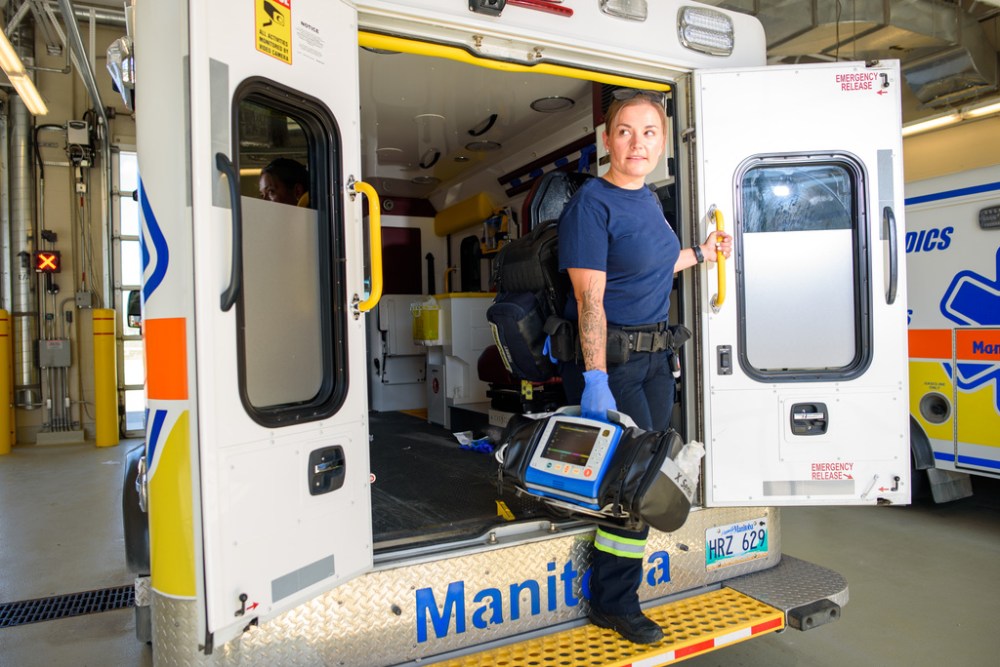
The college’s primary care paramedic (PCP) program will proceed as usual in 2020-21. However, the advanced program — which certifies graduates with the highest possible level of paramedic training (or as ACPs), is going on hiatus for at least one year, so the college can discuss training needs with health-care partners.
The now-suspended program was developed in partnership with the province to help train ACPs to work in rural and northern areas of Manitoba because the Winnipeg Fire Paramedic Service’s educational site primarily trains paramedics to work in the City of Winnipeg.
Despite the reason for its creation and the Paramedic Association of Manitoba’s ongoing advocacy, McBride said ACP graduates are not being hired into the “advanced roles that they were trained for.”
Shared Health is hiring graduates as PCPs and intermediate care paramedics (ICP) — one step up from the entry-level PCP. (ICP is not a designated certification, but rather a term employers have created to denote a PCP with advanced skills, which are obtained on the job – not at college.)
It’s become widely accepted in the local paramedic profession Manitoba’s rural health regions don’t hire ACPs, unlike elsewhere in Canada, where these qualified professionals work both on ambulances and in other health-care facilities. It’s unclear why.
Rebecca Clifton, a full-time paramedic in rural Manitoba who serves as the administrative director at the Paramedic Association of Manitoba, told the Free Press the reason certainly isn’t because paramedics want to enhance their training and provide high-level care outside Winnipeg.
“We’ve probably put out 40 to 50 ACPs in rural Manitoba (via Red River) and none of those advanced care paramedics are able to use that skill set… because there is no employer to employ them as such,” said Clifton, who works as an ICP.
There are currently 1,404 PCPs in Manitoba compared to 133 ACPs, according to Shared Health. These ACPs work in Winnipeg and for private providers, including STARS.
Shared Health did not provide additional comment on the matter Wednesday; Manitoba Health Minister Cameron Friesen was not made available for an interview before deadline.
“Basic skills are really what saves lives most of the time, but it can be frustrating that I know how to do (additional treatment when it’s needed), I have the education. I have the training, but I can’t do it,” said one recent Red River ACP graduate who works in rural Manitoba as an ICP, despite his advanced certification — and who spoke to the Free Press on the condition of confidentiality for fear of reprisal at work.
Qualifications of a PCP include basic life support and the ability to stabilize wounds and fractures, start an IV, administer certain medications and initiate cardiac monitoring.
ACPs have additional knowledge that allows them to provide advanced life support, interpret cardiac rhythms and certain diagnostic test results, undertake advanced respiratory and cardiac care procedures and administer additional medications.
The recent graduate said there seems to be no real plan about how to use ACPs outside the capital; both he and Clifton suspect employers are deterred by the additional cost (an approximately $2/hr raise for certified paramedics) and concerns about rural ACPs being able to maintain their competence with adequate mentorship and practice.

The result, Clifton said, is unequal front-line service across the province: “Rural Manitobans are not provided the same high quality level of care and intervention that someone in Winnipeg would get.”
A provincial spokesperson did not comment on the hiring of ACPs in Manitoba. The spokesperson provided a generic statement that noted the province’s commitment to the paramedic profession by adding 150 new paramedics, giving the profession the right to self-regulate and purchasing 65 new ambulances.
They directed inquiries about the ACP program to the college.
maggie.macintosh@freepress.mb.ca
Twitter: @macintoshmaggie
Maggie Macintosh
Education reporter
Maggie Macintosh reports on education for the Free Press. Originally from Hamilton, Ont., she first reported for the Free Press in 2017. Read more about Maggie.
Funding for the Free Press education reporter comes from the Government of Canada through the Local Journalism Initiative.
Every piece of reporting Maggie produces is reviewed by an editing team before it is posted online or published in print — part of the Free Press‘s tradition, since 1872, of producing reliable independent journalism. Read more about Free Press’s history and mandate, and learn how our newsroom operates.
Our newsroom depends on a growing audience of readers to power our journalism. If you are not a paid reader, please consider becoming a subscriber.
Our newsroom depends on its audience of readers to power our journalism. Thank you for your support.
Maggie Macintosh
Education reporter
Maggie Macintosh reports on education for the Free Press. Originally from Hamilton, Ont., she first reported for the Free Press in 2017. Read more about Maggie.
Funding for the Free Press education reporter comes from the Government of Canada through the Local Journalism Initiative.
Every piece of reporting Maggie produces is reviewed by an editing team before it is posted online or published in print — part of the Free Press‘s tradition, since 1872, of producing reliable independent journalism. Read more about Free Press’s history and mandate, and learn how our newsroom operates.
Our newsroom depends on a growing audience of readers to power our journalism. If you are not a paid reader, please consider becoming a subscriber.
Our newsroom depends on its audience of readers to power our journalism. Thank you for your support.
Advertisement Advertise With Us
Advertisement Advertise With Us
History
Updated on Wednesday, July 8, 2020 9:37 PM CDT: Updates details of job title for reporter.
Updated on Wednesday, July 8, 2020 9:41 PM CDT: Updates photo