

U of M student community law centre expands reach

Advertisement
Read this article for free:
or
Already have an account? Log in here »
To continue reading, please subscribe:

Digital Subscription
One year of digital access for only $205*
- Enjoy unlimited reading on winnipegfreepress.com
- Read the E-Edition, our digital replica newspaper
- Access News Break, our award-winning app
- Play interactive puzzles
*First annual payment billed as $205.00 + GST for one year. This annual subscription will automatically renew at $233.00 + GST every 52 weeks (10% off the regular annual price of $259.35). Offer available to new and qualified returning subscribers only. Cancel any time.
To continue reading, please subscribe:
Add Free Press access to your Brandon Sun subscription for only an additional
$1 for the first 4 weeks*
- Enjoy unlimited reading on winnipegfreepress.com
- Read the E-Edition, our digital replica newspaper
- Access News Break, our award-winning app
- Play interactive puzzles
*Your next Brandon Sun subscription payment will increase by $1.00 and you will be charged $17.95 plus GST for four weeks. After four weeks, your payment will increase to $24.95 plus GST every four weeks.
Read unlimited articles for free today:
or
Already have an account? Log in here »
Hey there, time traveller!
This article was published 25/03/2022 (1597 days ago), so information in it may no longer be current.
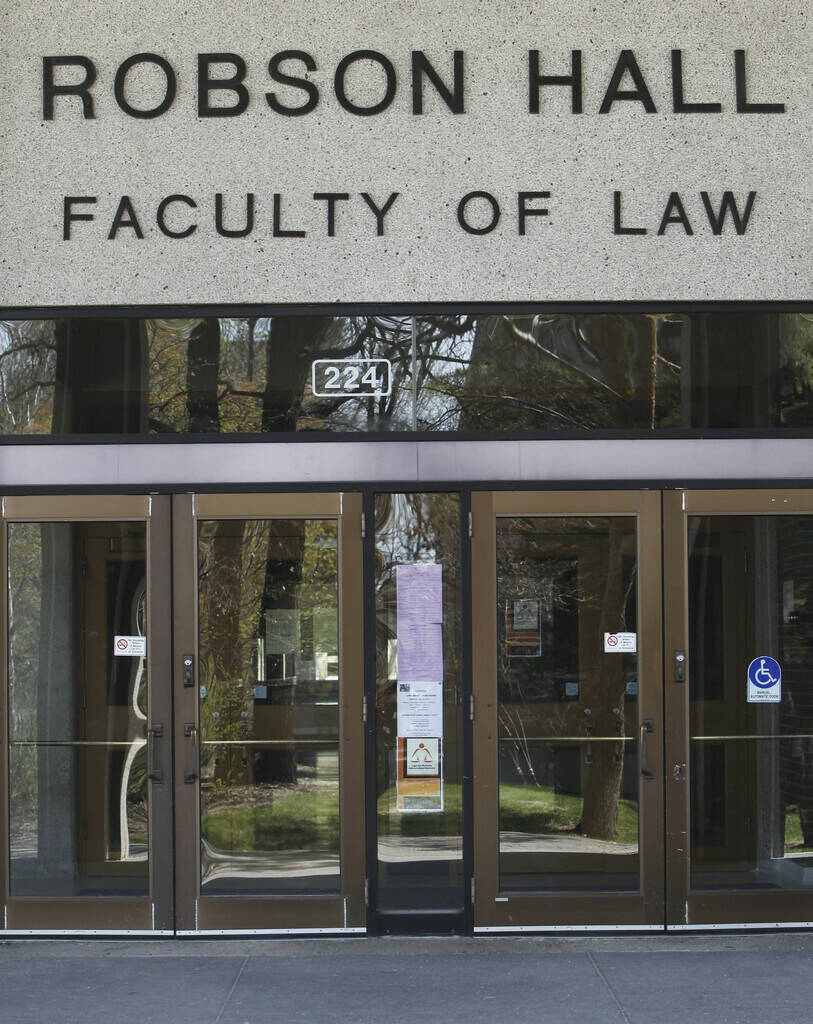
Robson Hall’s community legal clinic is expanding so lawyers-in-training can now provide low-cost counsel to clients with minor family law and prison law cases, as well as Indigenous legal services.
The University of Manitoba and Legal Aid Manitoba recently signed a memorandum of understanding to both renew their partnership, which is marking its 50-year anniversary in 2022, and bolster the U of M Community Law Centre.
Since 1972, the so-called UMCLC has been staffed by law students seeking experiential learning opportunities, primarily in relation to criminal law, and course credit.
“One thing that people worry about is the quality of service that students can provide. The fact is a student is able to devote a lot more time to legal research, to speaking with their clients, and to generally working on their files — and we receive really good supervision and advice. We carry on the file from start to close,” said Patrick Gutowski, a third-year law student who began volunteering at the centre in December 2020.
Students handle, under the supervision of working professionals and faculty members, between 400 and 600 criminal cases on a typical year. As many as 100 volunteers at a time have received and reviewed disclosures, undertaken interviews, provided advice, and represented clients in court in the past.
Small claims cases and petty offences out of the scope of legal aid and thus, unlikely to see anyone face jail-time have typically been referred to the UMCLC. Now, students will also be able to advise clients on everything from uncontested divorces to appeals to the Court of Queen’s Bench to status applications under the Indian Act.
The affordable legal service, funded primarily by the Manitoba Law Foundation, provides eligible Manitobans with assistance for under $100.
“Hiring a lawyer is expensive and it’s a complicated process, no matter what area of law you’re looking at, so I think the more that we can help, the better,” said Gutowski, 27.
The UMCLC student supervisor spends several hours a day working on cases. He said key takeaways from the ongoing experience are the importance of trauma-informed practice and relationship-building with clients.
Law dean Richard Jochelson touted the importance of experiential learning at Robson Hall. Jochelson also noted there is growing recognition access to justice should go beyond criminal law advice to people in need of it.
Both of the above factored into the decision to expand the UMCLC.
Robson Hall is designating a team of four full-time faculty members, an Indigenous support co-ordinator, and a director of career services to support clinical upscaling work. Legal aid will also continue to provide the expertise of a handful of supervising lawyers.
Simply put, the initiative will ensure students assist more low-income people and learn about different areas of the law in a hands-on manner, said Michael Walker, UMCLC director.
Walker indicated the past few years have been quiet, owing to COVID-19 pandemic restrictions on court visits limiting referral opportunities, a drop in police charging minor offenses, and an increase in restorative justice decisions, among other reasons.
Meantime, Legal Aid Manitoba’s executive director said the bolstered partnership will ensure students are trained to consider truth and reconciliation principles as they assist Indigenous clients.

“It will turn law students’ minds to the practical application of this whole new area of law (Indigenous law) that is really changing as Canadians begin to learn what it really means to be treaty people,” said Peter Kingsley.
An added bonus of the expansion, he said, is more students will be exposed to legal aid and may become interested in providing it once they are licensed.
The UMCLC operates primarily out of the basement at Robson Hall, but volunteers will start working at 287 Broadway as face-to-face operations resume.
maggie.macintosh@freepress.mb.ca
Twitter: @macintoshmaggie
Maggie Macintosh
Education reporter
Maggie Macintosh reports on education for the Free Press. Originally from Hamilton, Ont., she first reported for the Free Press in 2017. Read more about Maggie.
Funding for the Free Press education reporter comes from the Government of Canada through the Local Journalism Initiative.
Every piece of reporting Maggie produces is reviewed by an editing team before it is posted online or published in print — part of the Free Press‘s tradition, since 1872, of producing reliable independent journalism. Read more about Free Press’s history and mandate, and learn how our newsroom operates.
Our newsroom depends on a growing audience of readers to power our journalism. If you are not a paid reader, please consider becoming a subscriber.
Our newsroom depends on its audience of readers to power our journalism. Thank you for your support.
Maggie Macintosh
Education reporter
Maggie Macintosh reports on education for the Free Press. Originally from Hamilton, Ont., she first reported for the Free Press in 2017. Read more about Maggie.
Funding for the Free Press education reporter comes from the Government of Canada through the Local Journalism Initiative.
Every piece of reporting Maggie produces is reviewed by an editing team before it is posted online or published in print — part of the Free Press‘s tradition, since 1872, of producing reliable independent journalism. Read more about Free Press’s history and mandate, and learn how our newsroom operates.
Our newsroom depends on a growing audience of readers to power our journalism. If you are not a paid reader, please consider becoming a subscriber.
Our newsroom depends on its audience of readers to power our journalism. Thank you for your support.
Advertisement Advertise With Us
Advertisement Advertise With Us