
Censorship and cancel culture
Please review each article prior to use: grade-level applicability and curricular alignment might not be obvious from the headline alone.
Manitoba leads in protecting human rights
5 minute read Wednesday, May. 27, 2026It is perhaps little noticed in our province — as we grapple with the cost of living, homelessness and the impending threat of forest fires — that the NDP government of Premier Wab Kinew has emerged as a leading defender of the Charter of Rights and Freedoms, even as the governments of Quebec, Alberta and Saskatchewan are doing their best to weaken it.
Issues of human rights and the role of the Charter were at the forefront of a recent four-day hearing before the Supreme Court of Canada on the legality of Quebec’s secularism law, Bill 21.
The law prohibits public sector employees — including teachers, police officers and government lawyers — from wearing religious symbols such as turbans, crosses, hijabs and yarmulkes while at work. Bill 21 forces religiously observant individuals to choose between their faith and employment in public institutions.
It is a clear violation of Section 2 of the Charter, which guarantees freedom of conscience, religion and association.

Manitoba doctors support provincial government’s proposed social media ban
3 minute read Preview Tuesday, Jun. 16, 2026
Outrage over Northland Tales program hypocritical
5 minute read Preview Friday, May. 22, 2026
CRTC triples streamers’ financial contributions to Canadian content
3 minute read Preview Friday, Jun. 12, 2026
Alberta legislature committee eyes separation vote as meeting hits bizarre roadblock
6 minute read Preview Thursday, May. 21, 2026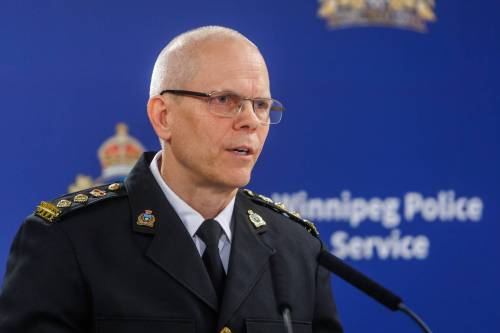
Winnipeg police get behind Ottawa’s ‘lawful access’ bill
3 minute read Preview Wednesday, May. 20, 2026Words matter
4 minute read Wednesday, May. 20, 2026I have been following with interest the media’s reporting of the ban in Manitoba’s Legislative Assembly on the use of the words racist, bigot, homophobe, misogynist and transphobe to call out hateful speech. The stated goal of the ban is “to improve House decorum.”
I’ve appreciated the fulsome coverage of this issue in the Free Press through the publishing of editorials, op-eds and letters to the editor. I was in particular struck by Premier Wab Kinew’s comments during his May 7 monthly interview with Marcy Markusa on CBC Radio.
Kinew’s strong opposition to the ban raises a critical question: How do we keep democratic civil society alive while silencing the calling out of discriminatory language and behaviour? Of course we can’t. By confusing decorum with silence we run the risk of contributing to a “head in the sand” mindset; to what American journalist and activist Barbara Ehrenreich referred to as a “Smile or Die” culture.
But then a followup question emerges: How do we effectively voice our legitimate dissent in ways that move us towards correcting discriminatory practices? A “no holds barred” approach to voicing our opposition may not be the answer. It’s all too easy to slip into shaming people by lobbing ad hominem/ad feminam attacks across partisan lines.
Designated encampments are a poor solution
5 minute read Wednesday, May. 20, 2026The overall shrinking of public space and degradation of the policy environment on use of public space is contributing to people experiencing homelessness being less safe — and contributing to interest in ideas like designated encampments. Unfortunately, this direction fails to centre the interests of people living unhoused. Further, we forget too easily that any consideration of land use on Treaty 1 land needs to start with historic claims and ancestral rights.
Among people experiencing homelessness, Indigenous people are overrepresented. Many people are living unsheltered on their own ancestral territories. Having endured intergenerational theft that started with land (transferred to settlers whose descendants now enjoy generational wealth), and continued with limits on movement, ability to make money, access to education and more, they are now actively surviving homelessness. Yet, the limits on their person continue.
Recent years have seen the closure and limits on use of public space throughout the downtown and broader city. These include Portage Place mall, the Millennium Library and Winnipeg Transit, and previously through the closure of downtown single-room occupancy hotels and their barrooms.
For some time, the city has been telegraphing an intention to limit access to outdoor public space according to housing status. At every opportunity, those cautioning against this move have raised the problem of limiting those with ancestral rights, and further limiting free movement of citizens on public land. The latter has been decided through B.C. legal process, and suggests the City of Winnipeg’s exposure to risk as it moves forward.

U.S. says it’s pausing long-standing military board with Canada
5 minute read Preview Tuesday, Jun. 9, 2026Solidarity Dialogues workshops counter polarization
5 minute read Saturday, May. 16, 2026Amal Elsana Alhjooj is not a person to sit idly by when she encounters a challenge, conflict or situation that needs correcting. Over the years, that attitude and activism have led her to establish several innovative social justice and civil society initiatives that, among other achievements, have enhanced the livelihood and independence of Bedouin women in Israel, where Alhjooj was raised, and the relationship between Jews and Arabs both in Israel, Palestine and in Canada, where Alhjooj now lives.
Alhjooj’s most recent venture is a series of workshops called Solidarity Dialogues.
Solidarity Dialogues is an offshoot of PLEDJ, a social change non-profit that Alhjooj, who is Muslim, co-established in 2021 with Brian Bronfman, the Jewish president of the Peace Network for Social Harmony, to empower and organize marginalized communities to address systematic injustices that impede their lives.
Solidarity Dialogues is more narrow in scope, as it is designed specifically to address the deep seated polarization currently permeating Canadian workplaces, schools and society in general. Solidarity Dialogues’ series of workshops provide participants with the tools to navigate that polarization and the heated, intolerant and uncomfortable exchanges that tend to characterize that polarization. By differentiating between dialogue and debate, and hurt and harm, the workshops provide participants with safe spaces in which to step out of their comfort zones, listen empathetically and openly to others’ lived experiences, and develop mutual understanding and an ability to respond to conflict.