

There’s a big difference between ‘can’ and ‘should’
Advertisement
Read this article for free:
or
Already have an account? Log in here »
To continue reading, please subscribe:
Monthly Digital Subscription
$1 per week for 24 weeks*
- Enjoy unlimited reading on winnipegfreepress.com
- Read the E-Edition, our digital replica newspaper
- Access News Break, our award-winning app
- Play interactive puzzles
*Billed as $4.00 plus GST every four weeks. After 24 weeks, price increases to the regular rate of $19.95 plus GST every four weeks. Offer available to new and qualified returning subscribers only. Cancel any time.
Monthly Digital Subscription
$4.99/week*
- Enjoy unlimited reading on winnipegfreepress.com
- Read the E-Edition, our digital replica newspaper
- Access News Break, our award-winning app
- Play interactive puzzles
*Billed as $19.95 plus GST every four weeks. Cancel any time.
To continue reading, please subscribe:
Add Free Press access to your Brandon Sun subscription for only an additional
$1 for the first 4 weeks*
*Your next subscription payment will increase by $1.00 and you will be charged $16.99 plus GST for four weeks. After four weeks, your payment will increase to $23.99 plus GST every four weeks.
Read unlimited articles for free today:
or
Already have an account? Log in here »
Hey there, time traveller!
This article was published 27/07/2022 (1357 days ago), so information in it may no longer be current.
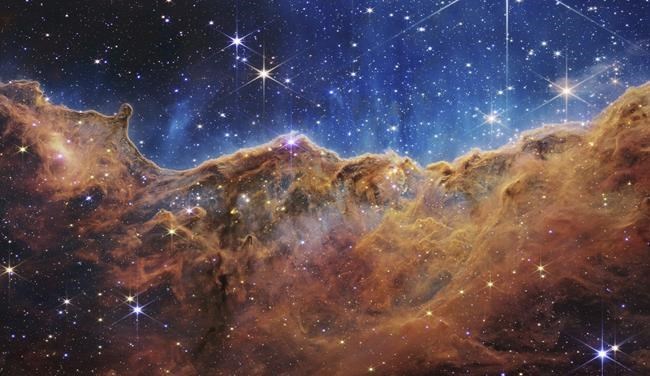
The James Webb space telescope has given us glimpses of the universe far away in space and time from here and now.
Ever since humans first looked up into the night sky, we have wondered if it was the home of the gods, or alien creatures — and asked what all the lights really meant.
If we ever to encounter an alien civilization on even terms, part of the process of “getting to know you,” as they looked over our planet, would mean having to explain ourselves.
Observing the current condition of the Earth, I suspect those aliens would want to know “Why?”
We would have no good reasons to offer for our situation, I fear, just a narrative of how our current civilization has unfolded from its roots in the distant past. It would be hard, if not impossible, to explain the disastrous choices we have made as a species.
After all, our ability to reason is supposed to be what separates us from the other animals with whom we share the planet, not just our ability to do stuff. We can do much more than any other species — of course we can. But should we? Especially when “doing” often means “destroying”?
There is literally a world of difference between “can” and “should,” something those aliens would certainly point out, as they observed our planetary systems in crisis.
Shifting the focus down to ground level, however, there is actually the same difference between legality and morality as there is between “can” and “should” — between what is legal and what is moral, between what is the law and what is right.
Our laws lag behind social changes by at least a generation, which is why marijuana has finally been legalized about 50 years after its use became widespread in Canada. A changing society changes its laws; changing the laws first, on their own, changes very little in society if people don’t agree.
Without the support of the majority of the people, whatever laws are passed will be ineffective and hard to enforce. When it generally makes sense to buckle your seatbelt, or not to smoke indoors, or not to drink and drive, passing legislation puts the legal seal of approval on what most reasonable people were going to do anyway.
Some people will always ignore these laws, but there is no sympathy for them when they are either caught or suffer the consequences of their poor decisions.
But another way to frame this can/should problem is to see “can” as a reflection of power, and “should” as a reflection of critical thinking or wisdom. It’s my car, my life, so I can drive through the intersection on a red light if I want. Whether I should do this, whether it is smart (or wise), is a separate issue — something we may need to learn the hard way.
If your choices only affect you, it’s your consequence as well as your call. But, usually, those choices affect others, too – and so making choices just because you can, and not considering whether you should, is a recipe for certain trouble.
The news has been full of such examples, especially relating to legality and morality. The U.S. Supreme Court (SCOTUS), with its conservative majority, has overturned long-standing practice because it can, without sufficient consideration of the wisdom of doing so. Whether this is about abortion rights, or land rights, or the ability of the Environmental Protection Agency to do its job, power has overruled wisdom — or, at least, the legal power of those who hold the balance in SCOTUS, right now, has overruled the collective wisdom of the American people.

Or so it seems — we will see whether American social morality has really changed, and the law is just catching up, or if (as I suspect) it is a handful of people trying to reverse course and impose a change on a country that will have none of it. The same applies to gun lobbies and gun legislation, as mass shootings spread like a plague, and general frustration grows.
In Canada, we have the same power/wisdom problem. Lobbies, special interests, personal connections — we have seen many examples of power lately, at both provincial and municipal levels, but little wisdom. The Manitoba government heads into the fall with impending legislation to change a number of things — including rolling back the restrictions on cosmetic pesticides — mostly because they can, not because it’s wise. They have the majority, right now, so the opposition can only protest.
What we need, however, is less “can” and more “should” — less legality, and more morality. What a difference it would make — for us here, and for the whole planet — if the wisdom of our elders began to be reflected in the decisions of our leaders.
Then, we would be able to answer — in a good way — those aliens who would look at our planet and ask us “Why?”
Peter Denton’s latest book is The End of Technology.