

Springing into action
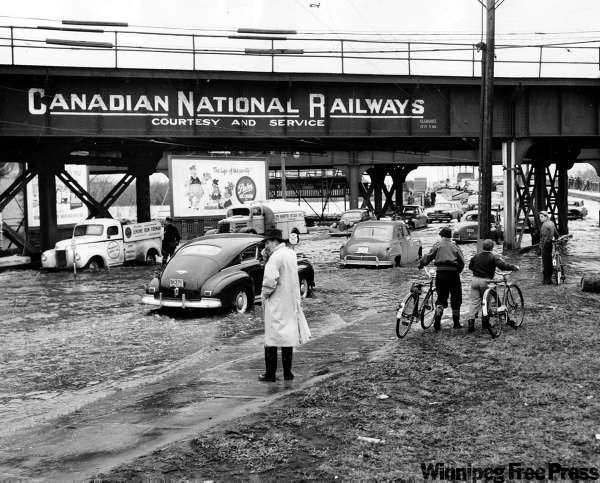
A career that began in the muck of the 1950 flood
Advertisement
Read this article for free:
or
Already have an account? Log in here »
To continue reading, please subscribe:
Monthly Digital Subscription
$1 per week for 24 weeks*
- Enjoy unlimited reading on winnipegfreepress.com
- Read the E-Edition, our digital replica newspaper
- Access News Break, our award-winning app
- Play interactive puzzles
*Billed as $4.00 plus GST every four weeks. After 24 weeks, price increases to the regular rate of $19.95 plus GST every four weeks. Offer available to new and qualified returning subscribers only. Cancel any time.
Monthly Digital Subscription
$4.99/week*
- Enjoy unlimited reading on winnipegfreepress.com
- Read the E-Edition, our digital replica newspaper
- Access News Break, our award-winning app
- Play interactive puzzles
*Billed as $19.95 plus GST every four weeks. Cancel any time.
To continue reading, please subscribe:
Add Free Press access to your Brandon Sun subscription for only an additional
$1 for the first 4 weeks*
*Your next subscription payment will increase by $1.00 and you will be charged $16.99 plus GST for four weeks. After four weeks, your payment will increase to $23.99 plus GST every four weeks.
Read unlimited articles for free today:
or
Already have an account? Log in here »
Hey there, time traveller!
This article was published 12/04/2009 (6200 days ago), so information in it may no longer be current.
I pedalled my bike along the 1950 streets of evacuated Norwood to the wooden station in St. Boniface and took the train to work, a five-minute trip to the CN Rail station at Main Street and Broadway.
There’s nothing funny about Red River Valley flooding, but taking the train to work seems amusing now. At the time, on the middle of the bridge with that implacable flow just inches below and edging into downtown, it was intimidating.
We lived in Norwood and everyone was evacuated, members of my family going to rough it in some kind person’s Winnipeg Beach cottage. But I decided to stick it out in our Hill Street house. Being a copy boy at The Tribune, I saw a great future in being a newspaperman, and didn’t want to miss the excitement of the newsroom.
It was a gloomy, doomy time back at the house. Once I had checked the cotton bag of linseed (flax) I had packed into the basement sewer drain to keep flood water from entering, there wasn’t much to do. Work had stopped on the Lyndale dike a couple of hundred feet away, water lapped near the top, and the area was deserted. So, after a day, I went to stay with a friend on Furby Street.
No one in Manitoba who still had his marbles had experienced a Manitoba flood. Duff’s Ditch wasn’t even a dream, and Duff Roblin had just embarked on the Herculean task of re-organizing provincial conservative thinkers all by himself; the man who had helped organize European landing fields for fighter planes after the D-Day invasion of Normandy would have been ideal for setting up a flood-fighting machine. But Premier Douglas Campbell — the original pay-as-you-goer — couldn’t see the need (is that what started the decline of the provincial Liberal party?)
In most social emergencies, an attitude develops, a spirit of determined “can-do”, and this common esprit de corps of Winnipeggers and all Red River Valley inhabitants was vivid well into May, despite the weeks of continuous rain, drizzle, mud, leaking basements, collapsing dikes and general discomfort.
As water spilled the Red River banks and edged up streets just a block from Portage and Main, low structures seemed to sink until just eaves and roofs were visible. Throughout the downtown area, pumps purred and grey-green water spurted from hoses sticking out from the basements of giant buildings and into the gutters to add to the miserable scene.
But there was little misery. Just as in recent wartime Britain, folks joined in a camaraderie of “business as usual.” The army had finally taken over flood fighting, and teenagers met after supper to decide which one of the many city dikes they would attend to lift and spread sandbags. Often, their hard work was illuminated by powerful military searchlights beamed straight down the dike line. And there was banter and laughter at the coffee and sandwich distribution points.

Everyone wore rubber boots. The Tribune newsroom scene had altered dramatically. If it had ever been true that a bottle of hooch could be found in every reporter’s desk drawer, now every self-respecting reporter punching a typewriter had a pair of suitably mucky rubber boots by his desk.
This lowly copy boy spent most of his evenings at The Trib, soaking up atmosphere. Finally, one of the night reporters allowed me to go out on assignment with him to one of the evacuated municipal hospitals where a dike breech was imminent, and efforts to save it had been abandoned. In trench coat and fedora, I was certain I could be mistaken for a reporter.
In heavy drizzle we slopped about until my right rubber boot was sucked into the mud and came off. As I hopped on spot, trying to pull it out, the taxi driver was honking his horn, nervous that a deluge of flood water was about to engulf us. At the reporter’s urging, I abandoned the boot and we fled. Not many minutes later, water gushed in and covered my boot.
BUT — I had helped cover the great Winnipeg flood of 1950.
Jim Shilliday is a former Trib reporter and editor.