

Keep water on the land
Restoring wetlands and reducing runoff key to better flood protection
Advertisement
Read this article for free:
or
Already have an account? Log in here »
To continue reading, please subscribe:
Monthly Digital Subscription
$1 per week for 24 weeks*
- Enjoy unlimited reading on winnipegfreepress.com
- Read the E-Edition, our digital replica newspaper
- Access News Break, our award-winning app
- Play interactive puzzles
*Billed as $4.00 plus GST every four weeks. After 24 weeks, price increases to the regular rate of $19.95 plus GST every four weeks. Offer available to new and qualified returning subscribers only. Cancel any time.
Monthly Digital Subscription
$4.99/week*
- Enjoy unlimited reading on winnipegfreepress.com
- Read the E-Edition, our digital replica newspaper
- Access News Break, our award-winning app
- Play interactive puzzles
*Billed as $19.95 plus GST every four weeks. Cancel any time.
To continue reading, please subscribe:
Add Free Press access to your Brandon Sun subscription for only an additional
$1 for the first 4 weeks*
*Your next subscription payment will increase by $1.00 and you will be charged $16.99 plus GST for four weeks. After four weeks, your payment will increase to $23.99 plus GST every four weeks.
Read unlimited articles for free today:
or
Already have an account? Log in here »
Hey there, time traveller!
This article was published 07/06/2009 (6144 days ago), so information in it may no longer be current.
We ignore the lessons of the 2009 Red River flood at our peril. It reveals another reason why urban taxpayers should take an interest in what happens on the rural landscape.
Well-managed agriculture can help keep your basement dry, your tax bill lower and give us an edge in adapting to climate change.
Agricultural water management has always been a difficult issue in Manitoba where floods and droughts are common. The mile-section quilt that defines southern Manitoba’s landscape replaced natural features, such as sloughs, wetlands, and creeks with straight-line drains. Modern drainage succeeded in speeding runoff from fields, but also increased downstream flooding. And it wasn’t long before serious problems arose.
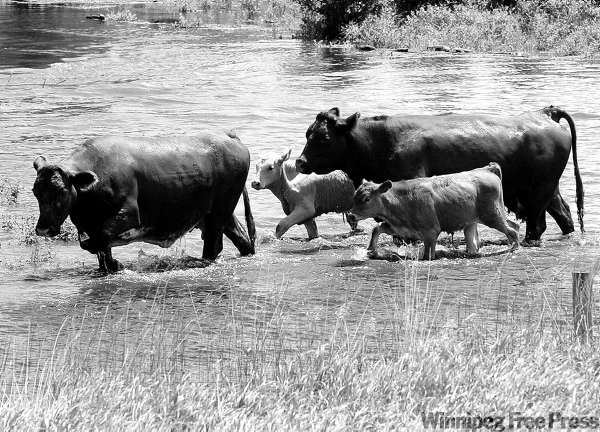
The downstream flooding liability associated with drainage projects has been well understood for more than a century, little has changed on the ground.
The catastrophic 1950 and 1997 floods provoked the construction and then expansion of the Red River Floodway. Without question it has been an excellent public investment, but it has limitations as demonstrated during the unusual conditions experienced this spring, which is troubling given the potential risks of climate change. Whether or not the 2009 flood was a climate change event, its characteristics — heavy fall and late winter precipitation, difficult ice conditions, and intermittently slow and rapid melting — are entirely consistent with climate change projections.
We need to prepare for more years like 2009. With the operational limitations of the floodway now better understood, we need agricultural water- management options that provide rural as well as urban benefits. This is where the next increment of flood protection must come.
Fortunately, excellent examples of improved management already exist within Manitoba and the Red River Valley, including the Alternative Land Use Services pilot project. Participating farmers receive compensation for maintaining ecological features on their farms, such as wetlands and riparian areas that can help reduce flooding.
The small dam network in the South Tobacco Creek Watershed is another good example of the many innovations to slow water flow on the Prairies. A study by the Prairie Farm Rehabilitation Administration calculated that small dams reduce peak flood flows by as much as 90 per cent.
The innovative waffle concept developed by Energy and Environment Research Center in Grand Forks uses the section road grid as a network of dykes to store and slow water flow, much like the ridges on a waffle store maple syrup.
Drought and excess nutrient loadings on Lake Winnipeg are also key water-management issues. Fortunately, actions that reduce flooding can reduce nutrient loads, and help us cope with drought — another climate-adaptation priority for the Prairies, which is expected to become hotter with more frequent drought episodes. For example, wetlands remain productive and can provide an emergency source of livestock forage during very dry spells.
The real challenge lies in changing the traditional practice of clearing and draining land of excess water.
Farmers must be convinced that storing spring runoff is in their interest. Overturning traditional practice is difficult but not impossible as the great success with minimum tillage demonstrates. The difference with flood-water storage is that minimum tillage produces an immediate benefit to the farmer’s bottom line by reducing input costs. Although flood-water storage can pay a dividend later in the growing season during dry years, it generally hits profitability by taking land out of production.

Therefore compensation is important — with support and financial incentives farmers are showing that they can and will produce public flood-protection benefits. Governments must respond with a sophisticated agricultural policy, capable of producing the right mix of multi-purpose flood protection in our agricultural watersheds.
While the province plays a key role in agricultural policy, jurisdiction is shared. Agriculture and Agri-food Canada’s new policy framework, Growing Forward, includes all the essential principles for coherent agricultural policy in the Red River Valley and the Lake Winnipeg Basin.
It recognizes that agriculture practice should address the societal priority of strong environmental stewardship, adapt to climate change, and deliver ecological good and services implemented on a watershed basis. These principles are laudable and enlightened — as always the test is the funding to implement.
Hopefully, the 2009 Red River flood provides a clear understanding that it’s not just the farm vote that cares. Good policy benefits everyone and makes finding the necessary political will much easier.
Henry D. (Hank) Venema is the director of the International Institute for Sustainable Development’s Sustainable Natural Resources Management program and Water Innovation Centre.