

Bomb Canada!
Anti-Canadianism often aimed at world's oldest anti-Americans
Advertisement
Read this article for free:
or
Already have an account? Log in here »
To continue reading, please subscribe:

Digital Subscription
One year of digital access for only $205*
- Enjoy unlimited reading on winnipegfreepress.com
- Read the E-Edition, our digital replica newspaper
- Access News Break, our award-winning app
- Play interactive puzzles
*First annual payment billed as $205.00 + GST for one year. This annual subscription will automatically renew at $233.00 + GST every 52 weeks (10% off the regular annual price of $259.35). Offer available to new and qualified returning subscribers only. Cancel any time.
To continue reading, please subscribe:
Add Free Press access to your Brandon Sun subscription for only an additional
$1 for the first 4 weeks*
- Enjoy unlimited reading on winnipegfreepress.com
- Read the E-Edition, our digital replica newspaper
- Access News Break, our award-winning app
- Play interactive puzzles
*Your next Brandon Sun subscription payment will increase by $1.00 and you will be charged $17.95 plus GST for four weeks. After four weeks, your payment will increase to $24.95 plus GST every four weeks.
Read unlimited articles for free today:
or
Already have an account? Log in here »
Hey there, time traveller!
This article was published 18/10/2009 (6121 days ago), so information in it may no longer be current.
Admit it — as Canadians, we love to tweak the feathers on Uncle Sam’s eagle. In fact, anti-Americanism has been so prevalent throughout the centuries that scholars refer to Canadians as the world’s oldest anti-Americans.
But perhaps that distinction requires a revision of sorts. As it turns out, similar sentiment exists south of the border, too.
Since the early days of Confederation, bouts of anti-Canadianism have persistently cropped up in the American media during periods of tense bilateral relations. Alternating between the unabashedly ignorant and the absurd, to the comical and the witty, anti-Canadian remarks by American journalists and commentators provide a colourful narrative to a complex relationship.
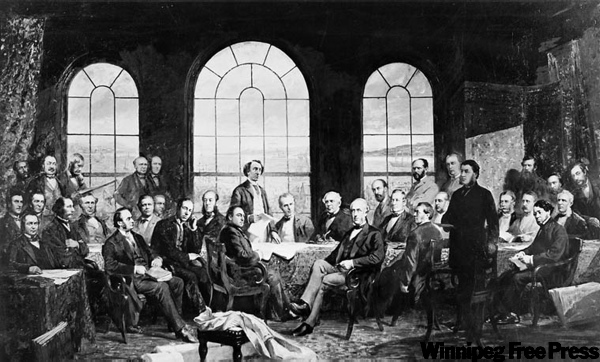
Take for example, the Chicago Tribune’s declaration in 1867 that "Canada can never hope to be anything more than she now is — a helpless, hopeless, aimless dependent, without a present and without a future, other than a blank in history, and a blank in all things."
Or the reciprocity treaty in 1911, when the United States agreed to the Canadian government’s long-held desire for free trade negotiations. The treaty passed through Congress, but was defeated during a Canadian election, when voters said no to free trade by electing Robert Borden’s Conservatives to power. "The Canadians have permitted themselves to be fooled and bamboozled," the New York Times declared.
Following the reciprocity treaty came bilateral rifts during the Cold War era, with one top U.S. diplomat telling journalists that Canadians had become too reliant on American investment and were "hewers of wood and drawers of water because that is what they want to be."
Prime Minister Pierre Trudeau didn’t help cross-border relations either. Originally lauded as "Canada’s version of the Kennedys," Trudeau was a darling of the U.S. media until his Third Option policies and unrestrained cries of "Viva Castro!" during a Cuban rally in 1976 quelled mushy analogies of the "go-go French-Canadian" and he was promptly labelled a failure.
But it wasn’t until 2002, in the months leading up to the invasion of Iraq, that anti-Canadianism reached new lows and the remarks became downright cynical, even sinister, particularly among America’s influential conservative media.
At the National Review magazine, Jonah Goldberg proposed a non-politically correct option to buck up his northern neighbour’s resolve — bomb Canada. Granted, Goldberg wasn’t calling for a full-scale attack, just a quick raid on an unoccupied structure like an empty hockey arena so that Canada would rearm itself and stop relying on the United States. "In a sense, the U.S. owes it to Canada to slap it out of its shame-spiral. That’s what big brothers do," Goldberg quipped, after describing Canada as a "northern Puerto Rico with an EU sensibility."
And that was only the beginning. There was MSNBC host Tucker Carlson’s controversial comment that Canada is like the "retarded cousin you see at Thanksgiving and sort of pat him on the head. You know, he’s nice, but you don’t take him seriously." At Fox, Neil Cavuto raised eyebrows by asking, "Could our neighbours to the north soon be our enemies?"
Blatantly false and clearly sensationalist in nature, these anti-Canadian remarks reflect a disturbing trend in the American media as the push for higher ratings and larger corporate profits routinely trump journalistic principles of fairness and objectivity. The resulting shallowness worries those in the profession. In the Pew Research Center’s 2008 State of the News Media report, almost 80 per cent of journalists surveyed thought the news didn’t pay enough attention to complex issues. More than 60 per cent said the line between reporting and commentary was becoming increasingly blurred.
So what does this all mean? It’s clear that compared to the sheer number of words thrown about during a daily news cycle, the amount of anti-Canadianism in the American media is miniscule. Yet after the start of the war in Iraq, opinion polls repeatedly showed that a growing number of Americans viewed Canada in less favourable terms as policy differences muddied bilateral relations with criticisms reflected in the press.

The election of a Democratic president and a Democratic-controlled Congress was thought to indicate a possible convergence in policy outlook, but that hasn’t been the case as demonstrated by border security issues and "Buy American" provisions.
Currently, the American media is preoccupied by dynamic debates over a Pandora’s box of domestic and international policies, from health care to the war in Afghanistan and economic stimulus action plans.
But if history is any indication, anti-Canadianism will be back.
Chantal Allan is a former Manitoba broadcaster and author of Bomb Canada and Other Unkind Remarks in the American Media, published by Athabasca University Press and available at McNally Robinson Booksellers and Chapters. She lives in Los Angeles.