

The perfect prairie vehicle
Advertisement
Read this article for free:
or
Already have an account? Log in here »
To continue reading, please subscribe:
Digital Subscription
One year of digital access for only $75*
- Enjoy unlimited reading on winnipegfreepress.com
- Read the E-Edition, our digital replica newspaper
- Access News Break, our award-winning app
- Play interactive puzzles
*Billed as $5.77 plus GST every four weeks. After 52 weeks, price increases to the regular rate of $19.95 plus GST every four weeks. Offer available to new and qualified returning subscribers only. Cancel any time.
Monthly Digital Subscription
$4.99/week*
- Enjoy unlimited reading on winnipegfreepress.com
- Read the E-Edition, our digital replica newspaper
- Access News Break, our award-winning app
- Play interactive puzzles
*Billed as $19.95 plus GST every four weeks. Cancel any time.
To continue reading, please subscribe:
Add Free Press access to your Brandon Sun subscription for only an additional
$1 for the first 4 weeks*
- Enjoy unlimited reading on winnipegfreepress.com
- Read the E-Edition, our digital replica newspaper
- Access News Break, our award-winning app
- Play interactive puzzles
*Your next Brandon Sun subscription payment will increase by $1.00 and you will be charged $17.95 plus GST for four weeks. After four weeks, your payment will increase to $24.95 plus GST every four weeks.
Read unlimited articles for free today:
or
Already have an account? Log in here »
Hey there, time traveller!
This article was published 26/07/2010 (5775 days ago), so information in it may no longer be current.
It was slow and awkward, but the Red River cart played a signal role in Winnipeg’s development, a fact that’s in danger of being forgotten.
The Red River cart was a perfect vehicle. It was environmentally-friendly. It fit the Prairie economy, climate and geography of its time like a cup in a saucer.
As well, it had a profound impact on the look of Winnipeg and set up the city as a major hub for overland transportation in Western Canada.
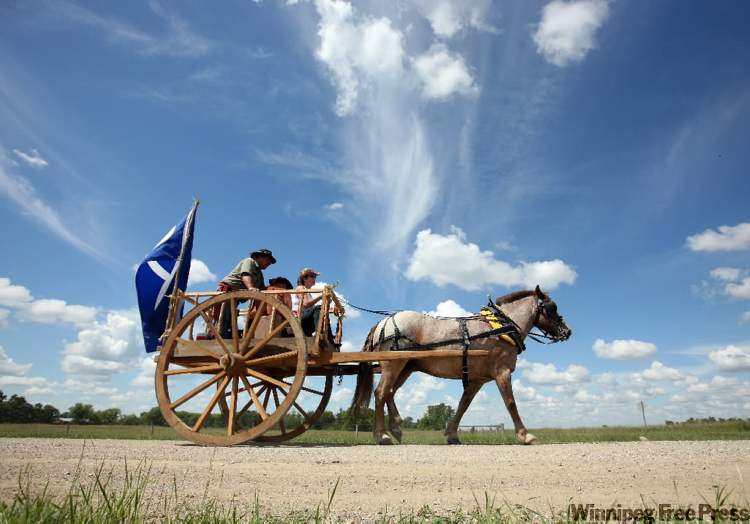
In the chronology of transportation, the Métis carts came between water transport and the railways. In his book, Caesars of the Wilderness, Peter C. Newman says "if the buffalo was the Métis equivalent of the fur trade’s beaver, the Red River cart was its canoe." Canoes and steam engines came from elsewhere. Red River carts were Winnipeg’s.
Most of our cars are designed to massage male egos. The Red River carts were developed to meet Prairie conditions. Its two big concave wheels could get through swamps and gumbo. No need to spend millions paving and constantly repaving roads. It was made entirely of local wood, held together by wooden pegs and buffalo skin strips. And if a road flooded, as often happens in Manitoba, the cart could float. When the wheels were placed in the cart’s box and a tarp was thrown over it, the Métis drivers could paddle the vehicle. Repairs could be made easily.
A cart’s wheels and axle were never greased. No need for dirty or even clean oil. Grease would have picked up dust and grit and that would have scarred the axle. The resulting wood-on-wood squeaking of the carts could be heard from kilometres away.
Two shafts attached to the axle were strapped to an aging pony or an ox, who worked for grass and helped fertilize the prairies. A cart could carry about 450 kilograms and travelled a steady 25 kilometres a day.
Starting in the 1850s, cart brigades travelled the 885-kilometre Pembina Trail from Upper Fort Garry to St. Paul, Minn., the head of navigation on the Mississippi system and later a railhead.
By the 1860s, 600 carts were making two round trips annually on the Pembina Trail and the Crow Wing Trail on the opposite, east bank of the Red River. The service was so good the Hudson’s Bay Company started bringing in all its trade goods by cart.
The Carlton Trail, the other major route, wound from Upper Fort Garry to Fort Ellice, on today’s Manitoba-Saskatchewan border, and on to Fort Carlton and Fort Edmonton. In the 1860s, about 300 carts made one round trip per season carrying trade goods, furs and food, including the essential pemmican, another Métis invention.
I’ve seen ruts left by the carts in parts of Saskatchewan.
The Métis gift for organization can be seen in an 1840 buffalo hunt that brought together 620 men, 650 women, 360 children, 586 oxen, 655 cart horses, more than 1,000 carts and 403 fast horses or "buffalo runners."
The Métis cart trails were the basis of two routes essential today to Winnipeg’s transportation companies. They are a big part of the planning for CentrePort, the city’s new intermodal transportation hub.
The Métis cart trails met in the city’s west end near the St. Charles Roman Catholic church, the centre of a small Métis community. The Pembina Trail crossed the Assiniboine River on a sand bar near Southboine Drive in Charleswood. I wandered around for an afternoon, but couldn’t see any plaque marking the spot. The two trails became what is now Portage Avenue.
The Métis not only set the location of the main street, but also its width. When the road got too mucky, the drivers would move their carts over and put one wheel on fresh ground. Over time, the road gradually increased in width and gave Winnipeg an impressive downtown street.

In my scrambling around Winnipeg, I could not find an exhibit that set out all the impacts of the carts. Investors Group in 1974 sponsored an impressive sculpture of an ox and cart in Assiniboine Park. Orille Haugan, a poet, makes Red River carts in the basement of the St. Norbert Arts Centre on rue des Ruines du Monastère.
But he had to use old photos in building his carts because he couldn’t find any plans and "the practice has been lost." And it would appear the history of the Red River carts is getting lost as well.
Tom Ford is managing editor of The Issues Network.