

Downtown safety a political — not policing — issue
Advertisement
Read this article for free:
or
Already have an account? Log in here »
To continue reading, please subscribe:

Digital Subscription
One year of digital access for only $205*
- Enjoy unlimited reading on winnipegfreepress.com
- Read the E-Edition, our digital replica newspaper
- Access News Break, our award-winning app
- Play interactive puzzles
*First annual payment billed as $205.00 + GST for one year. This annual subscription will automatically renew at $233.00 + GST every 52 weeks (10% off the regular annual price of $259.35). Offer available to new and qualified returning subscribers only. Cancel any time.
To continue reading, please subscribe:
Add Free Press access to your Brandon Sun subscription for only an additional
$1 for the first 4 weeks*
- Enjoy unlimited reading on winnipegfreepress.com
- Read the E-Edition, our digital replica newspaper
- Access News Break, our award-winning app
- Play interactive puzzles
*Your next Brandon Sun subscription payment will increase by $1.00 and you will be charged $17.95 plus GST for four weeks. After four weeks, your payment will increase to $24.95 plus GST every four weeks.
Read unlimited articles for free today:
or
Already have an account? Log in here »
Hey there, time traveller!
This article was published 19/10/2010 (5800 days ago), so information in it may no longer be current.
Over the course of the summer, numerous surveys and statistics of all types have hit the media about the issue of safety in our downtown. People who are downtown more often feel it is much safer than those who don’t visit as often, both night and day. Many Winnipeggers agree the media influences how people feel about downtown safety.
It’s clear downtown revitalization is on a roll, but there is much that needs to be done to enhance safety, not only in our downtown but in our city.
Yet what emerged from the surveys is many people feel threatened by the visibility of serious social issues. Homelessness, panhandling and intoxication are social issues that do not register on crime stats unless they lead to a crime, which sometimes happens, but more often not.
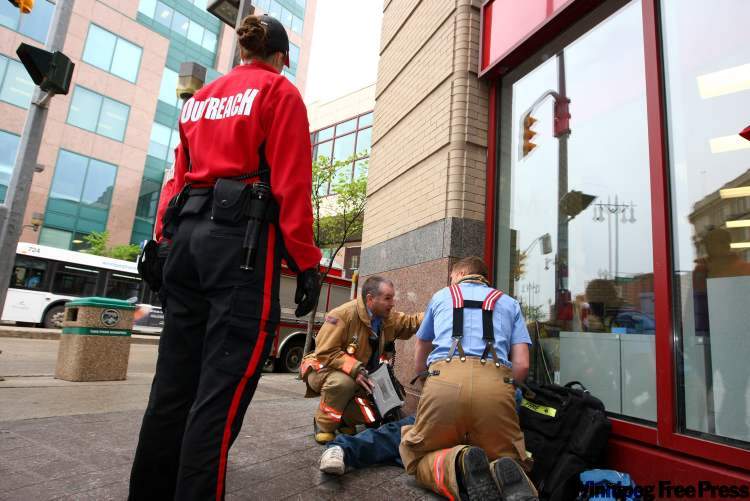
But the sheer reality of simply staring into the face of poverty and the ramifications of addictions out on the streets of downtown hugely influence the public’s perceptions about safety.
These are social issues. From a crime perspective, statistics show the downtown proper is relatively safe. Of course, this does not mean crime does not exist; it does, as it does everywhere. In talking with other downtown organizations, this situation of perceptions created largely by social issues versus the reality of statistics repeats itself in other city centres, from London, England — one of the most pedestrian-friendly cities in the world — to Saskatoon, Sask. And the solutions championed by downtown boosters are the same, from greater supports for the homeless to the continued creation of more reasons for people to live, work and play downtown and, of course, increased foot patrols and policing. The same resonates for downtown Winnipeg.
Everyone wants more police downtown and the police are committed to downtown safety. But Winnipeg police resources are focused on problem areas of crime — which are outside of the downtown. When resources permit, the police do their best to place foot patrols downtown and they also work to make our downtown safer behind the scenes. While police foot patrols are the ultimate solution for downtown safety woes, we just have not been able to see them in a sustained manner.
The obvious immediate solution is more policing to better manage these social issues, as happens in places like New York. But there are serious crimes elsewhere that are a greater priority and Winnipeg Police Service resources are deployed to areas of greatest need, based on crime. Herein lies the problem.
The issue is a political decision, not a policing one.
The downtown is the economic engine of our province, generating employment and taxation, and creating the brand image for our city. Our downtown is the pulse of the entire city by which tourists, investors and Winnipeggers themselves judge the economic health of our province and the overall image of our community.
These are serious community-building goals, and not necessarily policing ones.
You hear a lot from the leading mayoral candidates, Sam Katz and Judy Wasylycia-Leis, about downtown being a priority and the need for extra police foot patrols downtown. But will these vague statements make a difference on downtown streets?

The cadet program is a wonderful initiative, but only if it is resourced properly. The Downtown BIZ’s Outreach and Watch programs are working, so let’s grow them.
The conversion of the Bell Hotel into a supportive housing project is a great start, so let’s multiply this by five housing projects in three years. The Mission: Off the Streets program is giving hope to those less fortunate who are finding pride again in not panhandling, but putting in an honest day’s work making our downtown beautiful. Let’s help these people more.
The Downtown BIZ urges the candidates during this election to make a bold stand and commit to a concrete plan to tackle downtown safety issues, once and for all.
Stefano Grande is executive director of the Downtown BIZ.