

Army decides what’s best for ‘nation’
Its monopoly on organized violence tips this way and that in Mideast
Advertisement
Read this article for free:
or
Already have an account? Log in here »
To continue reading, please subscribe:
Monthly Digital Subscription
$0 for the first 4 weeks*
- Enjoy unlimited reading on winnipegfreepress.com
- Read the E-Edition, our digital replica newspaper
- Access News Break, our award-winning app
- Play interactive puzzles
*No charge for 4 weeks then price increases to the regular rate of $19.95 plus GST every four weeks. Offer available to new and qualified returning subscribers only. Cancel any time.
Monthly Digital Subscription
$4.99/week*
- Enjoy unlimited reading on winnipegfreepress.com
- Read the E-Edition, our digital replica newspaper
- Access News Break, our award-winning app
- Play interactive puzzles
*Billed as $19.95 plus GST every four weeks. Cancel any time.
To continue reading, please subscribe:
Add Free Press access to your Brandon Sun subscription for only an additional
$1 for the first 4 weeks*
*Your next subscription payment will increase by $1.00 and you will be charged $16.99 plus GST for four weeks. After four weeks, your payment will increase to $23.99 plus GST every four weeks.
Read unlimited articles for free today:
or
Already have an account? Log in here »
Hey there, time traveller!
This article was published 10/03/2011 (5420 days ago), so information in it may no longer be current.
From the onset of the political turmoil sweeping the Middle East, media attention has focused on the people in the streets protesting against autocratic governments. All of the protests appear to share the common objective of democratization; some by revolution and others by reform.
In Tunisia, Libya, Egypt and Yemen, the protestors sought to overthrow a corrupt dictator. In Jordan, Bahrain, and Oman, protesters seek a range of reforms, including a more open political system. All of these states possess the trappings of democracy, with one significant difference. The former states are republics with a president as dictator. The latter states are monarchies.
Beneath these differences, and central to the different outcomes that have appeared is the key political actor — the nation’s armed forces. In Tunisia, the army has largely stepped aside, and it remains to be seen what actions it may take if political chaos continues. In Yemen, the army appears to have remained loyal to regime, at least for now. In Egypt, the army sided with the masses in the streets, forced Mubarak to resign, prevented widespread violence, took power, and promised to hold democratic elections by the fall. In Libya, the army has apparently fractured, the country became divided, and civil war broke out. In the case of the monarchies, the army has stood firmly beside the ruling families.
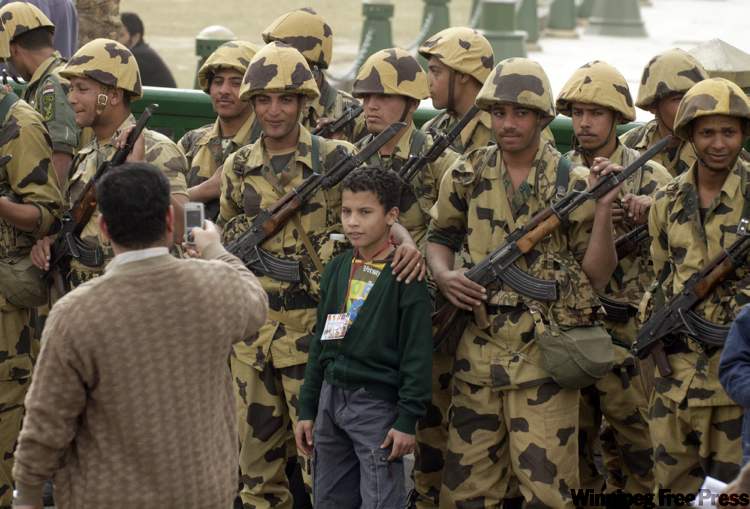
In all these cases, the army is the pivotal political actor for one basic reason. The army has a monopoly on organized violence. The army possesses the means, the training and discipline to employ force if necessary in a controlled manner. With this capability, who controls the army is the major political issue.
In the West, democratic, civilian control of the military is taken for granted. Situations in which an army crushes a popular protest on behalf of a dictator are fully condemned. Similarly, a military coup against a democratically elected government is also condemned. However, a military coup, as has occurred in Egypt, against a corrupt dictator is acceptable, at least in the interim.
This distinction portrays the army in revolutionary situations as an agent of either the people or the government/dictator. Furthermore, it is generally believed that bribery in the form of salaries and weapons’ purchases, “toys for the boys” lies at the basis of army support of a dictator against the people. While there may be some truth in this belief, it is far too simplistic.
In many circumstances, the army perceives itself as an agent of neither the people nor the dictator. It is the agent, and the defender of the nation. The nation is something much greater and more symbolic than either the people or the government. Officers and soldiers are taught their sacred duty to defend the nation against all enemies, external or internal. This was especially the case in Latin America during its era of military juntas, Turkey and Pakistan in the recent past, and to some degree Burma today.
Armies are also inherently conservative, hierarchical organizations. They privilege order and stability, as disorder and instability are enemies of the nation. In the case of Egypt, Mubarak’s rule generated disorder, thereby threatening the nation, and requiring his removal. The people in the streets also represent disorder, and thus political power could not be directly transferred to their representatives. Until order returns, it is the army’s duty to rule on behalf of the nation.
One of the problems is that generals, like politicians, can become addicted to power, and reluctant to return political authority to the civilian sector. Or, as in the case of Egypt, the army may remain the silent ‘power behind the throne.’ The Egyptian republic was established by a military coup led by an army officer, Gamal Nasser, who became a civilian president. Mubarak was a senior air force officer.
The Egyptian experience is somewhat unique, however. The nature and political role of the army differs across the Arab world, which reflect different historical experiences and notions of the nation. In the monarchies, especially Jordan, the army’s sense of nation is closely tied to the King and the royal family. It is a professional Bedouin army, whose roots go back to British training under Sir John Glubb.
In Libya, the attempt to socialize a conscript army into accepting Moammar Gadhafi as the embodiment of the nation failed. Moreover, the fracturing of the army, likely on tribal grounds, further indicates Gadhafi’s failure to create a sense of nation by using the army as a nation-building tool.

In the end, the people are the catalyst for revolution in the Middle East, but the army decides the final outcome.
James Fergusson is the director of the
Centre for Defence and Security Studies
at the University of Manitoba.