

Unilingualism needs no apology
Calls for bilingual public officers offend charter eligibility rights
Advertisement
Read this article for free:
or
Already have an account? Log in here »
To continue reading, please subscribe:
Monthly Digital Subscription
$1 per week for 24 weeks*
- Enjoy unlimited reading on winnipegfreepress.com
- Read the E-Edition, our digital replica newspaper
- Access News Break, our award-winning app
- Play interactive puzzles
*Billed as $4.00 plus GST every four weeks. After 24 weeks, price increases to the regular rate of $19.95 plus GST every four weeks. Offer available to new and qualified returning subscribers only. Cancel any time.
Monthly Digital Subscription
$4.99/week*
- Enjoy unlimited reading on winnipegfreepress.com
- Read the E-Edition, our digital replica newspaper
- Access News Break, our award-winning app
- Play interactive puzzles
*Billed as $19.95 plus GST every four weeks. Cancel any time.
To continue reading, please subscribe:
Add Free Press access to your Brandon Sun subscription for only an additional
$1 for the first 4 weeks*
*Your next subscription payment will increase by $1.00 and you will be charged $16.99 plus GST for four weeks. After four weeks, your payment will increase to $23.99 plus GST every four weeks.
Read unlimited articles for free today:
or
Already have an account? Log in here »
Hey there, time traveller!
This article was published 24/12/2011 (5223 days ago), so information in it may no longer be current.
Judge Marshall Rothstein was not fluent in the French language when he was appointed as a judge on the Supreme Court of Canada.
At the parliamentary committee hearing preceding his appointment, he expressed his willingness to become more proficient in the French language, and in furtherance of that undertaking, he has been taking lessons to improve his skills in Canada’s other official language.
Apparently, this is not good enough to please at least some members of Parliament.
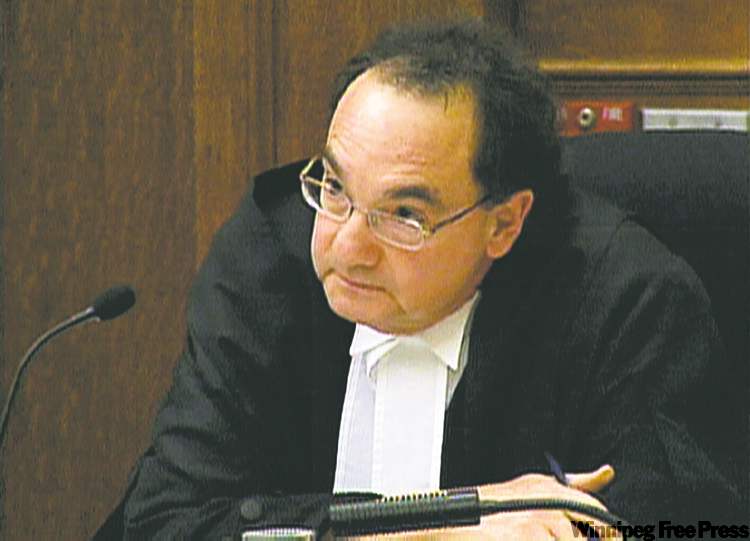
About two months ago, two new nominees to the court went through the hearing process. One of the nominees was Judge Michael J. Moldaver, an experienced member of the Ontario Court of Appeal and an expert in the area of criminal law. He is eminently suited to sit on Canada’s highest court, save for the fact that he is not fluent in French.
He was given a difficult time at the committee, and in particular by the New Democrat MP Joe Comartin.
The Globe and Mail reported that Judge Moldaver apologized several times, professed a love for French culture and language and chastised himself for “squandering” the chance to learn the language in high school. He said that litigants have every right to want to try cases in their native tongue and promised to do everything in his power to become proficient.
Comartin remained unconvinced.
It would be convenient if all members of the Supreme Court could speak both of our official languages, but it is by no means necessary or even desirable. I would hazard the guess that, outside the province of Quebec, 90 per cent of lawyers across Canada and perhaps 80 per cent of judges are not proficient in both English and French.
Any skill that was achieved in high school, or even university, may have withered away with time and lack of use.
In this province, there are remarkably few cases that reach the Court of Appeal level where the parties elect to argue the case in the French language. (During my 28 years on the Court of Appeal, I can recall only two cases where argument was in French.)
If my guesses of proficiency are anywhere close to the mark, we would make an enormous number of possible candidates ineligible by requiring bilingual skills for appointment to the Supreme Court
It was never intended that the Supreme Court be a bilingual tribunal. For almost all of its history, there have been unilingual members of the court, and they functioned without difficulty. If the case is to be heard in French, translation of all the written materials is available. Law clerks working for individual judges are invariably proficient in both languages. Discussions with the other members of the panel dispel any misunderstandings of either evidence or argument. Simultaneous translation is available at the hearing itself. In most of the cases heard by the Supreme Court, a decision is reserved, which provides additional time for a judge to master the intricacies of the case, whether argued in English or French. In short, proficiency in only one language is no bar to full participation in all cases coming before the court. The only issue is the optics.
During his stewardship, Chief Justice Brian Dickson decided that, from a public standpoint, the court should at least look like a fully bilingual tribunal. The court adopted the pretence of being a fully bilingual court, with no reliance on simultaneous translation services. But Judge Willard Estey, for one, had no facility in the French language, and when the court was addressed by a French speaker, he sat through oral argument with little or no comprehension.
Chief Justice Dickson’s concern about appearances was ill placed. The pretence of a bilingual panel was a sin far more egregious than having simultaneous translation of oral argument.
However, there is an active lobby to classify senior administrative positions in the civil service as bilingual. So it is with the position of auditor general, which led to a recent issue at the confirmation hearing of the new auditor general. He escaped only because he had some knowledge of the French language and promised to further his skills in the future.
We can probably all agree that it is highly desirable that the occupants of certain positions, such as the governor general, should be functionally bilingual. But the designation of positions as bilingual should be used sparingly. Canadians are entitled to conduct their business with the federal government in either of the official languages, but that does not require the particular department head to be bilingual. It requires competent translation services, wherever they are required, in both official languages.
What is true of the federal civil service is also true of federal institutions, including the Supreme Court of Canada. Yet the trend appears to be moving in the opposite direction.
In 2010, Bill C-232, a private member’s bill, was introduced in Parliament by an NDP member that would require all future appointees to the Supreme court to “understand French and English without the assistance of an interpreter.”

Subsequently, the Canadian Bar Association provided some support for the proposed legislation by passing a resolution at its annual meeting that proclaims, in part, “that a Supreme Court of Canada composed of judges who understand both official languages is an ultimate ideal,” and urged Parliament to take “immediate concrete steps to achieve institutional bilingualism in the Supreme Court.”
Bill C-232 died on the vine when Parliament prorogued but has been reintroduced by an NDP private member as Bill C-208. The NDP wants to maintain all those seats in Quebec that the party won in the May election, but it is unlikely that the proposed legislation will become law in a Parliament in which the NDP is in minority, at least for the time being. Judge Moldaver, however, did not help the situation by his apology for being unilingual.
The Charter of Rights and Freedoms proclaims that either English or French may be used by any person in any process in any court established by Parliament. It does not say that the presiding judge or judges must understand the language used without the aid of an interpreter. Bilingualism should be encouraged, but no citizen should apologize for being fluent in only one of our official languages, and all should be eligible to be employed in the nation’s business.
Charles Huband is a former Manitoba Court of Appeal judge and a former leader of the Manitoba Liberal party.