

Shape shifter was her greatest role
Advertisement
Read this article for free:
or
Already have an account? Log in here »
To continue reading, please subscribe:
Monthly Digital Subscription
$1 per week for 24 weeks*
- Enjoy unlimited reading on winnipegfreepress.com
- Read the E-Edition, our digital replica newspaper
- Access News Break, our award-winning app
- Play interactive puzzles
*Billed as $4.00 plus GST every four weeks. After 24 weeks, price increases to the regular rate of $19.95 plus GST every four weeks. Offer available to new and qualified returning subscribers only. Cancel any time.
Monthly Digital Subscription
$4.99/week*
- Enjoy unlimited reading on winnipegfreepress.com
- Read the E-Edition, our digital replica newspaper
- Access News Break, our award-winning app
- Play interactive puzzles
*Billed as $19.95 plus GST every four weeks. Cancel any time.
To continue reading, please subscribe:
Add Free Press access to your Brandon Sun subscription for only an additional
$1 for the first 4 weeks*
*Your next subscription payment will increase by $1.00 and you will be charged $16.99 plus GST for four weeks. After four weeks, your payment will increase to $23.99 plus GST every four weeks.
Read unlimited articles for free today:
or
Already have an account? Log in here »
Hey there, time traveller!
This article was published 11/08/2012 (4987 days ago), so information in it may no longer be current.
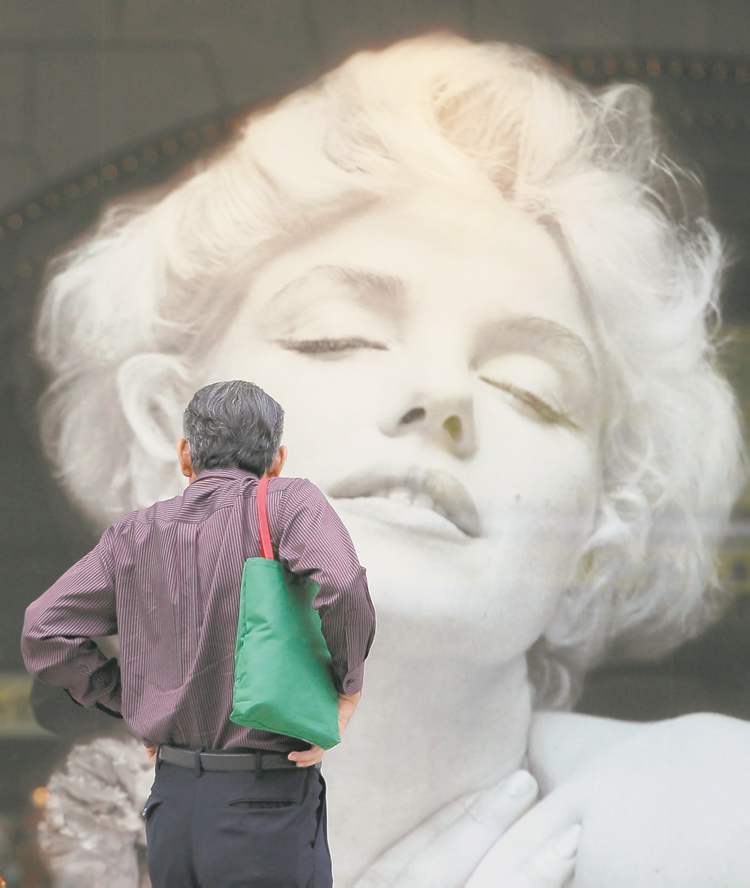
Why is Marilyn Monroe still an icon 50 years after her death? She is endlessly analyzed in films and biographies; her image appears on T-shirts and posters; her popularity is reflected in the 52,000 Marilyn-related items for sale on eBay.
My University of Southern California students, fixated on contemporary pop culture, know little about 1950s Hollywood stars, except for Monroe. Like everyone else, they puzzle over her death, respond to her beauty, recognize her paradoxes: the child-woman, the virgin-whore of the western imagination.
But it is another role — that of shape shifter — that makes her especially relevant. Monroe’s multiple transformations allow each generation, even each individual, to create a Marilyn to their own specifications.
It is well-known that Norma Jeane Dougherty (her name when Hollywood discovered her) actively shaped the person known as Marilyn Monroe after signing a contract with 20th Century Fox in 1946.
But the complexity of the Marilyn that emerged is often overlooked. She wasn’t just split into the shy and angry child Norma Jeane and the exuberant and sexual adult Marilyn Monroe.
“I’ve got many quivers to my bow,” she told her close friend Susan Strasberg. “I can become anyone they want me to be.”
She loved intrigue and playing practical jokes, possessed a self-deprecating wit and had a love-hate relationship with her celebrity status. She used aliases and wore disguises; she had secret friends and secret apartments. A psychologist might say her split self was caused by a childhood spent in 11 homes and an orphanage, and by episodes of childhood sexual abuse.
Such trauma could have fractured her persona and caused her to “dissociate.” We can guess she drew on this dissociation as she shaped her many public personas.
By all reports, Monroe could be shy, with no self-confidence, taking drugs to keep herself on track; or a banshee screaming in anger; or so charismatic that few could resist her. Photographs prove she could be a glamour queen on the order of Marlene Dietrich, or a lost waif who resembled Shirley Temple. On screen she was a convincing “dumb blond” clown; in interviews, an ironist who made fun of dumb blonds; in acting class, a dramatic artist in the making.
When she married baseball great Joe DiMaggio in 1954 and famously promised to give up her career, she was the maternal, domestic Marilyn who liked to cook and clean. When she married playwright Arthur Miller in 1956, she was the intellectual Marilyn who read books and wanted to be a serious actress.
Feminists can claim her because she fought the dictatorial Hollywood moguls and won, standing in the vanguard of the few female stars who created their own production companies. She also took the extraordinary step of publicly describing the sexual abuse visited on her as a child, even though in the 1950s such abuse was likely to be regarded as the fault of the female victim, even if a child.
Naming such abuse was central to 1970s feminism. Post-feminists who dislike victimization theories can point out she participated in her own “sexual objectification” — actively presenting herself as a sex object for men, in tight, low-cut dresses and no underwear. She did so, by the accounts of her friends, because she understood the power such explicit sexuality gave her over men — a post-feminist stance. She also saw it as rebellious, as furthering the sexual revolution that would peak after her death.
As new documents surface, new interpretations of Monroe challenge old conclusions about her and create new complexities. The latest finding, in line with the rise of queer theory and the lesbian, gay, bisexual and transgender movements, is she had lesbian affairs and was bisexual by nature.
Most biographers reject this possibility, but papers at the Academy of Motion Picture Arts and Sciences, combined with a new reading of Monroe’s autobiography, My Story, and revelations in the papers of Ralph Greenson, her last psychoanalyst, suggest it’s true.
In the end, Monroe is one of the most complex female public figures in American history, and that real complexity plays a role in her continuing ability to fascinate us. We admire her beauty, puzzle over her mysteries and see her as a reflection of the quixotic, multifaceted, always striving and often contradictory American character.

In the final analysis, however, we make Marilyn an icon because we can also make her into whatever we want her to be. I think she would be pleased.
Lois Banner, a professor of history and gender studies at the University of Southern California, is the author of American Beauty and the just-published Marilyn: The Passion and the Paradox.
— The Los Angeles Times