

Alcohol quenched Churchill’s thirst for talk
Advertisement
Read this article for free:
or
Already have an account? Log in here »
To continue reading, please subscribe:
Monthly Digital Subscription
$1 per week for 24 weeks*
- Enjoy unlimited reading on winnipegfreepress.com
- Read the E-Edition, our digital replica newspaper
- Access News Break, our award-winning app
- Play interactive puzzles
*Billed as $4.00 plus GST every four weeks. After 24 weeks, price increases to the regular rate of $19.95 plus GST every four weeks. Offer available to new and qualified returning subscribers only. Cancel any time.
Monthly Digital Subscription
$4.99/week*
- Enjoy unlimited reading on winnipegfreepress.com
- Read the E-Edition, our digital replica newspaper
- Access News Break, our award-winning app
- Play interactive puzzles
*Billed as $19.95 plus GST every four weeks. Cancel any time.
To continue reading, please subscribe:
Add Free Press access to your Brandon Sun subscription for only an additional
$1 for the first 4 weeks*
*Your next subscription payment will increase by $1.00 and you will be charged $16.99 plus GST for four weeks. After four weeks, your payment will increase to $23.99 plus GST every four weeks.
Read unlimited articles for free today:
or
Already have an account? Log in here »
Hey there, time traveller!
This article was published 02/02/2013 (4810 days ago), so information in it may no longer be current.
STORIES about Winston Churchill’s fondness for food and drink are legendary, but easily misunderstood, according to a new book by Cita Stelzer called Dinner with Churchill: Policy-Making at the Dinner Table.
There was the time in 1931, when he was being treated at Lenox Hill Hospital in New York City after being hit by a car. He asked his doctor for the following Prohibition-era “prescription.”
“This is to certify that the post-accident convalescence of the Hon. Winston S. Churchill necessitates the use of alcoholic spirits, especially at mealtime. The quantity is naturally indefinite, but the minimum requirements would be 250 cubic centimeters.”
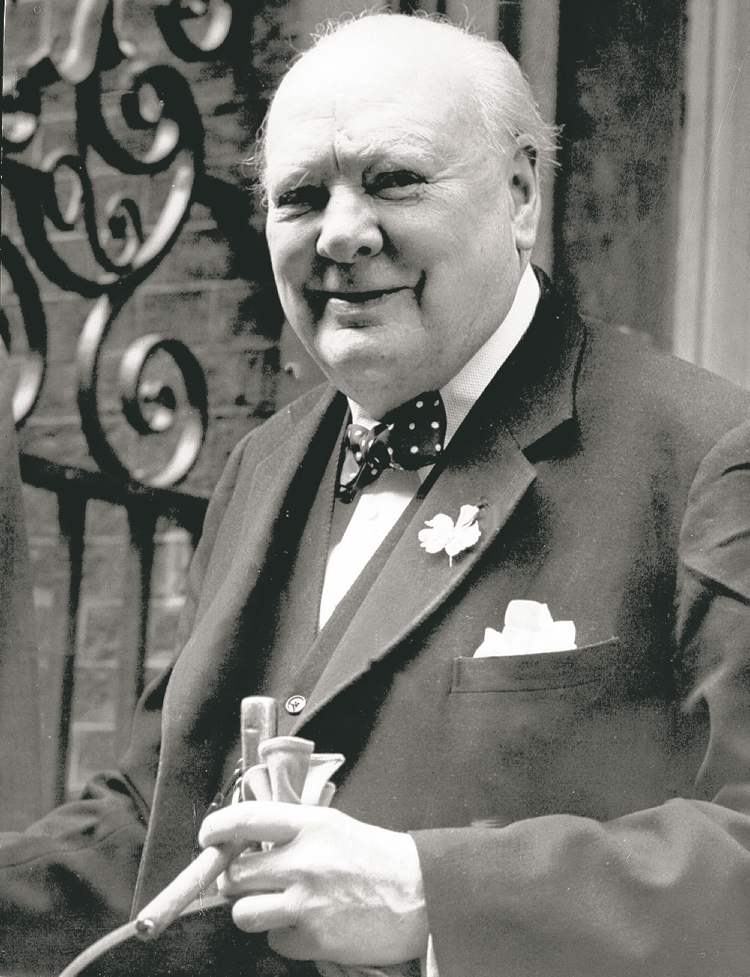
Just weeks after Pearl Harbor, during a clandestine visit to the White House, the beloved and respected butler Alonso Fields was summoned to Churchill’s bedroom. Here’s how Fields remembers his instructions: “Now, Fields, we had a lovely dinner last night, but I have a few orders for you. We want to leave here as friends, right?… I must have a tumbler of sherry in my room before breakfast. A couple of glasses of scotch and soda before lunch, and French champagne and 90-year-old brandy before I go to sleep at night.”
During the war, Churchill routinely hosted dinner parties that began at 8:30 p.m. and ended after a film was shown, concluding after midnight. At that point, the prime minister would say, “Now down to business,” before embarking on work until the wee hours of the morning.
Each sounds deleterious to productive work, but Stelzer told me Churchill was more effective at the dinner table than the conference table.
“I think that Churchill felt that he could do more selling his goals and his purposes at the dinner table face-to-face for several reasons,” Stelzer said. “At Chartwell (his country estate), he designed his own table, and he wanted it round. He wanted nobody at the head. He wanted everybody to share equally in the conversation.
“He also used alcohol and champagne to ease the conversation to relax people so that they could not talk socially, but talk more openly and freely as friends and allies. Also, Churchill always used the ritual of lighting his cigar and smoking it at the end of a dinner to extend the time that the dinner could take so that there would be more time for policy discussion and conversation.”
Perhaps U.S. President Barack Obama could take a few lessons. This sort of socializing doesn’t appear to come naturally to him, though when asked about the insular nature of his White House at a recent news conference, he said, “Most people who know me know I’m a pretty friendly guy… And I like a good party.”
Should he adapt a Churchillian approach, he’ll want to consult the first lady, a healthy-foods advocate, about the menu. “In all my research, I never ran across anything that Churchill mentioned about a green vegetable,” Stelzer told me.
When Obama does extend himself, his overtures need to be reciprocated by his political foes. ABC News recently reported House Speaker John Boehner has turned down an invitation to every formal state dinner Obama has held — six in total. Senate Minority Leader Mitch McConnell turned down at least two. When, in 2011, the White House held a reception for new members of Congress, only 27 of the 87 new Republican House members showed up.
Churchill would have seized such occasions to conduct business.
“Churchill had a purpose for every lunch and every dinner that he had,” Stelzer said. “He was always working, and when he was setting up something — dinner with President Roosevelt or Truman or Stalin — he had in mind goals he wanted from them.”
What lessons could today’s leaders learn from Churchill?
“Churchill had been an anti-Bolshevik all his life, very public, aggressive speeches against the Soviet Union,” Stelzer said. “But once Hitler attacked the Soviet Union in June (1941), Churchill realized that the Soviet Union was suddenly an ally, and, in spite of his distaste for Stalin and that way of governing, he realized that he would have to sit down face-to-face with this man or, as he put it, ‘face the bear in his lair,’ and go and meet with him and try to work out an arrangement where the new allies could work together to beat Hitler’s fascism. It seems to me that the politicians today are not willing to do that.”
Perhaps the value of such collegiality was best summed up by Leon Kass in The Hungry Soul: Eating and the Perfecting of our Nature.

“So too with friendship, whose beginnings are made possible by dinner, the shared meal itself grounds our being together. Amiability and friendliness are required and shared around the table. But it is the community of stories in conversation that is the true communion. Fellow diners get to know each other’s minds and hearts, even though no one is explicitly baring his soul or trafficking in personal matters. We are drawn to those whose tastes and tales we find admirable. We arrange to dine with them again on another occasion.”
Michael Smerconish writes for the Philadelphia Inquirer.
—McClatchy Tribune Services