

Philippines’ early warning
Advertisement
Read this article for free:
or
Already have an account? Log in here »
To continue reading, please subscribe:

Digital Subscription
One year of digital access for only $205*
- Enjoy unlimited reading on winnipegfreepress.com
- Read the E-Edition, our digital replica newspaper
- Access News Break, our award-winning app
- Play interactive puzzles
*First annual payment billed as $205.00 + GST for one year. This annual subscription will automatically renew at $233.00 + GST every 52 weeks (10% off the regular annual price of $259.35). Offer available to new and qualified returning subscribers only. Cancel any time.
To continue reading, please subscribe:
Add Free Press access to your Brandon Sun subscription for only an additional
$1 for the first 4 weeks*
- Enjoy unlimited reading on winnipegfreepress.com
- Read the E-Edition, our digital replica newspaper
- Access News Break, our award-winning app
- Play interactive puzzles
*Your next Brandon Sun subscription payment will increase by $1.00 and you will be charged $17.95 plus GST for four weeks. After four weeks, your payment will increase to $24.95 plus GST every four weeks.
Read unlimited articles for free today:
or
Already have an account? Log in here »
Hey there, time traveller!
This article was published 15/11/2013 (4642 days ago), so information in it may no longer be current.
SDLqWE’VE been telling the rest of the world we don’t want what’s happening to us to happen to everyone else,” said Lucille L. Sering, the vice-chairwoman of the Philippines’ Climate Commission, as the country struggled to cope with the aftermath of typhoon Haiyan. “This is your early warning system… we will all eventually be victims of this phenomenon.”
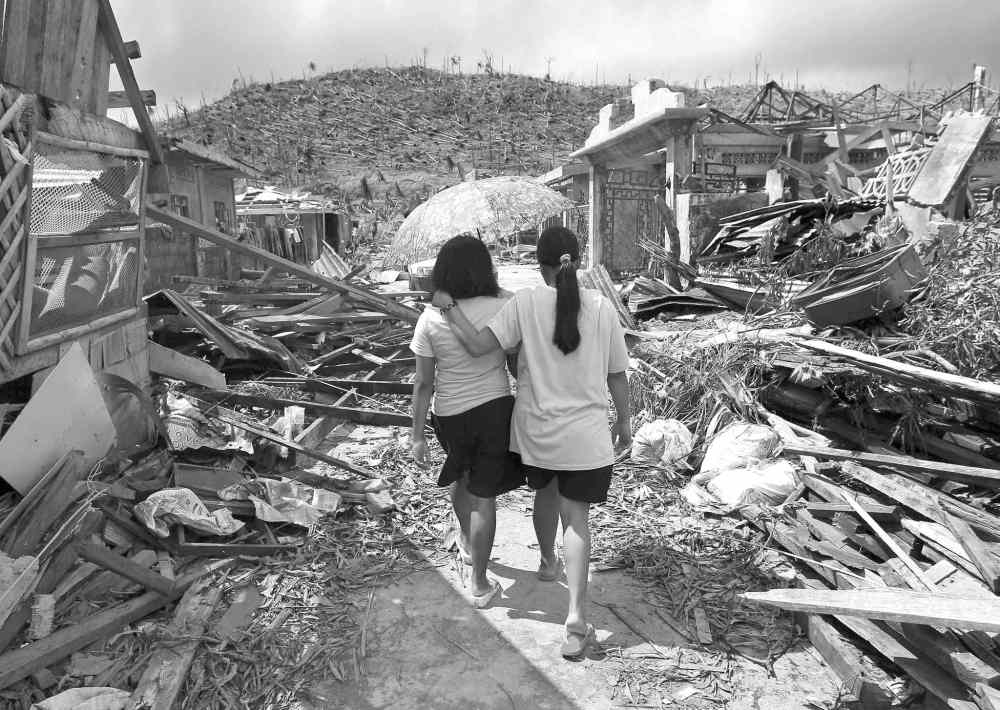
A full week after the typhoon roared through the eastern Visayas, the number of people killed is still unknown. Ten thousand dead is the number being used in the media, but the area around Tacloban city alone may have lost that many. Many other parts of Samar and Leyte islands are still inaccessible to both media and aid workers.
But the question people will be asking elsewhere is: will we really all become victims of this and similar phenomena? Is this truly an early warning of storms so big and strong they will change the way we live? The answer, of course, is maybe.
As scientists always hasten to explain, you can never attribute a particular weather event to climate change with complete confidence. Normal variations in the weather include occasional extreme events as destructive as all but the very worst storms that you would see in a world that was, say, 2 C (3.5 F) warmer. The difference is in a warmer world, you will see a lot more of these extreme events.
But consider this. The Philippines is the most-exposed large country in the world to tropical cyclones. Their tracks most often take them across northern Luzon or the eastern Visayas, and about six to nine of them make landfall each year. They do a lot of damage, but by and large Filipinos have learned to ride them out. However, you cannot just ride out something as big as Haiyan.
What did most of the killing in Samar and Leyte last week was not the high winds (although they stripped off almost every roof in the affected areas). It was the “storm surge” that submerged coastal regions to the height of a two-storey building. The pressure at the centre of the typhoon was so low a “hump” of water six metres high was pushed up beneath the eye and travelled with it.
Shelters are not much good against that sort of thing unless (as in Bangladesh) you start building them on elevated platforms. Even then, you may decide you want to move elsewhere if your city is going to be inundated and destroyed every 10 years or so. The east coast of Luzon is very sparsely populated for precisely this reason, and this may be the future that awaits the eastern Visayas as well if storms of this scale become more frequent.
The very worst typhoon that hit the Philippines since detailed records began in the 19th century was Thelma, which killed about 5,100 people in 1991. But of the next worst nine, all of which killed over a thousand people, six have happened in the past decade: 2004, 2006, 2008, 2011, 2012, and 2013.
So Haiyan may really be an early warning of what is to come, not just for the Philippines but for China and Japan, Burma and Bangladesh, the Windward Islands and Florida — indeed, for any coastal area that is within 1,000 kilometres of the usual tracks of tropical storms. And at some point, people will decide that it’s just not worth living in such constant danger. They will become, for want of a better word, “climate refugees.”

In some areas, it will be frequent mega-storms that drive them out. In other areas it will be drought and desertification, or heat so great it kills the crops people depend on. There are going to be a lot of refugees, and not many places willing to let them in.
Lucille Sering is right: this is an early warning of how the warming will unfold, and what the impacts on human societies will be. But we are getting lots of early warnings, and so far we are managing to ignore them all.
Gwynne Dyer is an independent journalist whose articles are published in 45 countries.
Related Articles
Manitoba to speed application process for Filipino immigrants

Advertisement Advertise With Us
Advertisement Advertise With Us