

Irony in placement of Gandhi statue near British Parliament
Advertisement
Read this article for free:
or
Already have an account? Log in here »
To continue reading, please subscribe:

Digital Subscription
One year of digital access for only $205*
- Enjoy unlimited reading on winnipegfreepress.com
- Read the E-Edition, our digital replica newspaper
- Access News Break, our award-winning app
- Play interactive puzzles
*First annual payment billed as $205.00 + GST for one year. This annual subscription will automatically renew at $233.00 + GST every 52 weeks (10% off the regular annual price of $259.35). Offer available to new and qualified returning subscribers only. Cancel any time.
To continue reading, please subscribe:
Add Free Press access to your Brandon Sun subscription for only an additional
$1 for the first 4 weeks*
- Enjoy unlimited reading on winnipegfreepress.com
- Read the E-Edition, our digital replica newspaper
- Access News Break, our award-winning app
- Play interactive puzzles
*Your next Brandon Sun subscription payment will increase by $1.00 and you will be charged $17.95 plus GST for four weeks. After four weeks, your payment will increase to $24.95 plus GST every four weeks.
Read unlimited articles for free today:
or
Already have an account? Log in here »
Hey there, time traveller!
This article was published 09/07/2014 (4452 days ago), so information in it may no longer be current.
WASHINGTON — The British government announced this week that it will install a statue of Indian independence icon Mahatma Gandhi opposite Parliament alongside statues of other pioneering statesmen, including Nelson Mandela and Abraham Lincoln. The statue is scheduled to be unveiled next spring to mark the centennial of Gandhi’s return to India from South Africa, where the then-young lawyer had begun cultivating his ideas about self-rule and civil disobedience.
“As the father of the largest democracy in the world, it’s time for Gandhi to take his place in front of the mother of Parliament,” said Britain’s chancellor of the exchequer, George Osborne. “He is a figure of inspiration, not just in Britain and India, but around the world.”
That’s certainly true. Gandhi statues have proliferated all over the world, from his homeland to New York City’s Union Square and many parks and squares in between.
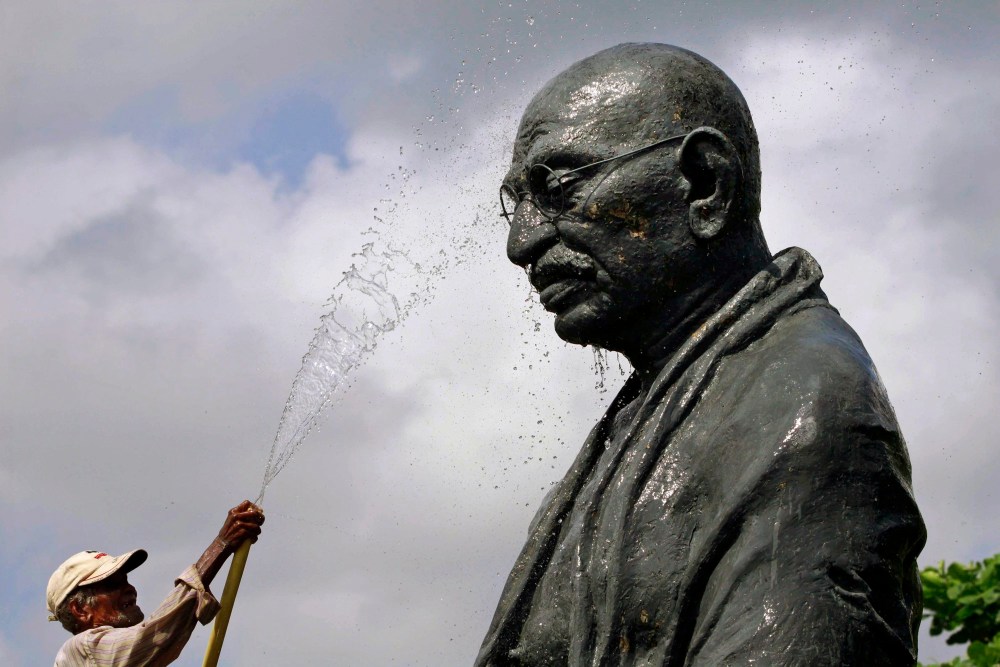
But there’s an undeniable irony in placing a statue of Gandhi before an institution he struggled against for decades.
India’s parliamentary democracy may draw directly from the Westminster model — Osborne’s “mother of Parliament” — but that is hardly a political system Gandhi considered ideal. His vision for Indian democracy involved something built from the country’s myriad villages, a decentralized, grass-roots politics that drew its power from the freedom of every individual, not from the monuments and gilded halls of the capital. It was a worldview that was as spiritual as it was political. And it certainly didn’t owe a debt to the British Parliament, the Magna Carta or any other founding institution of Britain’s own democracy.
The announcement of the new Gandhi statue comes at a time when Britain is seeking to improve trade and economic ties with India and the newly elected government of Prime Minister Narendra Modi. But that eagerness to deepen links with India — as well as pander to voters of Indian origin at home — constantly rubs against debates about the injustices of Britain’s imperial past.
In recent years, British Prime Minister David Cameron has had to tip-toe awkwardly around the long-standing Indian demand for the return of the Koh-i-Noor diamond, captured in 1850 and eventually lodged in the queen mother’s crown that’s on display in the Tower of London. Last year, Cameron made a non-apology during a visit to the northern Indian city of Amritsar, where hundreds of Indian protesters were fatally shot by British troops in 1919.
The incident was memorialized in the 1982 Oscar-winning film Gandhi, but Cameron did not formally apologize for the massacre, only describing it as a “deeply shameful event.”

On one hand, this is understandable. If Britain’s prime minister formally apologized for one slaughter in one corner of its lapsed empire, there would be demands for similar overtures for atrocities elsewhere. Given the scale of the British empire — and how much blood it arguably has on its hands — that would warrant a seemingly endless, probably untenable apology tour on the part of the British premier.
But it would be fitting if the presence of Gandhi’s gaunt figure outside the halls of Westminster served as a permanent reminder of Britain’s darker legacy.
Tharoor writes about foreign affairs for The Washington Post. He previously was a Senior Editor at Time magazine, based first in Hong Kong and later in New York.