

Scottish revolt on conservatives
Advertisement
Read this article for free:
or
Already have an account? Log in here »
To continue reading, please subscribe:
Monthly Digital Subscription
$1 per week for 24 weeks*
- Enjoy unlimited reading on winnipegfreepress.com
- Read the E-Edition, our digital replica newspaper
- Access News Break, our award-winning app
- Play interactive puzzles
*Billed as $4.00 plus GST every four weeks. After 24 weeks, price increases to the regular rate of $19.95 plus GST every four weeks. Offer available to new and qualified returning subscribers only. Cancel any time.
Monthly Digital Subscription
$4.99/week*
- Enjoy unlimited reading on winnipegfreepress.com
- Read the E-Edition, our digital replica newspaper
- Access News Break, our award-winning app
- Play interactive puzzles
*Billed as $19.95 plus GST every four weeks. Cancel any time.
To continue reading, please subscribe:
Add Free Press access to your Brandon Sun subscription for only an additional
$1 for the first 4 weeks*
*Your next subscription payment will increase by $1.00 and you will be charged $16.99 plus GST for four weeks. After four weeks, your payment will increase to $23.99 plus GST every four weeks.
Read unlimited articles for free today:
or
Already have an account? Log in here »
Hey there, time traveller!
This article was published 13/09/2014 (4222 days ago), so information in it may no longer be current.
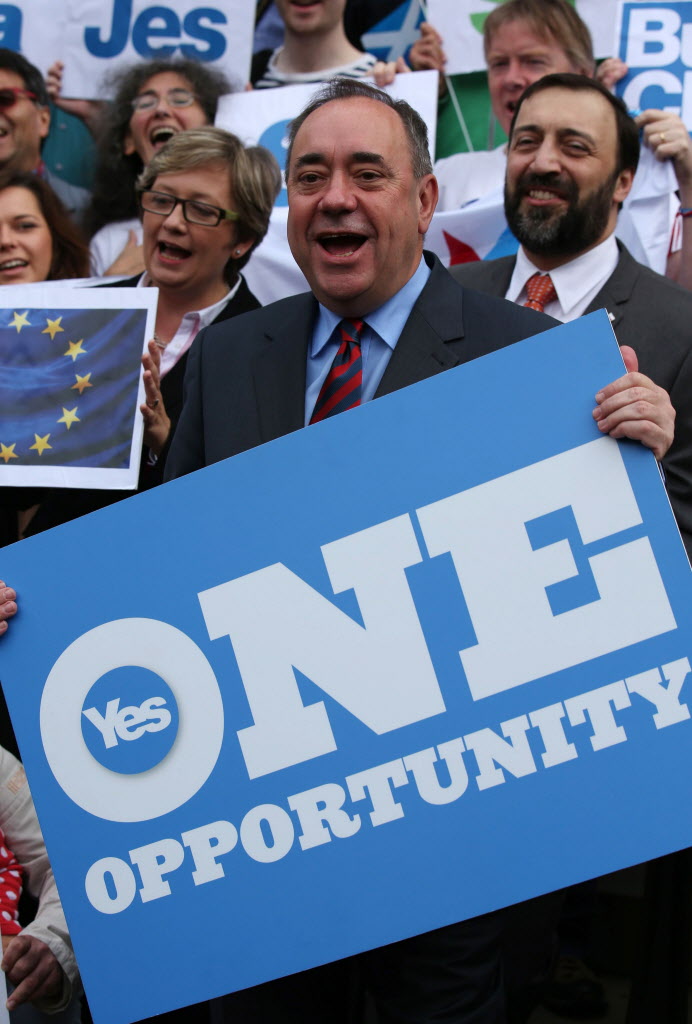
If the Scots vote Yes to independence on Thursday, as one poll suggests they will, three things are likely to happen in the following week.
First, David Cameron may cease to be the leader of the Conservative Party and the prime minister of the U.K. He would be removed by his own Conservative MPs, who would hold him responsible for allowing the break-up of a very successful union that has lasted 307 years.
Secondly, the British pound would start to fall against other currencies, not because Scottish independence would necessarily be an economic disaster for the rest of the U.K., but because the markets hate uncertainly.
To prevent a serious decline of the pound, the British government would have to act on its pre-referendum warnings that a post-independence Scottish government could not have any say in managing the currency. Nobody can stop the Scots from using the pound if they want (and the Yes campaigners say they will), but they would be using it the same way that Panama and Liberia use the U.S. dollar. No control over interest rates or anything else.
And thirdly, Spain would block automatic membership in the EU for an independent Scotland (perhaps with support from some other EU members). Maybe Scotland could become a member eventually, but at least it would have to join the end of the queue for membership and go through years of convoluted negotiations. And it would have to accept the euro as its currency.
The Spanish government has already said it would insist on this, because the Spanish province of Catalonia is holding its own (unauthorized) referendum on independence in November. Madrid has veto power, and it is determined to show that breaking up an existing EU country is not easy or painless.
On the other hand, it would not be like South Sudan or East Timor: there would be no bloodshed and no refugees. Some businesses, particularly banks, would move their head offices from Scotland to England, but in five or 10 years the Scots would stop blaming England for all their problems and start blaming their own politicians. And the English would simply have forgotten Scotland.
The right question in this situation, therefore, is not “What will happen if…?” Nothing very extreme would happen, although Scotland is unlikely to enjoy the economic and cultural boom that First Minister Alex Salmond, who called the referendum on independence, frequently predicts. The better question is “How did it end up like this?”
The real grievance that fuels Scotland’s independence movement is the fact that Britain keeps electing governments that are either explicitly Conservative or (like Tony Blair’s three terms in office) conservative in all but name. They take Britain into stupid foreign wars, and they impose austerity on ordinary British people while looking after the rich.

Scots see themselves as more socially conscious and more egalitarian, and there is some truth in that view. (Only one of Scotland’s 59 members of the British Parliament is a Conservative.) So the “Yes” campaign argues that the only way to avoid perpetual rule by Margaret Thatcher clones in London is to break away and build a separate Scottish state.
That argument is getting a lot of traction in Scotland at the moment, and voting intentions have swung from 61 per cent for No and 39 per cent for Yes in early August to a knife-edge (49 per cent No, 51 per cent Yes) in one of this week’s polls. The other recent polls still show a small advantage for the No’s, but it could go either way.
If it goes Yes, then the change is forever, and everybody will just have to live with it. But since Scotland’s current dissatisfaction with the Union is mainly about the political colour of recent British governments, a No to independence might also be permanent. A couple of genuinely left-wing British governments and a strong economic recovery (which is actually happening), and the whole thing might blow over.
Gwynne Dyer is an independent journalist whose articles on world affairs are published in 45 countries.