

The circuitous path of Meech Lake
Advertisement
Read this article for free:
or
Already have an account? Log in here »
To continue reading, please subscribe:
Digital Subscription
One year of digital access for only $1.44 a week*
- Enjoy unlimited reading on winnipegfreepress.com
- Read the E-Edition, our digital replica newspaper
- Access News Break, our award-winning app
- Play interactive puzzles
*Billed as $5.77 plus GST every four weeks. After 52 weeks, price increases to the regular rate of $19.95 plus GST every four weeks. Offer available to new and qualified returning subscribers only. Cancel any time.
To continue reading, please subscribe:
Add Free Press access to your Brandon Sun subscription for only an additional
$1 for the first 4 weeks*
- Enjoy unlimited reading on winnipegfreepress.com
- Read the E-Edition, our digital replica newspaper
- Access News Break, our award-winning app
- Play interactive puzzles
*Your next Brandon Sun subscription payment will increase by $1.00 and you will be charged $17.95 plus GST for four weeks. After four weeks, your payment will increase to $24.95 plus GST every four weeks.
Read unlimited articles for free today:
or
Already have an account? Log in here »
Hey there, time traveller!
This article was published 12/06/2015 (4012 days ago), so information in it may no longer be current.
Manitoba’s participation in the Meech Lake accord followed a circuitous path from the beginning. It had been signed originally by Howard Pawley on April 27, 1987. The former premier had not introduced it for debate in the Manitoba legislature when his government fell in March 1988. It therefore became part of the unfinished business to be dealt with by our minority Conservative government, which was elected on April 25, 1988. Our government had taken no firm position on the accord during the election campaign, but introduced a motion in the legislature to approve the accord on Dec. 16, 1988.
The day I introduced the motion, the Supreme Court of Canada struck down the Quebec Language Law, and then-premier Robert Bourassa, in response to a huge uproar both in the Quebec legislature and in the public, said his government would consider employing the notwithstanding clause to restore the law.
I immediately phoned Bourassa, who left his caucus meeting to take my call, to urge him not to utilize the notwithstanding clause as I believed it would stir up a strong negative response in our province and would jeopardize the chances of our passing the accord.
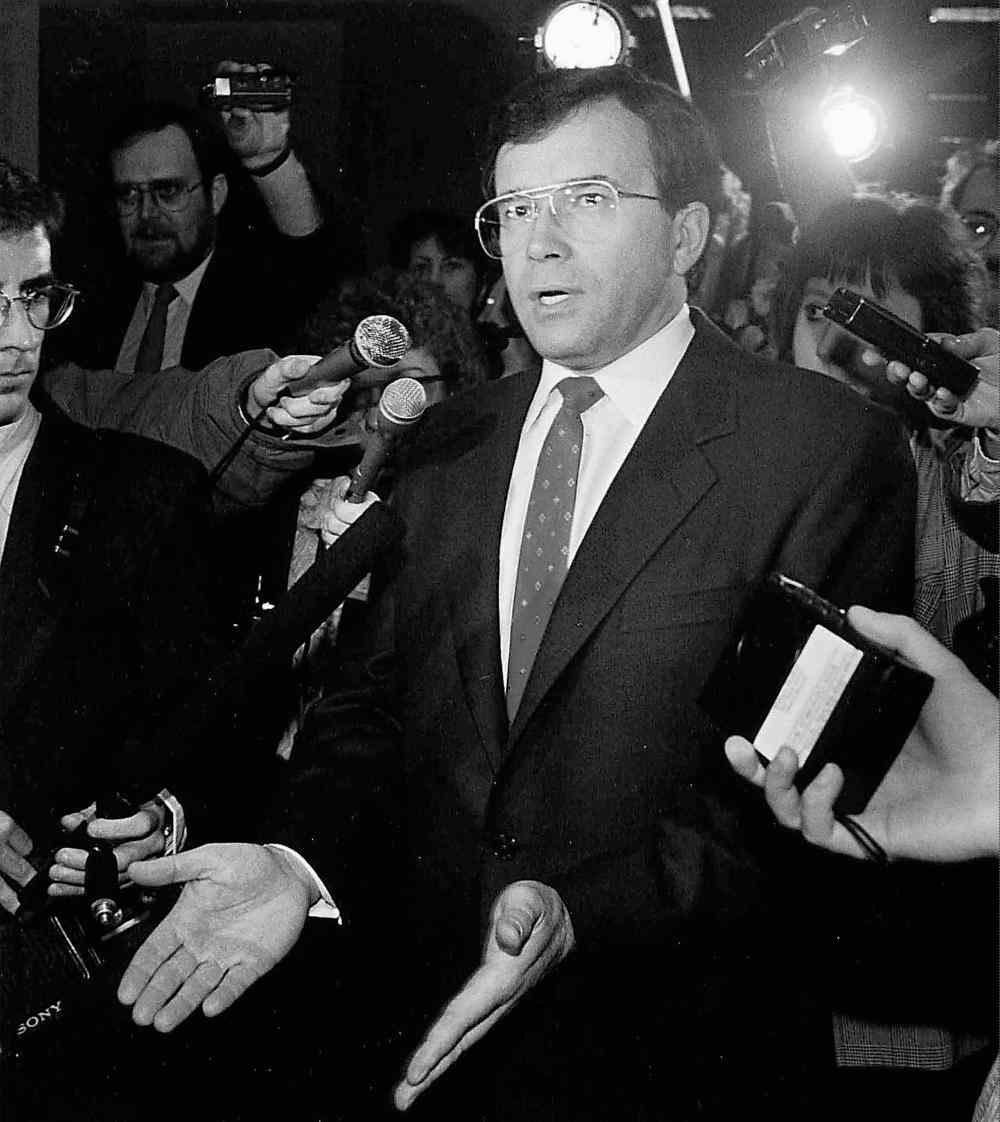
Given we were in a minority government, I indicated the chance of passing the resolution was questionable and if he announced he would be employing the notwithstanding clause, I would likely withdraw the resolution from debate.
Bourassa replied “I’ll do what I have to do Gary, and you do what you have to do.” I withdrew the resolution the following Monday and that began an 18-month process of meetings, discussions and debates both in Manitoba and across the country.
Because we were a minority government, I knew we would not be able to pass the accord without the support of other parties. The Liberals, led by Sharon Carstairs, had campaigned against the accord and were adamantly opposed.
The New Democrats, despite the fact Howard Pawley had signed the accord, were now having second thoughts under the new leadership of Gary Doer.
I decided to strike an all-party committee, with a non-partisan chairman, Prof. Wally Fox-Decent, to travel the province, hold public hearings and then report back to the legislature with recommendations.
The resulting report recommended we not approve the accord without significant changes. This became the major stumbling block to passage of the accord in Canada.
Manitoba thus joined New Brunswick, where the government of Frank McKenna also refused to pass the accord, which had been signed by former premier Richard Hatfield.
Later in the spring of 1989, Clyde Wells replaced premier Brian Peckford who had signed the accord and passed it in Newfoundland’s legislature. Wells was an outspoken opponent of Meech, and his government passed a resolution rescinding its approval.
For the next year, representatives of the Mulroney government in Ottawa and the Bourassa government in Quebec travelled to Manitoba, New Brunswick and Newfoundland to try to persuade us to pass the accord. In Manitoba, the opposition intensified and emotions ran high.
Ultimately, as the deadline for approval of the accord (June 23, 1990) drew near, Mulroney called a last-ditch meeting in Ottawa with all 10 premiers in attendance to discuss a resolution to the impasse. I invited Carstairs, Doer along with Fox-Decent, then-attorney general Jim McCrae and senior staff and our constitutional lawyers to travel with me to Ottawa. This was important because no final decision could be made without the support of a majority of votes in the legislature. And although Carstairs and Doer could not attend the discussions with the prime minister and other premiers, I could fully brief them each day to keep them in the loop. On occasion, the three of us met with Bourassa and some of his people.
After almost seven days of meetings, a compromise agreement was reached on June 10, whereby the issues the Manitoba all-party committee had raised were placed in a parallel agreement to the accord as opposed to direct amendment (which was unacceptable to Quebec).
This package was to be introduced in the Manitoba legislature on June 12, immediately upon our return to the province. The difficulty was, we had only 12 days in which to pass the resolution and we were not in session. Notice had to be given to reconvene the legislature to introduce the resolution as well as to pass first reading, to introduce second reading, to hold public hearings, to pass second reading and to introduce and pass third reading.

Each element of the process normally required anywhere from 48 hours to 72 hours’ notice before proceeding, unless there was unanimous consent of all 57 members of the legislature to waive the rules and allow a speedy passage.
One member, Elijah Harper, refused to give his consent. Hundreds of Manitobans signed up to speak in opposition to the accord at the committee stage, but it never got to that point.
There was a further option that was demanded of us by the prime minister — to impose a “speed-up” motion to waive the normal time requirements and set aside the Manitoba legislative process. I had earlier told the prime minister on such a critical matter as a constitutional amendment, I would never impose closure on debate by using this tactic. I rejected his approach, and the accord died at midnight June 23, 1990, because it had failed to receive approval in all 10 legislatures in Canada.
Gary Filmon was premier of Manitoba from May 1988 until October 1999. He is a corporate director and lives in Winnipeg.
Related Articles
Constitutional lessons far from over
Advertisement Advertise With Us
Advertisement Advertise With Us