

Happy 800th, Magna Carta
Much to King John's surprise
Advertisement
Read this article for free:
or
Already have an account? Log in here »
To continue reading, please subscribe:
Digital Subscription
One year of digital access for only $1.44 a week*
- Enjoy unlimited reading on winnipegfreepress.com
- Read the E-Edition, our digital replica newspaper
- Access News Break, our award-winning app
- Play interactive puzzles
*Billed as $5.77 plus GST every four weeks. After 52 weeks, price increases to the regular rate of $19.95 plus GST every four weeks. Offer available to new and qualified returning subscribers only. Cancel any time.
To continue reading, please subscribe:
Add Free Press access to your Brandon Sun subscription for only an additional
$1 for the first 4 weeks*
- Enjoy unlimited reading on winnipegfreepress.com
- Read the E-Edition, our digital replica newspaper
- Access News Break, our award-winning app
- Play interactive puzzles
*Your next Brandon Sun subscription payment will increase by $1.00 and you will be charged $17.95 plus GST for four weeks. After four weeks, your payment will increase to $24.95 plus GST every four weeks.
Read unlimited articles for free today:
or
Already have an account? Log in here »
Hey there, time traveller!
This article was published 15/06/2015 (4039 days ago), so information in it may no longer be current.
Talk about bad press. For the past eight centuries, few English monarchs have been vilified in popular legend, books, plays films, and even a Disney cartoon movie, as much as King John, who reigned from 1199 to 1216.
He has been portrayed as an evil tyrant and a lecherous ruler; in 1200, at 34 years old, he married Isabella, who was 12.
In 2001, the British documentary The Most Evil Men and Women in History included John in a hall of infamy with Attila the Hun, Vlad the Impaler, Adolf Hitler and Joseph Stalin and other nefarious despots.
In attempting to usurp the power of his brother King Richard the Lionheart, who was off fighting the crusades, John also became one of the chief villains in the Robin Hood stories, though if there was such a character he likely lived long after John had died.
King John’s greatest legacy was a moment of surrender, if only temporary from his perspective: 800 years ago, in June 1215, he acceded to the demands of a group of rebel barons and gave royal assent to Magna Carta, the Great Charter, which laid the foundation for due process and the rule of law.
John likely would be surprised that Magna Carta endured and became “a symbol of freedom from oppression.” As a fourth son of Henry II, John beat the odds when he was crowned king after his brother Richard died. King John’s reign was fraught with crises. He fought a war with France and lost much of the long-held English territory in Normandy and Anjou. He also feuded with Pope Innocent III, so much so he became the first English monarch to be excommunicated. Then, he appropriated church property and coerced his bishops to purchase the land back from him at a sizable profit.
For many years, the English nobility begrudgingly accepted John’s autocratic style and forked over the taxes he demanded to finance the war against France. But following a military defeat in 1213, a minority of the barons rebelled. A meeting in January 1215 between the king and the unhappy barons solved nothing. By early May, a civil war had broken out and the rebel barons soon controlled London.
Faced with more conflict, King John agreed to further peace negotiations. The barons presented him with a charter written in Latin containing 63 clauses dealing with everything from their property rights to standardized measurements for wine, ale and corn, to rules governing debt repayment to Jewish moneylenders. On June 15, 1215, the king affixed his seal on the Great Charter at Runnymede, west of London.
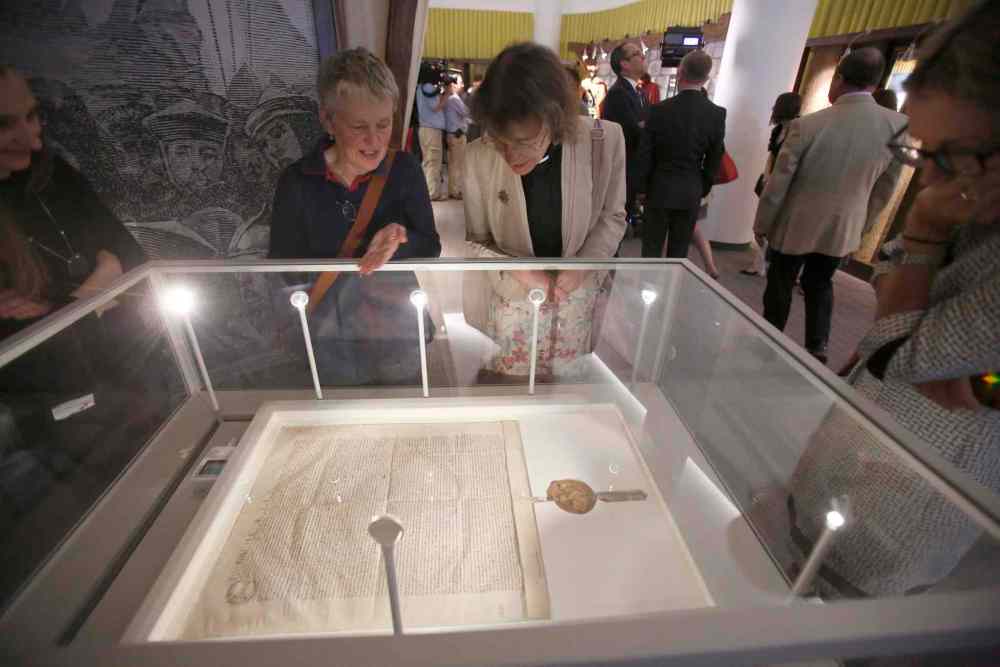
During her visit to Winnipeg in July 2010, Queen Elizabeth presented the Canadian Museum for Human Rights with a cornerstone from the fields of Runnymede. And, this summer (Aug. 15 to Sept. 18) four copies of the original Magna Carta (of the 30 or so made at the time) will be displayed at the CMHR as part of a travelling exhibit to commemorate the charter’s 800th anniversary.
Magna Carta curtailed the king’s arbitrary power. Arguably, the most significant clause was No. 39, which stated that “no free man shall be seized or imprisoned, or stripped of his rights or possessions, or outlawed or exiled, or deprived of his standing in any way, nor will we proceed with force against him, or send others to do so, except by the lawful judgment of his equals or by the law of the land.”
Other clauses stipulated that “free men” — of which many Englishmen were not in the 13th century — were entitled to speedy justice, trial by jury of one’s peers, and it declared that in the future “no official shall place a man on trial upon his own unsupported statement, without producing credible witnesses to the truth of it.” The charter also included the first significant declaration of women’s rights by protecting a widow’s property rights.

These legal rights became the basis of English common law and influenced the American Bill of Rights, the French Declaration of the Rights of Man and of the Citizen, the United Nations’ Universal Declaration of Human Rights and the Canadian Charter of Rights and Freedoms.
Ironically, King John had no intention of honouring the charter after he assented to it and merely used it as a stalling tactic, according to British historian Mike Ibeji. John planned “to demonstrate his reasonableness to the undecided baronial majority in the run-up to inevitable hostilities. It was a bargaining chip: nothing more,” says Ibeji.
By November 1215, with the king in control again, the Magna Carta was in trouble. John’s death in October 1216 from dysentery changed the dynamic. Officials in charge of his young son, now Henry III, issued a revised version of Magna Carta. This act made allies of the rebel barons and subsequently stopped a French invasion. As Ibeji adds, King John’s death saved England and ensured the principles of Magna Carta would prevail.
Now & Then is a column in which historian Allan Levine puts the events of today in a historical context.
History
Updated on Monday, June 15, 2015 7:38 AM CDT: Replaces photo