

Trudeau must get tough on Putin
Advertisement
Read this article for free:
or
Already have an account? Log in here »
To continue reading, please subscribe:
Monthly Digital Subscription
$1 per week for 24 weeks*
- Enjoy unlimited reading on winnipegfreepress.com
- Read the E-Edition, our digital replica newspaper
- Access News Break, our award-winning app
- Play interactive puzzles
*Billed as $4.00 plus GST every four weeks. After 24 weeks, price increases to the regular rate of $19.95 plus GST every four weeks. Offer available to new and qualified returning subscribers only. Cancel any time.
Monthly Digital Subscription
$4.99/week*
- Enjoy unlimited reading on winnipegfreepress.com
- Read the E-Edition, our digital replica newspaper
- Access News Break, our award-winning app
- Play interactive puzzles
*Billed as $19.95 plus GST every four weeks. Cancel any time.
To continue reading, please subscribe:
Add Free Press access to your Brandon Sun subscription for only an additional
$1 for the first 4 weeks*
*Your next subscription payment will increase by $1.00 and you will be charged $16.99 plus GST for four weeks. After four weeks, your payment will increase to $23.99 plus GST every four weeks.
Read unlimited articles for free today:
or
Already have an account? Log in here »
Hey there, time traveller!
This article was published 01/11/2015 (3821 days ago), so information in it may no longer be current.
Canada’s federal election returned the Liberals to centre stage and relegated the Conservatives to the Opposition. Given the shift, what are the implications for Canada’s foreign policy regarding Ukraine?
Here, Prime Minster Stephen Harper often punched above Canada’s weight by making Ukraine’s just fight for sovereignty and territorial integrity one of Canada’s central foreign policy issues. Canada was noticed and praised for standing up to the bully.
For example, in 2011, when Russia’s expansionism would have brought laughter from seasoned diplomats to worries from Ukraine’s patriots, the prime minister telephoned then-president Viktor Yanukovych to remind him to respect the rule of law and release illegally incarcerated prime minister Yulia Tymoshenko.
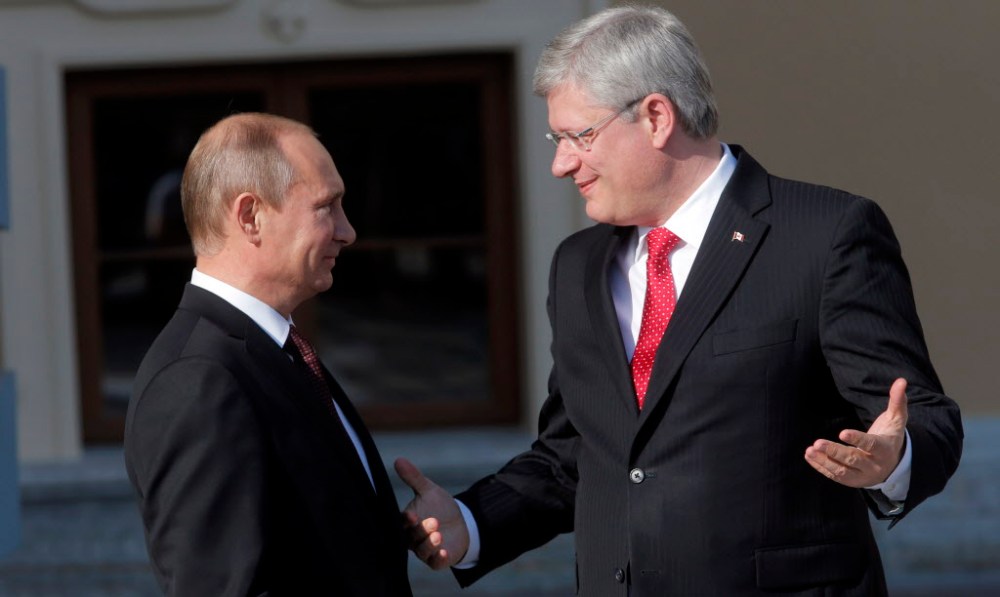
Harper visited Maidan in visible support to protests against government corruption. After Russia’s soldiers moved on Crimea, he denounced the aggression and clearly stated Canada’s position against recognizing the illegal annexation. His government stood firmly behind Ukraine’s defence of its sovereignty and territorial integrity against its gigantic neighbour’s military invasion.
Russia’s invasion came in response to Ukraine’s choice to move toward European integration rather than closer association with Russia. It has killed 7,000, wounded nearly 14,000 and displaced 1.5 million.
To assist in this political and humanitarian crisis, the Conservatives committed $700 million with a large part earmarked for fighting corruption, indispensable to stabilizing Ukraine and diminishing the grip of Russia-controlled oligarchs still exercising political control.
Canada also supported the rogue state’s exclusion from the G8 where President Vladimir Putin’s aggression stood in marked contrast to democratic values of the other members. Harper took an unprecedented step. He told Putin to “get out of Ukraine.” This was a show of confidence for Canada, a moral boost for Ukraine and a public shaming of the man who wants to make Russia great by resorting to global chaos.
During the election campaign, prime minister-designate Justin Trudeau also promised to be tough with Russia. Trudeau stated Russia is “dangerous” to eastern Europe and “provocative” in the Arctic. He believes “Canada needs to continue to stand strongly with the international community pushing back against the bully.”
Furthermore, the Liberal government promises to deal with Russia and press for the release of Ukraine’s political prisoners, including most famously the Russia-kidnapped pilot Nadia Savchenko. As well, it wants the removal of Russia from the global banking system that allows money to flow internationally.

These are good reasons to believe he will continue backing Ukraine. He will be helped by 188 elected Liberals including seasoned pro-Ukraine members such as former minister Ralph Goodale and Winnipeg’s Kevin Lamoureux.
Canada elected 11 MPs of Ukrainian descent. Among them are six from the west; three from Manitoba including the well-respected Conservative and former parliamentary secretary for defence James Bezan (Selkirk-Interlake) along with two Liberals Terry (Taras) Duguid (Winnipeg South) and Mary Ann Mihychuk (Kildonan-St. Paul).
Now’s the time for Trudeau to make good on his election promises. He can start by holding Putin to international law, and here he is in an enviable position. Based on the Munk foreign-policy debates held during the election campaign, he should have no trouble getting approval of his plans in the House of Commons. All leaders agreed Russia’s aggression must stop.
Oksana Bashuk Hepburn, a former Government of Canada senior policy adviser, is a co-founder of the Canadian Group for Democracy in Ukraine.