

Look West, Hydro
Western provinces natural market for Manitoba power
Advertisement
Read this article for free:
or
Already have an account? Log in here »
To continue reading, please subscribe:

Digital Subscription
One year of digital access for only $205*
- Enjoy unlimited reading on winnipegfreepress.com
- Read the E-Edition, our digital replica newspaper
- Access News Break, our award-winning app
- Play interactive puzzles
*First annual payment billed as $205.00 + GST for one year. This annual subscription will automatically renew at $233.00 + GST every 52 weeks (10% off the regular annual price of $259.35). Offer available to new and qualified returning subscribers only. Cancel any time.
To continue reading, please subscribe:
Add Free Press access to your Brandon Sun subscription for only an additional
$1 for the first 4 weeks*
- Enjoy unlimited reading on winnipegfreepress.com
- Read the E-Edition, our digital replica newspaper
- Access News Break, our award-winning app
- Play interactive puzzles
*Your next Brandon Sun subscription payment will increase by $1.00 and you will be charged $17.95 plus GST for four weeks. After four weeks, your payment will increase to $24.95 plus GST every four weeks.
Read unlimited articles for free today:
or
Already have an account? Log in here »
Hey there, time traveller!
This article was published 24/11/2015 (3949 days ago), so information in it may no longer be current.
For historic reasons, electric power tends to be transmitted north/south within provinces, with any extra power being exported to the United States. However, shale natural gas along with a general decline in the cost of fossil fuels worldwide has made Canadian electricity less attractive to Americans. This can become a huge advantage for our country. If we can invest in creating an east-west electrical grid, we can generate and transmit the cheapest and cleanest power in the world.
The best place to start is on the Prairies. Federal infrastructure money set aside by the previous federal government or new promised infrastructure dollars from the new federal government could help sweeten the deal.
There are three main perspectives to take into consideration: the environment, the financial cost benefit and the political and regulatory issues.
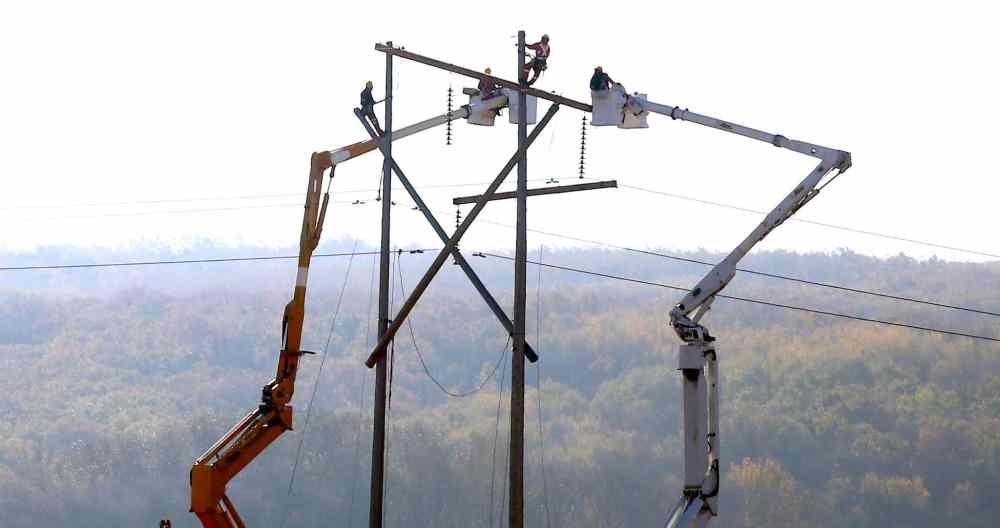
On the environment, we must first understand each province has developed its own power generation based on the natural resources available to it. Naturally, the energy used to generate power varies greatly from province to province as do the percentages of renewable and non-renewable resources to generate that power.
In 2013, the power generated in Alberta was 51 per cent coal, 38 per cent natural gas; wind, biomass and hydro made up the remainder. In Saskatchewan in 2014, power was generated as follows: 44 per cent coal, 29 per cent natural gas, 20 per cent hydro, three per cent wind and four per cent was imported.
By contrast, Manitoba generates 96 per cent of its power from clean, renewable power generated at 15 hydro-electric stations across the province. The remaining four per cent of power generated comes from wind and diesel generating stations. Moreover, Manitoba has hydro resources that could be developed to double their present power-generating capacity.
Based on these profiles, greenhouse gas emissions from Alberta and Saskatchewan are 400 and 140 times higher, respectively, than emissions from Manitoba.
If the Prairie provinces were to work together, clean Manitoba power could be used to displace dirty fossil fuel power in the other provinces.
It is interesting to note the distance between the hydro generating stations in northern Manitoba to load centres Winnipeg is almost the same distance from the same hydro generating stations in northern Manitoba to Fort McMurray, Alta. High-voltage direct-current technology would effectively transmit the power from Manitoba to Saskatchewan and Alberta. It has been used for decades, and is cost-effective when compared with other options for transmission of large amounts of power over large distances.
Moreover, if Alberta were to use Manitoba electricity, its greenhouse gas emissions would drop, thus improving that province’s greenhouse gas profile, which is currently 400 times higher than Manitoba.
From a financial cost benefit, this would be good for Manitoba and First Nations. It would help Manitoba diversify its export markets. Overall, this could be seen as an exercise in nation-building.

But it doesn’t stop there. The cost of power to individuals and companies in Saskatchewan and Alberta is likely to go down as well, spawning economic growth and power reliability for everyone involved. The cost of power would be cheaper, but this is especially true if governments begin taxing carbon, which will only increase costs for consumers, if the status quo is maintained as far as the electricity distribution. Since power transmission would cross interprovincial boundaries, it may be eligible for federal-infrastructure money under national or regional significance. However, the provinces need to carry out appropriate studies and then apply for federal funding.
The third challenge is political and regulatory issues. An east-west grid between the Prairie provinces is such an obvious solution to so many challenges, it is a wonder why such a scheme has not yet been constructed. Some reasons may be the monopolistic tendencies of Crown corporations and the protection of provincial jurisdictions, of which electricity development falls within. Therefore, if the premiers are really serious about nation-building, growing our economy and protecting the environment, perhaps they should reflect on the barriers of the past and bring them down.
Prairie premiers need to lead on this issue, interconnecting the transmission grids between Manitoba, Saskatchewan and Alberta is an idea whose time has come.
Steven Fletcher was the MP for Charleswood-St. James-Assiniboia-Headingley from 2004 to 2015. He was a cabinet minister from 2008 to 2013 when he helped create the Building Canada fund, responsible for federal infrastructure on the Prairies.
History
Updated on Tuesday, November 24, 2015 7:28 AM CST: Replaces photo