

Dangerous weather nothing new
Advertisement
Read this article for free:
or
Already have an account? Log in here »
To continue reading, please subscribe:
Monthly Digital Subscription
$1 per week for 24 weeks*
- Enjoy unlimited reading on winnipegfreepress.com
- Read the E-Edition, our digital replica newspaper
- Access News Break, our award-winning app
- Play interactive puzzles
*Billed as $4.00 plus GST every four weeks. After 24 weeks, price increases to the regular rate of $19.95 plus GST every four weeks. Offer available to new and qualified returning subscribers only. Cancel any time.
Monthly Digital Subscription
$4.99/week*
- Enjoy unlimited reading on winnipegfreepress.com
- Read the E-Edition, our digital replica newspaper
- Access News Break, our award-winning app
- Play interactive puzzles
*Billed as $19.95 plus GST every four weeks. Cancel any time.
To continue reading, please subscribe:
Add Free Press access to your Brandon Sun subscription for only an additional
$1 for the first 4 weeks*
*Your next subscription payment will increase by $1.00 and you will be charged $16.99 plus GST for four weeks. After four weeks, your payment will increase to $23.99 plus GST every four weeks.
Read unlimited articles for free today:
or
Already have an account? Log in here »
Hey there, time traveller!
This article was published 11/08/2016 (3526 days ago), so information in it may no longer be current.
The storm was furious; it was miraculous no one was hurt.
It was the worst electrical storm on record that passed through the community of Griswold that Saturday morning. And it was accompanied by what the Brandon Sun writer of the day called a “regular tornado” of wind and rain.
Nearly all the fences and metal chimneys came down, the tents on the CNR construction were flattened out, and a lot of supplies for workers were spoiled as a result of that storm.
The same system caused more damage in Souris, Newdale, Pipestone, Reston and several other places, with extensive damage to buildings. In some cases, several horses were killed.
That was June 16, 1907.
One day later, another violent storm passed through Wheatland near Rivers with a “massive wind” that damaged buildings and property all over the district.
The roof of the ice rink was blown several hundred metres away, and the waiting rooms of the building were demolished. The chimney of the local English church was blown off, and every grain elevator in the region sustained some kind of damage.
Violent, dangerous storms are not unknown to Manitoba. There are several accounts of tornadoes and funnel clouds hitting various communities over the years.
In July 1965, a tornado struck the small farming community of Ridgeville, located 100 kilometres south of Winnipeg. Chimneys were knocked down, trees were uprooted and several windows were broken. At least three sheds were demolished in that storm system, which also spawned funnel clouds near the Winnipeg airport and the Assiniboia Downs race track.
Three years later, a “savage” twister that was said to be about “50 yards across” by an eyewitness caused extensive damage to the La Rivière resort area and threw a railway caboose around like a toy. The tornado then wound its way through 25 km of farms and farmyards, destroying trees, sheds and machinery, before it blew itself out south of Manitou.
And in July 1977, another tornado killed two people and injured two others when it struck the small town of Rosa, in eastern Manitoba. The twister had taken the lives of Mike Klem and his wife, Katie, when it picked up their farmhouse and slammed it down several hundred metres away.
It was storms like this one that prompted the Manitoba Emergency Measures Organization to set up a system to spot tornadoes and other potentially dangerous weather conditions.
It’s a system we have in place today.
For every major storm system that moves through the province, Environment Canada has set up storm alerts to warn the public of the potential for violent systems and accompanying tornado activity.
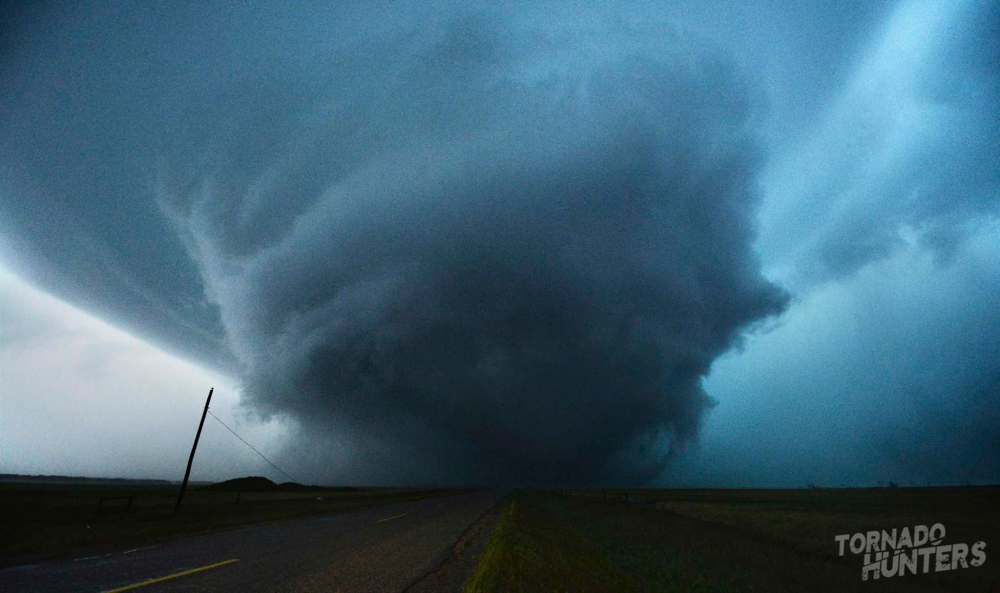
That alert system was active Monday evening, when a strong storm cell that produced at least three tornadoes —and likely a fourth north of Erickson — passed through Westman.
Seven houses were damaged in Waywayseecappo First Nation, and one home was completely destroyed by the confirmed tornado on the reserve.
There is even a video of the storm showing how the winds overturned a school bus in the community.
“In 20 (minutes) from my deck we watched four tornadoes form and dissolve…” wrote Waywayseecappo resident Eric Mentuck on his Facebook page Monday evening.
With the advent of better storm-tracking technology, the proliferation of smartphones among the population and the growing interest in storm-chasing, it’s easy to think Manitoba storms are becoming more violent and dangerous — a product of climate change.
As the Winnipeg Free Press reported this week, the confirmed tornado events in Manitoba as of Tuesday number at least 14 — up from eight in 2015 and six in 2014. But meteorologists with Environment Canada warn using confirmed tornado numbers to point to the effects of climate change is not a good idea, because of a “population bias” in the numbers. “The reports happen where the people are, because that’s who reports them,” Environment Canada climate-change meteorologist Natalie Hasell said.
“We have a large part of the province where we don’t have roads, where we don’t have settled people, where we don’t have regular inhabitants. So there could be many more tornadoes — many more hail, wind, rain events — but nobody is there to see them or report them to us and we don’t necessarily have a way to confirm them.”
Technology is certainly playing a role in the number of confirmed tornadoes, she said. In fact, Manitobans are rather fixated on storm-chasing these days, and thus we take notice when Environment Canada warns of an incoming system.

Hasell also said there really is no particular trend, noting Saskatchewan counted seven tornadoes in 2011, 33 in 2012, 17 in 2013, nine in 2014 and two in 2015.
Of course, this doesn’t mean climate change isn’t real. There have been multiple studies conducted over the decades and published in peer-reviewed scientific journals proving climate-warming trends are real and are linked to human activity.
We just can’t point to the storm photos on Twitter as the proof.
This editorial was originally printed in the Brandon Sun on Aug. 10.