

Network provides lessons for Trump popularity
Advertisement
Read this article for free:
or
Already have an account? Log in here »
To continue reading, please subscribe:
Digital Subscription
One year of digital access for only $1.44 a week*
- Enjoy unlimited reading on winnipegfreepress.com
- Read the E-Edition, our digital replica newspaper
- Access News Break, our award-winning app
- Play interactive puzzles
*Billed as $5.77 plus GST every four weeks. After 52 weeks, price increases to the regular rate of $19.95 plus GST every four weeks. Offer available to new and qualified returning subscribers only. Cancel any time.
To continue reading, please subscribe:
Add Free Press access to your Brandon Sun subscription for only an additional
$1 for the first 4 weeks*
- Enjoy unlimited reading on winnipegfreepress.com
- Read the E-Edition, our digital replica newspaper
- Access News Break, our award-winning app
- Play interactive puzzles
*Your next Brandon Sun subscription payment will increase by $1.00 and you will be charged $17.95 plus GST for four weeks. After four weeks, your payment will increase to $24.95 plus GST every four weeks.
Read unlimited articles for free today:
or
Already have an account? Log in here »
Hey there, time traveller!
This article was published 28/09/2016 (3541 days ago), so information in it may no longer be current.
‘I don’t have to tell you things are bad. Everybody knows things are bad. It’s a depression. Everybody’s out of work or scared of losing their job. The dollar buys a nickel’s worth, banks are going bust, shopkeepers keep a gun under the counter. Punks are running wild in the street and there’s nobody anywhere who seems to know what to do, and there’s no end to it. We know things are bad — worse than bad. They’re crazy.”
If you guessed that those words were spoken recently by a certain candidate for the presidency of the United States, you guessed wrong — but could be forgiven for thinking it.
Those words were written more than 40 years ago by a man named Paddy Chayefsky, who turned out to be an uncanny prophet and perhaps, perversely, Republican candidate Donald Trump’s secret inspiration. Chayefsky was a brilliant film and television writer who won three Academy Awards including one for 1976’s Network, his crowning achievement about television and America.
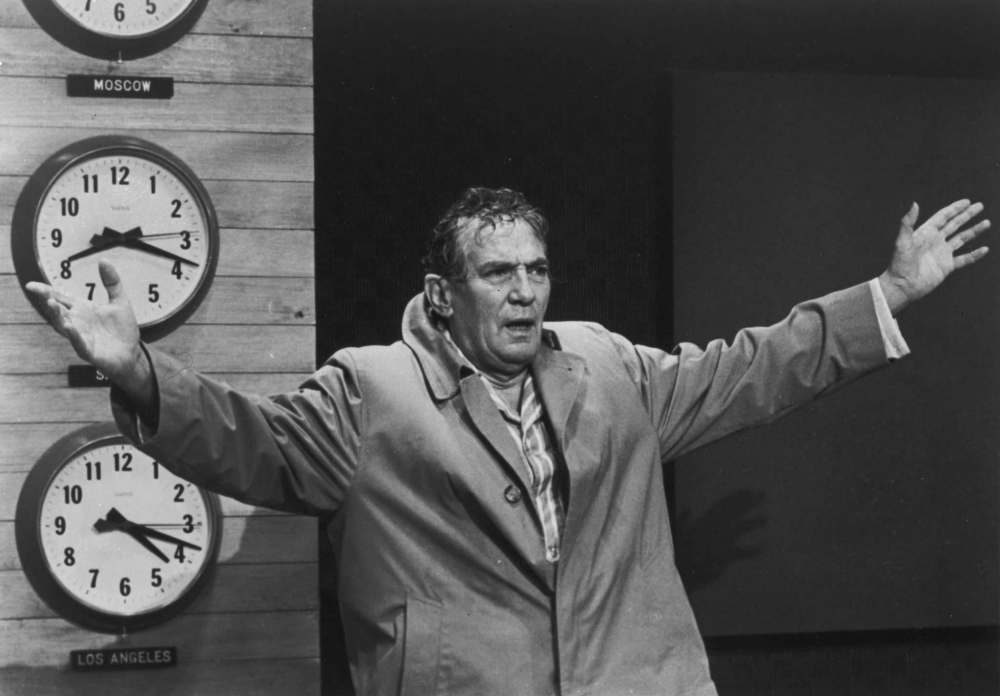
The central character in Network is Howard Beale, an iconic television news anchor who has an on-air meltdown and subsequently gets huge ratings as the “mad prophet” of the airwaves, exhorting viewers to go to their windows and scream into the streets: “I’m mad as hell, and I’m not going to take this anymore!”
Tapping into the fear, paranoia and desperation of the mid-’70s (things were rough in the post-Nixon/Vietnam era), Beale gave voice to the frustrations of millions of people for whom the American “dream” was turning into a nightmare. Decades later, a boorish real estate developer-turned-reality TV star is also “articulating the popular rage,” as Chayefsky described Beale’s rants.
To read Trump is (according to polls) tied or possibly even in the lead in the race with Hillary Clinton, and to be faced with the distinct possibility this colossal ingrate and ignoramus could well be running the United States of America in just a few months, is obviously beyond discomforting. As so many others have already said, it’s scary.
All around us, good and sensible people are asking the same question: how the hell did this happen? We’re shocked by Trump’s popularity, dumbfounded anyone would support him and convinced the actual prospect of his presidency must be a bad dream. But, instead of asking how the hell this happened, the better question might be: why are we surprised?
What does it say about America that Trump could be taken seriously as a candidate for president? Well, it says a lot, and unfortunately none of it is news and none of it is encouraging.
Just look at the culture. It pains me to say this, but it’s a culture of phoniness, privilege, guns, irrational worship of wealth and celebrity, broken government, misguided media, persistent racism, ignorance, stupidity, cowardice, denial, a prescription drug epidemic, misogyny, absence of accountability, the simultaneous glorification and unconscionable mistreatment of military veterans, and, oh yes, television — which is where most people get their information and perception of the society they live in. And as Chayefsky said at one point: “Television is democracy at its ugliest.”
Trump is Howard Beale redux. He wasn’t a newsman, but he was on television, as a “reality” TV star (although there was nothing real about it). Actually, it’s more accurate to say Trump is on television. Constantly. That’s because television is addicted to him, and the biggest “reality” show on TV is not Dancing with the Stars or The Bachelor or The Voice, it’s the endless race for president, and has been for years. CBS chief Les Moonves gleefully cracked wise earlier this year that Trump “may not be good for America, but it’s damn good for CBS! The money’s rolling in and this is fun… Sorry, it’s a terrible thing to say, but bring it on Donald!”
“Woe is us… we’re in a lot of trouble!” is another famous Howard Beale line from Network, the maniacal newsman berating and belittling his viewers, who, of course, loved the abuse. (Sound familiar? Trump said: “I love the poorly educated” after winning the Nevada Republican caucuses.)
Beale said: “We’re in trouble because less than three per cent of you people read books, less than 15 per cent read newspapers and the only truth you know is what you get over this tube.”
You don’t hear Trump exactly saying things like that, mostly because there’s no chance he would have accurate statistics such as those at his fingertips. And keep in mind, Chayefsky wrote this stuff 40 years ago. How many people are reading books and newspapers today?
“So you listen to me. Listen to me,” said Beale. “Television is not the truth! Television is a god-damned amusement park! Television is a circus, a carnival, a traveling troupe of acrobats, storytellers, dancers, singers, jugglers, side-show freaks, lion tamers and football players.”
Again, remember, this is the mid-’70s, long before “reality” TV, cable news and the television juggernaut the NFL has become.
Beale: “We’ll tell you anything you want to hear, we lie like hell.”
Trump: “I play to people’s fantasies. People may not always think big themselves, but they can still get very excited by those who do. That’s why a little hyperbole never hurts. People want to believe something is the biggest and the greatest and the most spectacular. I call it truthful hyperbole.”
Once you’ve seen it, it’s hard to get Network out of your head these days. As one of the other characters in it — the chairman of the conglomerate that owns the fictional television network UBS — says to Howard Beale, “There is no America. There is no democracy. There is only IBM, and ITT, and AT&T and DuPont, Dow, Union Carbide and Exxon. The world is a business, Mr. Beale.”

In conclusion, let’s revisit some key questions.
How the hell did we get here? What does it say about America?
Thanks partly to Paddy Chayefsky and Network, it’s all too obvious how we got here.
As for what it says about America, it may seem harsh, but this adage sadly sums it up: in a democracy, the people get the government they deserve.
Originally from Winnipeg, Steve Warden has studied politics and media, produced television in the United States, and seen Network more than once.