

Conservatives can’t keep ignoring Islamophobia
Advertisement
Read this article for free:
or
Already have an account? Log in here »
To continue reading, please subscribe:

Digital Subscription
One year of digital access for only $205*
- Enjoy unlimited reading on winnipegfreepress.com
- Read the E-Edition, our digital replica newspaper
- Access News Break, our award-winning app
- Play interactive puzzles
*First annual payment billed as $205.00 + GST for one year. This annual subscription will automatically renew at $233.00 + GST every 52 weeks (10% off the regular annual price of $259.35). Offer available to new and qualified returning subscribers only. Cancel any time.
To continue reading, please subscribe:
Add Free Press access to your Brandon Sun subscription for only an additional
$1 for the first 4 weeks*
- Enjoy unlimited reading on winnipegfreepress.com
- Read the E-Edition, our digital replica newspaper
- Access News Break, our award-winning app
- Play interactive puzzles
*Your next Brandon Sun subscription payment will increase by $1.00 and you will be charged $17.95 plus GST for four weeks. After four weeks, your payment will increase to $24.95 plus GST every four weeks.
Read unlimited articles for free today:
or
Already have an account? Log in here »
Hey there, time traveller!
This article was published 03/03/2017 (3495 days ago), so information in it may no longer be current.
In both Canada and the United States, conservatives have never had a problem associating radical Islam with terrorism. Lately, however, they are hard-pressed to admit that anti-Muslim prejudice is itself a source of indoctrination and violence.
It is the uncomfortable truths — the existence of Islamophobia and its negative impact on Muslim communities — that conservatives have failed to address honestly.
For hardcore Republicans, the reality of Islamophobia must be categorically denied. In the American neoconservative publication National Review, op-ed writer Brendan O’Neill insists “Islamophobia is a myth” and that “the idea that there is a climate of Islamophobia… is an invention.”
Atlantic magazine staff writer Conor Friedersdorf countered these assumptions, noting Islamophobia — an irrational fear of mainstream Muslims — “is a recognizable feature of post-9/11 America.” Examples include: various cities’ efforts to stop the construction of mosques, state attempts to ban Shariah law and the profiling of Muslim college students for no reason other than their religion.
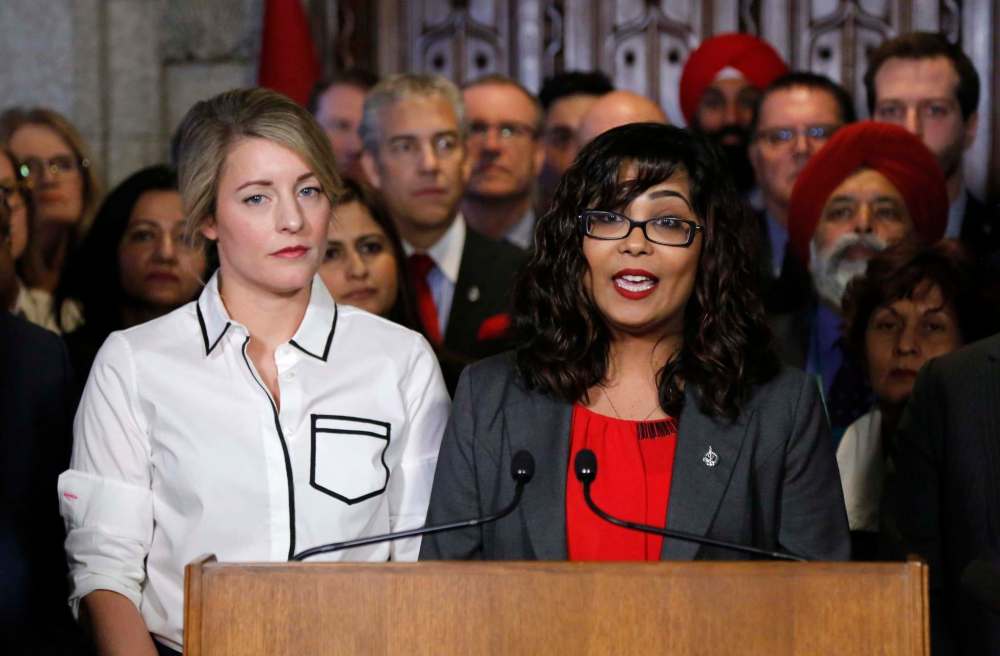
In Canada, we encounter similar anxieties, especially among our current crop of conservative politicians. When Liberal MP Iqra Khalid recently introduced Motion 103, which asks the government to condemn “Islamophobia and all forms of systemic racism and religious discrimination,” the reaction from Conservative leadership candidates was swift.
Pierre Lemieux warned that “the consequences of M-103 on free speech will be far-reaching.” Maxime Bernier refused to vote for the motion unless the word “Islamophobia” was removed. Kellie Leitch insisted that “no religion should be singled out for special consideration.”
M-103 sparked further outrage. Khalid and her office received thousands of violent, hateful threats. She even required police protection for having the courage to declare publicly the existence of Islamophobia.
Moreover, conservatives tend to downplay the connection between anti-Muslim attitudes and radicalization. For instance, in 2011 when Norway’s Anders Breivik killed 77 people to draw attention to his right-wing manifesto, the National Post’s Jonathan Kay described Breivik as “crazy,” not “conservative.”
The reality is, bigotry does not exist in a vacuum. Alexandre Bissonnette did not burst into the Islamic Cultural Centre in Quebec City and kill six Muslims on a whim. His fanaticism was learned from — and encouraged by — far-right extremists. A friend of his mentioned how Bissonnette was “enthralled by a borderline racist nationalist movement.” Put simply, right-wing thugs go on murderous rampages because they have been brainwashed by like-minded ideologues.
The fallback position for conservatives is to depict right-wing terrorists as “exceptions.”
Breivik and Bissonnette are, in fact, symptoms of a larger problem — namely, the hate merchants who manufacture vicious stereotypes. These include U.S. President Donald Trump’s chief strategist, Steve Bannon, who insists that “the West is at war with Islam,” as well as Trump’s former national security advisor, Gen. Michael Flynn, who referred to Islam as a “cancer.”
In Canada, Conservative leadership hopeful Leitch sends her condolences to the families of the Quebec mosque victims while promoting policies that simultaneously stir up anti-immigrant sentiments. When Leitch attempts to legitimize her “barbaric cultural practices” tip line or the screening of new immigrants for “Canadian values,” her brand of politics can only be described as disingenuous.

Conservatives sank even lower at this year’s Manning Centre Conference in Ottawa. Panelist Thomas Quiggin of the Terrorism and Security Experts network suggested that not only was every mosque in Canada — including the Islamic Cultural Centre in Quebec City — funding extremist groups, but that the gunman sought revenge for that support. In other words, Muslims should have seen it coming.
Even if North Americans are not drowning in waves of Islamophobia daily, anti-Muslim attitudes can easily be exploited for political gain. When this kind of paranoia becomes mainstream, right-wing radicals are given further assurance that their warped view of Islam is justified. Look no further than the disturbing letter sent March 1 to various media outlets by the Council of Conservative Citizens of Canada (C4). The unknown group threatened to detonate bombs targeting Muslim students at Concordia University during Islamic Awareness Week.
If conservatives wish to be part of the solution, they can start by publicly condemning Islamophobia. By denying its existence and minimizing its negative repercussions, the right becomes complicit in any future hostilities toward Muslims.
Stuart Chambers, PhD, teaches media ethics in the department of communication at the University of Ottawa.
schamber@uottawa.ca
Related Articles
O'Leary caught fibbing about reason for missing city event
Advertisement Advertise With Us
Advertisement Advertise With Us