

Get rail-relocation study back on track
Advertisement
Read this article for free:
or
Already have an account? Log in here »
To continue reading, please subscribe:
Digital Subscription
One year of digital access for only $1.44 a week*
- Enjoy unlimited reading on winnipegfreepress.com
- Read the E-Edition, our digital replica newspaper
- Access News Break, our award-winning app
- Play interactive puzzles
*Billed as $5.77 plus GST every four weeks. After 52 weeks, price increases to the regular rate of $19.95 plus GST every four weeks. Offer available to new and qualified returning subscribers only. Cancel any time.
To continue reading, please subscribe:
Add Free Press access to your Brandon Sun subscription for only an additional
$1 for the first 4 weeks*
- Enjoy unlimited reading on winnipegfreepress.com
- Read the E-Edition, our digital replica newspaper
- Access News Break, our award-winning app
- Play interactive puzzles
*Your next Brandon Sun subscription payment will increase by $1.00 and you will be charged $17.95 plus GST for four weeks. After four weeks, your payment will increase to $24.95 plus GST every four weeks.
Read unlimited articles for free today:
or
Already have an account? Log in here »
Hey there, time traveller!
This article was published 22/03/2017 (3499 days ago), so information in it may no longer be current.
It was just over a year ago then-premier Greg Selinger held a press conference to announce Jean Charest would head a task force to study the possible relocation of the main rail yards of the Canadian Pacific Railway.
The premier was joined on that occasion by Mayor Brian Bowman and by Diane Gray, the chief executive officer of CentrePort Canada. The mayor and Gray spoke enthusiastically about the study and the appointment of Charest.
The premier announced the provincial government would invest $400,000 toward the work of the task force. He indicated the long-range purpose of the rail relocation would be to reduce traffic congestion, enhance public safety and create new opportunities.
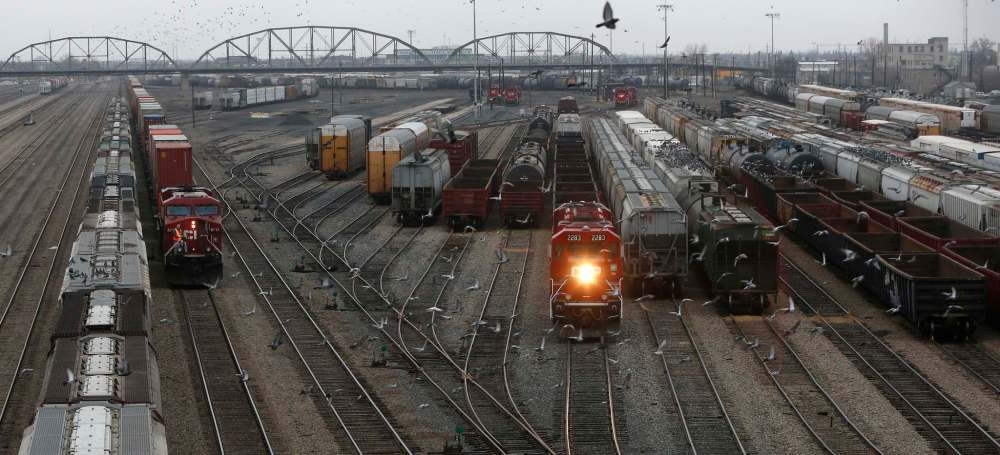
The premier was understating the benefits. Rail relocation would mean removal of that great barrier that divides our city and separates the north of Winnipeg from the city centre and the residential communities to the south of the main CP rail yards.
There are many more rail yards and tracks in Winnipeg, but none as large and as destructive of communities as the main CPR rail yards, which are said to be the largest in the world.
The formation of a task force was timely, because there is a need to replace the Arlington Bridge at considerable cost if the rail yards remain. More importantly, the removal of the yards would open up enormous possibilities for redevelopment, including a new east-west transportation corridor and new residential, commercial and recreational development in what has been an urban wasteland.
Charest is a lawyer by trade, with extensive experience in governmental affairs. He was a member of the House of Commons from 1984 to 1998, serving as a cabinet member in the Mulroney Progressive Conservative government for several of those years. He left federal politics to become leader of the Quebec Liberal party and served as premier of Quebec from 2003 to 2012.
Unfortunately, the announcement of the task force was hardly completed when it was abruptly withdrawn. Speaking for the new Pallister Progressive Conservative government the minister of municipal affairs indicated it would not support the rail-relocation study and Jean Charest has been so advised. The new premier labelled the announcement of the Selinger government as a political stunt, made a matter of days prior to the provincial election call.
Premier Brian Pallister may be right about this, but it raises the question whether the appointment of the Charest task force was a sound idea whose time had come. We have seen how the relocation of the CNR yards at The Forks has transformed that area into one of the most vital developments in Winnipeg’s history. The CPR rail yards occupy a much larger area. Redevelopment would be a gradual staged process.
The Social Planning Council of Winnipeg has advocated that the CPR rail yards should be moved to make way for new housing, green space, recreation facilities and urban infrastructure. CentrePort would welcome a major connection with relocated rail yards. It makes considerable sense for the CPR rail yards to be relocated in the space northwest of the airport. It would make CentrePort a true warehouse and distribution hub involving rail as well as trucking and air cargo. And there is money to be saved by not building bridges to span the railway yards.
Brent Bellamy, a senior developer at Number Ten Architectural Group and regular contributor to the Free Press, has pointed out Winnipeg suffers from low population density, resulting in residential development spreading to the outer suburbs, with resulting high infrastructure costs. Yet here are 200 or so acres of centrally located land with no residential housing footprint. Residential housing of various sorts, and for various economic strata, would help to increase density and bring a fresh flow of potential shoppers in close proximity to the stores and restaurants in central Winnipeg.
Rail relocation has been a subject of discussion for close to 60 years. It is time we took the subject seriously. The Charest task force was a welcome beginning. Is it too much to hope for a quick revival?
I recognize, along with most other Manitobans, the present provincial government dislikes spending money extracted from taxpayers, (although it is not against the federal government spending its funds in Manitoba).
However, there are occasions when funds expended today may bring rich dividends in future years.

The $400,000 provincial contribution for the Charest task force is a drop in the bucket. If that small expenditure helps to provide some guidelines on the relocation of the CPR yards, it would be a welcome investment.
Presumably the initial study would provide an outline of the probable cost of relocation, as well as the probable long-term benefits. We might learn what funds are available from the federal government as well as the expected role of the province and the city of Winnipeg.
Rail relocation would have a positive impact on the continued development and prosperity of the city of Winnipeg.
The provincial government must understand that the prosperity of the province is highly dependent on Winnipeg’s future progress.
Charles Huband is a former judge of the Manitoba Court of Appeal and a lawyer at Taylor McCaffrey LLP. He was the leader of the Manitoba Liberal party in the 1970s.
Related Articles
Let's get started on rail relocation
Advertisement Advertise With Us
Advertisement Advertise With Us
History
Updated on Wednesday, March 22, 2017 10:56 AM CDT: Corrects name.