

C-130 Hercules better suited to serve north
Advertisement
Read this article for free:
or
Already have an account? Log in here »
To continue reading, please subscribe:

Digital Subscription
One year of digital access for only $205*
- Enjoy unlimited reading on winnipegfreepress.com
- Read the E-Edition, our digital replica newspaper
- Access News Break, our award-winning app
- Play interactive puzzles
*First annual payment billed as $205.00 + GST for one year. This annual subscription will automatically renew at $233.00 + GST every 52 weeks (10% off the regular annual price of $259.35). Offer available to new and qualified returning subscribers only. Cancel any time.
To continue reading, please subscribe:
Add Free Press access to your Brandon Sun subscription for only an additional
$1 for the first 4 weeks*
- Enjoy unlimited reading on winnipegfreepress.com
- Read the E-Edition, our digital replica newspaper
- Access News Break, our award-winning app
- Play interactive puzzles
*Your next Brandon Sun subscription payment will increase by $1.00 and you will be charged $17.95 plus GST for four weeks. After four weeks, your payment will increase to $24.95 plus GST every four weeks.
Read unlimited articles for free today:
or
Already have an account? Log in here »
Hey there, time traveller!
This article was published 08/07/2017 (3294 days ago), so information in it may no longer be current.
The recent shifting of permafrost under the Churchill rail line, caused by climate change, will not allow the nature of northern shipping to return to “the good old days.” Rather, it has signalled that surface travel by rail or road in Manitoba’s north will become more and more difficult and expensive.
The reliability of winter roads is rapidly declining to shorter periods, to the point where the cost and uncertainty strongly demand consideration of options to replace them.
Airships for moving freight to northern Manitoba’s remote communities have been proposed numerous times over the past 10 years or so, but some analysis suggests they may not be particularly well-suited to this role.
There are some 40 remote communities involved (including Tadoule Lake now that the Dene community has left Churchill), 41 if Churchill itself is included, given the closing of the rail line.
Can they all be served by airships? Modern airships will soon be available, each costing around $52 million. Both United States (Lockheed Martin) and U.K. manufacturers are testing prototypes that are about the size of a football field, and are rated for up to 20 tons of payload, and up to 19 passengers plus the crew. Both are being designed to meet military purposes, but in time may have commercial value and could be adapted for that purpose.
For work in the north, there are several factors to be considered. Weather can be changeable at times, a concern for the airship, which will need less fuel than a heavy aircraft, but also flies much slower, hence the concern about wind and weather changes. The maximum speed is reported to be 80 knots (about 148 kilometres per hour). Either strong headwinds or crosswinds could significantly reduce actual speed across the ground.
Airships would bring considerable changes to shipments to northern communities. Costs could be reduced, although the timing of shipments, while clearly faster than trucks on winter roads, would be at the mercy of weather. But, landing and parking/tie-down is much more complicated than with a fixed-wing aircraft or a helicopter. Ground crews will be needed to tie up the airship at both ends. Adjustments to weight and balance may be tricky for such a large machine during loading and unloading under variable winds.
The question, then, is: what other options exist?
Given the reality of climate change, air shipment is the best option. Within that category, standard aircraft may be able to play an effective role, at least until airships elsewhere have clearly shown their strengths, weaknesses and costs.
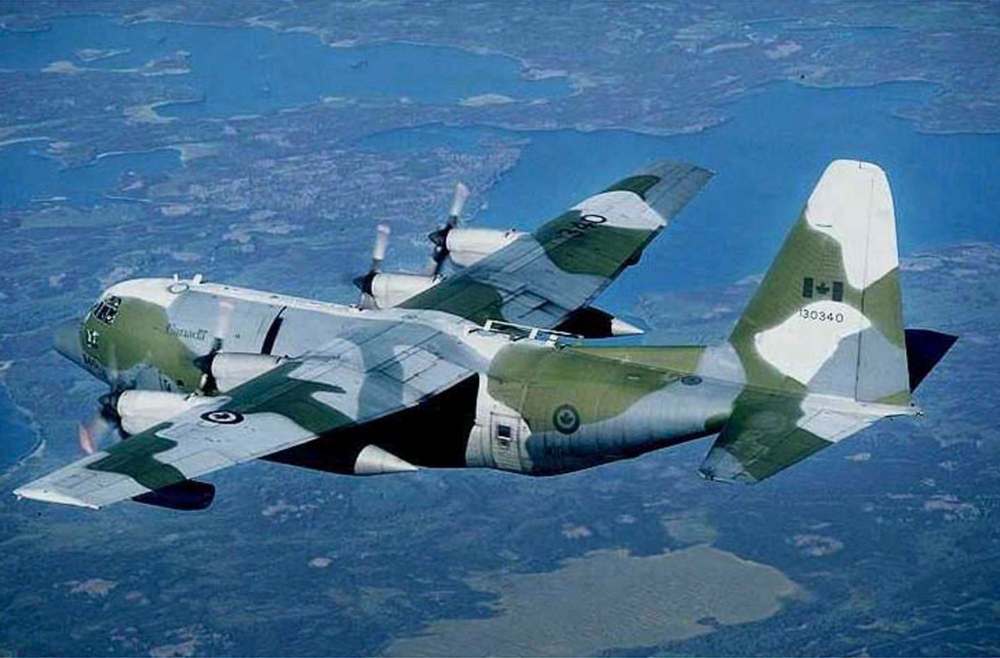
A currently viable option is the reliable C-130 Hercules. Introduced in 1954 for military use, this aircraft has carried out “Herculean” tasks all over the world, often under some of the most difficult circumstances, including weather. It can be accommodated by the existing 945-metre runways in the remote northern communities: it wouldn’t even need to reverse propellers to stop in that length.

The older Hercules cruised at 603 km/h, but the new J model flies at 671 km/h. The earlier planes carried up to 18,144 kilograms of freight — add another 907 kg for the J model. The hold of a Hercules has a floor that can accept pallets or various machinery, including a D8 Cat, thanks to the large rear doors, the lower one becoming the ramp when open. In case of emergency in the absence of an airstrip or relatively smooth ground, a heavy pallet can be dropped from the Hercules by parachute extraction at very low altitude (0.9 m to 1.5 m above the ground).
Although fuel for the airships runs about 25 per cent of that of the C-130s, the latter cruises at least four times the speed of the airship, meaning it can serve communities four times faster than an airship and with double the payload.
The airship raises weather risks due to its much slower airspeed and lower manoeuvrability. As well, purchase cost for about five airships that would be needed to match the delivery capability of one Hercules would be close to twice the cost of the Hercules. Existing runways (945 m) can accommodate the C-130s, whereas tie-downs would be needed for the airship.
Should climate change force the Manitoba government to seriously consider aircraft for northern supply, a much more detailed analysis would be required. However, tests of both types would lead to the conclusion that, although both options would work, heavy lift aircraft such as the C-130 Hercules have the speed and capacity best for the job.
Jim Collinson is a management consultant specializing in the complexities surrounding energy, economic and environmental issues. He was a pilot for more than 40 years, and has flown the C-130.