

Battle is poor metaphor for disease
Advertisement
Read this article for free:
or
Already have an account? Log in here »
To continue reading, please subscribe:
Digital Subscription
One year of digital access for only $1.44 a week*
- Enjoy unlimited reading on winnipegfreepress.com
- Read the E-Edition, our digital replica newspaper
- Access News Break, our award-winning app
- Play interactive puzzles
*Billed as $5.77 plus GST every four weeks. After 52 weeks, price increases to the regular rate of $19.95 plus GST every four weeks. Offer available to new and qualified returning subscribers only. Cancel any time.
To continue reading, please subscribe:
Add Free Press access to your Brandon Sun subscription for only an additional
$1 for the first 4 weeks*
- Enjoy unlimited reading on winnipegfreepress.com
- Read the E-Edition, our digital replica newspaper
- Access News Break, our award-winning app
- Play interactive puzzles
*Your next Brandon Sun subscription payment will increase by $1.00 and you will be charged $17.95 plus GST for four weeks. After four weeks, your payment will increase to $24.95 plus GST every four weeks.
Read unlimited articles for free today:
or
Already have an account? Log in here »
Hey there, time traveller!
This article was published 18/08/2017 (3354 days ago), so information in it may no longer be current.
The metaphor of battling illness is common but pernicious.
The recent news of U.S. Sen. John McCain’s brain cancer diagnosis and U.K. infant Charlie Gard’s death were discussed using the same metaphor — warfare. Former U.S. president Barack Obama tweeted, “John McCain is… one of the bravest fighters I’ve ever known” and Charlie’s parents stated, “our son is an absolute WARRIOR and we could not be prouder of him.”
If brain cancer kills McCain, will he be remembered as a failed fighter? If Charlie had “fought” harder, would he now be alive?
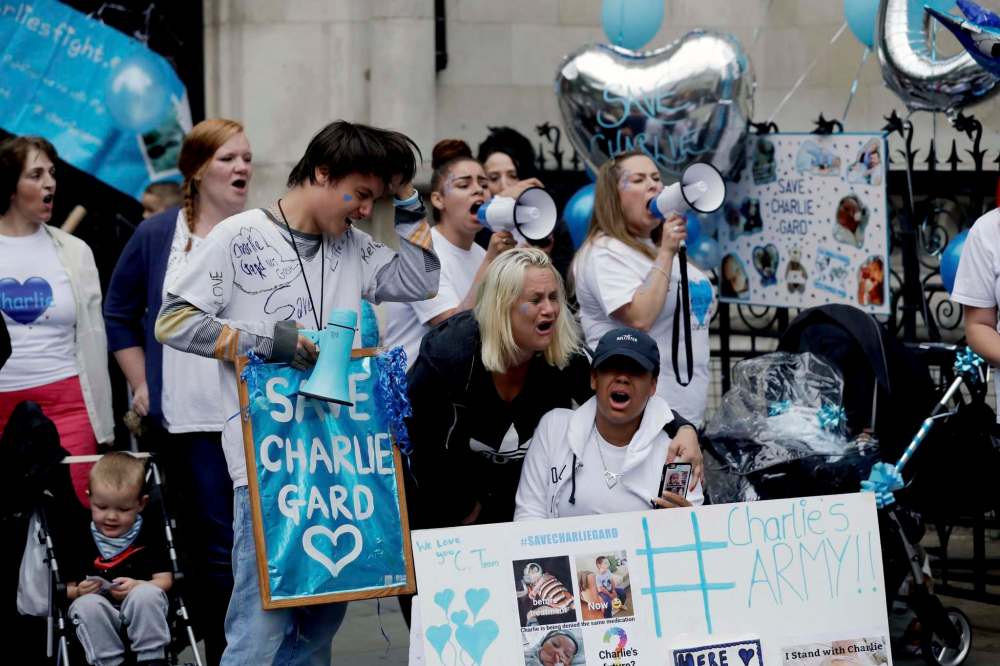
The battle metaphor is particularly harmful when it encourages parents to battle their child’s health-care team despite the child’s life-ending condition.
The facts of Charlie’s case are clear.
Charlie showed signs of illness before reaching two months of age. He was referred to the Great Ormond Street Hospital, a renowned institution that has been at the forefront of pediatric practice for almost two centuries. The hospital admitted Charlie immediately and applied the best of modern pediatric practice. The medical team rapidly saved his life with a ventilator that breathed for him. Many ventilated infants will make some effort to breathe. Unusually, and soon after admission, Charlie had “no spontaneous respiratory efforts.”
There followed another facet of best modern pediatric practice — intense and rapid investigations. These included advanced genetic testing, which yielded a diagnosis: the very rare mitochondrial DNA depletion syndrome. This diagnosis meant Charlie almost certainly would die in the near future.
Meanwhile, his condition was deteriorating. Charlie’s muscle weakness, which prevented him from breathing on his own, became so profound he could not open his eyelids. He had almost total hearing loss and was unresponsive to any normal stimuli.
Behind the scenes at Great Ormond Street, there would have been intense communication with Charlie’s parents about test results, the diagnosis and likely outcomes. Given the increasing severity of Charlie’s condition, and then the onset of intractable seizures, long-term ventilation was not a humane option. The ethics committee, an intermediary to help all parties in this difficult situation, agreed palliative care was in Charlie’s best interest.
Sadly, such discussions happen daily between parents and clinicians because many children have conditions the best practice still can’t treat effectively. Parents respond in many ways to these discussions but most eventually accept the reality, focusing on making the child’s remaining time as comfortable as possible.
Of course, such acceptance usually comes slowly and with great parental suffering, sometimes with anger directed toward the messengers. Parents find comfort with support from friends, family, the wider community, and also the health-care professionals who are intimately bound up in the child’s care.
The common response, to take refuge in the metaphor of warfare, typically doesn’t move beyond the use of words.
But in Charlie’s case, the fighting metaphor became reality, constraining the parents. Given Charlie was a “warrior,” the parents saw their duty as being co-fighters with him. But who or what was the target of the warfare? A rare disease? The medical team?
Battles are not meant to end in compromise, but in victory or defeat.
Just when Charlie’s needs required collaborative efforts between his parents and the health-care team, the focus shifted to winning and losing. On the sidelines, alliances (including the Vatican, the U.S. president and the public) developed through mainstream and social media, encouraging even more conflict. The warfare moved into the legal arena, intensifying the battle and causing any sense of collaboration to disappear.
The ensuing media reports rarely focused on the principal issue: Charlie was very sick with a fatal disease.

As in many battles, “victory” was central and the significance of Charlie’s suffering had all but disappeared.
Metaphors might endure in medicine but they are not harmless wordplay. They can perniciously encourage a distorted perception of reality. Regarding baby Charlie as a “warrior” led to a cascade of events detrimental to Charlie and all who cared for him.
Rather than using warfare metaphors, perhaps we can better address heartbreaking fatal diagnoses of children by having compassion for everyone involved, and we can support people such as McCain by admiring how he lives despite a renewed sense of his mortality — a condition we all share.
Ian Mitchell is clinical professor of pediatrics and Juliet Guichon is assistant professor, community health sciences, at the University of Calgary Cumming School of Medicine.
— Troy Media