

Indigenous self-government vital
Advertisement
Read this article for free:
or
Already have an account? Log in here »
To continue reading, please subscribe:
Digital Subscription
One year of digital access for only $1.44 a week*
- Enjoy unlimited reading on winnipegfreepress.com
- Read the E-Edition, our digital replica newspaper
- Access News Break, our award-winning app
- Play interactive puzzles
*Billed as $5.77 plus GST every four weeks. After 52 weeks, price increases to the regular rate of $19.95 plus GST every four weeks. Offer available to new and qualified returning subscribers only. Cancel any time.
To continue reading, please subscribe:
Add Free Press access to your Brandon Sun subscription for only an additional
$1 for the first 4 weeks*
- Enjoy unlimited reading on winnipegfreepress.com
- Read the E-Edition, our digital replica newspaper
- Access News Break, our award-winning app
- Play interactive puzzles
*Your next Brandon Sun subscription payment will increase by $1.00 and you will be charged $17.95 plus GST for four weeks. After four weeks, your payment will increase to $24.95 plus GST every four weeks.
Read unlimited articles for free today:
or
Already have an account? Log in here »
Hey there, time traveller!
This article was published 09/09/2017 (3191 days ago), so information in it may no longer be current.
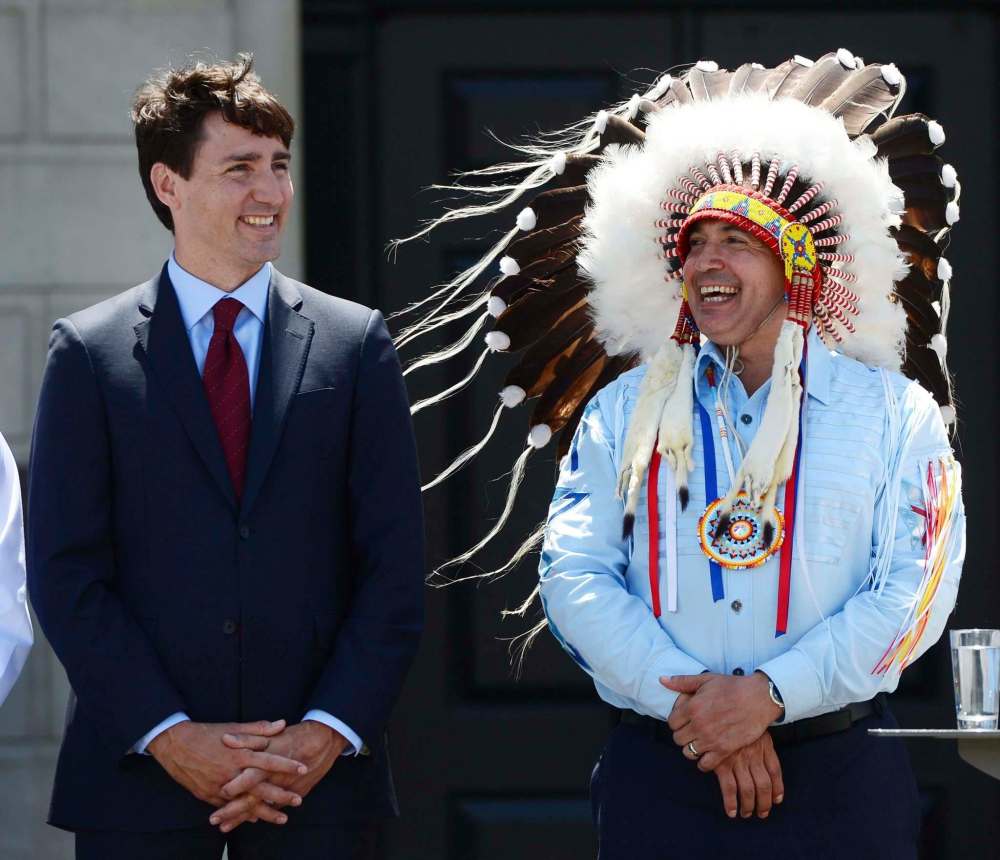
Recently, the Trudeau government introduced a series of initiatives to further Indigenous self-government and self-determination — including the splitting of the Department of Indigenous and Northern Affairs into two separate ministries. The new Department of Crown-Indigenous Relations will be tasked with accelerating “self-government and self-determination agreements based on new policies, laws and operational practices.”
This is a very tricky policy file — replete with political land mines, twists and turns and huge impediments — but one that can’t be ignored forever.
In July, the federal Justice Department released its 10 principles that will guide the governing Liberals in securing reconciliation with Canada’s Indigenous peoples. The very first principle is strikingly clear: “The Government of Canada recognizes that all relations with indigenous peoples need to be based on the recognition and implementation of their right to self-determination, including the inherent right of self-government.”
To begin, the concept of Indigenous self-government is not a new idea in Canada. One could go back to the 1966 Hawthorn-Tremblay Report, Pierre Trudeau’s 1969 White Paper and the (Keith) Penner Report of 1983 right up to the “third order of government” proposed in the ill-fated 1992 Charlottetown Accord and the 1996 Royal Commission on Aboriginal Peoples.
Furthermore, there are already several self-government agreements with the Cree in Quebec, the Nisga’a in British Columbia and the Inuit of Nunavut. There is also a groundbreaking self-government arrangement — the Mi’kmaq Education Act — between the Mi’kmaq and the government of Nova Scotia.
But much of the debate in non-Indigenous circles has surrounded the exact definition of self-government and its wider implications. Stated differently, all levels of government and office-holders in Canada want to know how it will impact existing power structures, constitutional and justice matters, fiduciary arrangements and economic/resource/land development issues, among other things.
Another key sticking point is the precise nature of the self-government model in question — that is, will it be based on a current municipal (urban), provincial or federal template? It is important to note that many First Nations reserves or bands in Canada have fewer than 1,000 members. So would that require the creation of, say, a regional self-government model?
What does seem a non-starter, though, is any move to impose a “cookie-cutter” or “one-size-fits-all” approach to Indigenous self-government — which federal government departments in Ottawa have traditionally favoured. A way forward will have to be found that allows for diversity, flexibility, unique circumstances and differences and a tailoring to specific Indigenous needs.
One of the key issues, of course, is whether Indigenous self-governments would have the requisite economic base and revenue-generation capability needed to support such a political system. In short, who is going to pay for all of this, especially given the desperate state of Indigenous communities in Canada?
The principal objections to Indigenous self-government have not changed much over the years. And they remain a significant “brake” on moving forward in any way on this thorny political file.
There are federal concerns about what the overall cost will be to enable self-government to get up and running, the termination of the paternalistic Indian Act, how all of this would affect off-reserve Indigenous peoples (such as the Métis) and the need for financial accountability and transparency structures.
There are provincial reservations about legislative/legal paramountcy — whether provincial laws would, if they conflict, take precedence over laws passed by Indigenous self-governments. The business community in Canada, which has the power to influence the policy direction of provincial governments, is deeply worried about who will dictate resource development on Indigenous or Crown lands.

Much of this resistance can be traced to fear (particularly among federal Indigenous Affairs officials) of losing control and power over Indigenous communities in Canada. Indeed, it is hard for some people to alter their idea of Indigenous peoples as dependent, as wards of the state.
Yet we all have to recognize that the existing Indigenous-governmental attitudes, systems, processes and structures are not working well. Reserves in Canada are plagued by a host of socio-economic and health problems that are not being properly addressed under the current policy regime. Dramatic change is desperately needed.
So we must begin serious negotiations — building upon the successful 2005 Kelowna Accord — on advancing the self-government agenda. What is needed, more than anything else, is the necessary political will on the part of the Trudeau government to move forward.
No one is suggesting that this process will be easy, uncomplicated or free of any bumps along the way. But we have to try. Besides, Indigenous peoples can’t do any worse than non-Indigenous already have in their past efforts to rectify the systemic problems inflicting Canada’s Indigenous communities.
Peter McKenna is professor and chair of political science at the University of Prince Edward Island in Charlottetown.