

Keeyask megaproject a perfect storm of problems

Advertisement
Read this article for free:
or
Already have an account? Log in here »
To continue reading, please subscribe:

Digital Subscription
One year of digital access for only $205*
- Enjoy unlimited reading on winnipegfreepress.com
- Read the E-Edition, our digital replica newspaper
- Access News Break, our award-winning app
- Play interactive puzzles
*First annual payment billed as $205.00 + GST for one year. This annual subscription will automatically renew at $233.00 + GST every 52 weeks (10% off the regular annual price of $259.35). Offer available to new and qualified returning subscribers only. Cancel any time.
To continue reading, please subscribe:
Add Free Press access to your Brandon Sun subscription for only an additional
$1 for the first 4 weeks*
- Enjoy unlimited reading on winnipegfreepress.com
- Read the E-Edition, our digital replica newspaper
- Access News Break, our award-winning app
- Play interactive puzzles
*Your next Brandon Sun subscription payment will increase by $1.00 and you will be charged $17.95 plus GST for four weeks. After four weeks, your payment will increase to $24.95 plus GST every four weeks.
Read unlimited articles for free today:
or
Already have an account? Log in here »
Hey there, time traveller!
This article was published 27/01/2018 (3087 days ago), so information in it may no longer be current.
As numbers go, these are big.
It is now estimated Manitoba Hydro’s latest — and perhaps last — generating station will cost at least $8.7 billion, with a 50-50 chance the final price tag will be more than $10 billion. That is, at minimum, 50 per cent more than the $6.5-billion estimate offered in 2014 when the project was given a green light by the former NDP government.
What happened? There will always be intense debate when a taxpayer- or ratepayer-supported infrastructure project goes horribly wrong. However, thanks to exhaustive hearings before the Public Utilities Board (PUB), as part of the utility’s 2018 electricity rate application, we are getting quite a bit of detail about what happened.
Unfortunately, we are not getting explanations of exactly how and why.
First, let’s deal with the “what.”
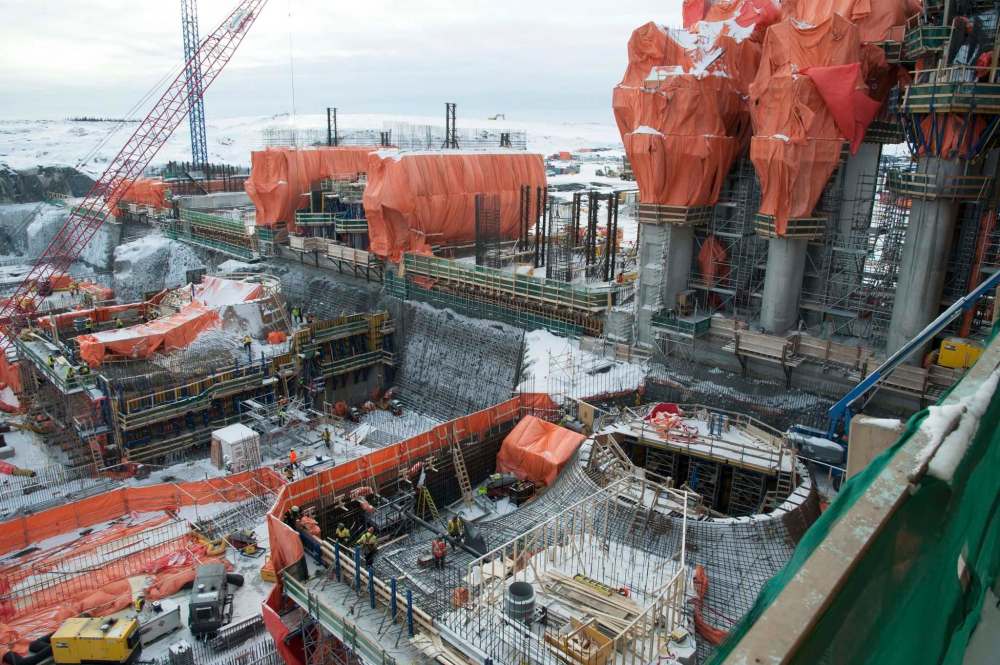
A huge construction project undertaken in the unforgiving environment of Manitoba’s north is, as a rule, always going to be risky. Hydroelectric dams have always been among the biggest, and most ambitious, infrastructure projects undertaken by the provincial government. The variables that can impact the final cost are nearly infinite.
They include highly variable geological conditions that are nearly impossible to predict with accuracy during pre-construction planning. The underlying geology in one location can be entirely different from another location within the same project footprint. Both the new Richardson International Airport and the Canadian Museum for Human Rights experienced construction delays and increased costs, in part because of wildly varying geological conditions.
There are also the weather and other environmental conditions to be considered. It’s northern Manitoba, and anyone who has visited will understand how harsh and volatile conditions can be. From forest fires to blizzards to floods, this is a tough place to pour concrete.
Some consideration must also be paid to the enigmatic construction industry itself. Prices quoted in year 1 can be radically different in year 3 or 4 of a big project. The costs of labour and equipment can fluctuate wildly due to turbulent commodity prices and the number of competing megaprojects that are launched in North America. Increased demand for experienced contractors and labour definitely leads to higher costs.
It all seems reasonable — unless you’re dealing with a project that has fallen so far behind, and whose costs have risen so much that it has eaten up the contractor’s entire profit margin. At that point, there are no other incentives, or disincentives, left for Hydro to leverage the contractor.
The result of all these factors is that the Keeyask project stands as one of the most poorly performing infrastructure-construction projects in the province’s history.
Behind schedule almost from its start, Keeyask has become a threat to ratepayers, as the utility seeks to get PUB approval for massive rate hikes to help it manage the larger-than-expected debt. It also expects to play a prominent role as an election issue in 2020, as the current Progressive Conservative government strives to lay all blame for the project’s runaway costs, and the accompanying increases to electricity rates, at the feet of its NDP predecessor.
Again, while we know that all of the factors listed above have impacted the cost of Keeyask, we are still left to ask “how” and “why” the utility and its general contractor could have underestimated the true cost of the project by such an enormous margin.
If all that adds up to “what,” then “how” and “why” did Hydro and its contractor fall so far behind schedule? Answers to those questions remain somewhat elusive.
For its part, Hydro has described Keeyask as a perfect storm of unforeseen circumstances: a complex and ambitious project that was afflicted by unforeseen geological complications and high water levels on the Nelson River.
“Each of these issues adds up cumulatively, especially on a large project such as Keeyask,” a Hydro spokesman said.
However, that explanation does not explain why contingencies built into the original bid were not sufficient to account for the slower pace of work and increased costs. What seems to be missing from the discussion is a full examination of the “root causes” of the productivity issues.
The root causes have been difficult to pin down. Two consultants brought in to review the project noted they did not entirely understand how and why BBE, the general contractor, fell so far behind its original schedule. One consultant that reported to the PUB this month said bluntly that the “absence of a clear understanding of the said root causes makes it impossible to identify and implement the proper corrective measures.”
All this leads to some speculation about whether Keeyask fell prey to a perfect storm of conditions, or whether the problem is the performance of BBE.
Hydro has certainly suggested, in some of its evidence provided to the PUB, that it appears now the schedule for excavation and concrete work provided by BBE “in hindsight proved overly optimistic.” Hydro has stopped short of accusing BBE of mismanaging the project.
However, the PUB panel hearing the rate application was supposed to hear details, in camera, that Hydro was so concerned about BBE’s performance and its inability to meet the original schedule that it considered bringing in another contractor or taking over management of the project itself.
That raises a number of questions, chief among them: are Keeyask delays and cost overruns a matter of bad luck, or bad management?
Contacted for comment, a BBE spokeswoman said all media inquiries about its work on Keeyask should be directed to Manitoba Hydro.
Byron Williams, the lawyer representing the Consumers’ Association of Canada and Winnipeg Harvest as interveners in the rate hearing, said it appears now that an “overly ambitious” bid from BBE, along with a contract structure that slowly eroded Hydro’s ability to force the contractor to boost productivity, are the principal reasons behind the project’s ballooning costs.
The contract struck by Hydro — referred to in the industry as a cost-reimbursable target price — functions as both carrot and stick. If the contractor can come in under budget, it earns a share of savings as a bonus; if costs go up, those are taken out of the contractor’s profits.

However, if a project is so far behind that it consumes all of the contractor’s profit, then the sponsor loses its ability to leverage improvements in productivity.
“That contract ended up providing a disincentive to the contractor to be productive,” Williams said.
Williams also noted the former NDP government should have accepted advice from interveners back in 2014 to take a pause before green-lighting the project. The interveners argued that low export electricity prices — largely the result of a glut of natural gas in North America — and high construction-inflation costs combined to make Keeyask financially risky.
“It turns out that our clients were right,” Williams said. “That’s all in hindsight, mind you, but they were right.”
dan.lett@freepress.mb.ca
Dan Lett is a columnist for the Free Press, providing opinion and commentary on politics in Winnipeg and beyond. Born and raised in Toronto, Dan joined the Free Press in 1986. Read more about Dan.
Dan’s columns are built on facts and reactions, but offer his personal views through arguments and analysis. The Free Press’ editing team reviews Dan’s columns before they are posted online or published in print — part of the our tradition, since 1872, of producing reliable independent journalism. Read more about Free Press’s history and mandate, and learn how our newsroom operates.
Our newsroom depends on a growing audience of readers to power our journalism. If you are not a paid reader, please consider becoming a subscriber.
Our newsroom depends on its audience of readers to power our journalism. Thank you for your support.
Dan Lett is a columnist for the Free Press, providing opinion and commentary on politics in Winnipeg and beyond. Born and raised in Toronto, Dan joined the Free Press in 1986. Read more about Dan.
Dan’s columns are built on facts and reactions, but offer his personal views through arguments and analysis. The Free Press’ editing team reviews Dan’s columns before they are posted online or published in print — part of the our tradition, since 1872, of producing reliable independent journalism. Read more about Free Press’s history and mandate, and learn how our newsroom operates.
Our newsroom depends on a growing audience of readers to power our journalism. If you are not a paid reader, please consider becoming a subscriber.
Our newsroom depends on its audience of readers to power our journalism. Thank you for your support.
Advertisement Advertise With Us
Advertisement Advertise With Us