

Remembering RFK, half a century later
Advertisement
Read this article for free:
or
Already have an account? Log in here »
To continue reading, please subscribe:
Monthly Digital Subscription
$1 per week for 24 weeks*
- Enjoy unlimited reading on winnipegfreepress.com
- Read the E-Edition, our digital replica newspaper
- Access News Break, our award-winning app
- Play interactive puzzles
*Billed as $4.00 plus GST every four weeks. After 24 weeks, price increases to the regular rate of $19.95 plus GST every four weeks. Offer available to new and qualified returning subscribers only. Cancel any time.
Monthly Digital Subscription
$4.99/week*
- Enjoy unlimited reading on winnipegfreepress.com
- Read the E-Edition, our digital replica newspaper
- Access News Break, our award-winning app
- Play interactive puzzles
*Billed as $19.95 plus GST every four weeks. Cancel any time.
To continue reading, please subscribe:
Add Free Press access to your Brandon Sun subscription for only an additional
$1 for the first 4 weeks*
*Your next subscription payment will increase by $1.00 and you will be charged $16.99 plus GST for four weeks. After four weeks, your payment will increase to $23.99 plus GST every four weeks.
Read unlimited articles for free today:
or
Already have an account? Log in here »
Hey there, time traveller!
This article was published 05/06/2018 (2879 days ago), so information in it may no longer be current.
There are only two U.S. historical figures who weren’t presidents who are still referred to by their initials: MLK or Martin Luther King, Jr. and RFK or Robert F. Kennedy. Both were murdered within two months of each other in the spring of 1968 at young ages — King was 39, Kennedy 42 — with much more left to accomplish. Both, too, have been immortalized, despite the fact they were much more controversial and polarizing figures during their lifetimes than we remember today.
History is full of “what-ifs.” On the evening of June 5, 1968, Robert Kennedy, the younger brother of the assassinated president John F. Kennedy, had just won the California Democratic Party primary. In all likelihood, “Bobby,” as he was affectionately called, was going to be anointed the Democratic presidential nominee in a contest that would have pitted him against Republican Richard Nixon, who had also run against JFK in 1960 and lost.
Fate, however, intervened. Concluding his victory speech in the ballroom of the Ambassador Hotel in Los Angeles, Robert Kennedy declared, “So my thanks to all of you, and on to (the convention in) Chicago and let’s win there.” Instead of making his way through the large crowd, Kennedy was directed to a shorter route through the hotel kitchen. On the way, he became separated from his wife, Ethel, and his bodyguard, a former FBI agent.
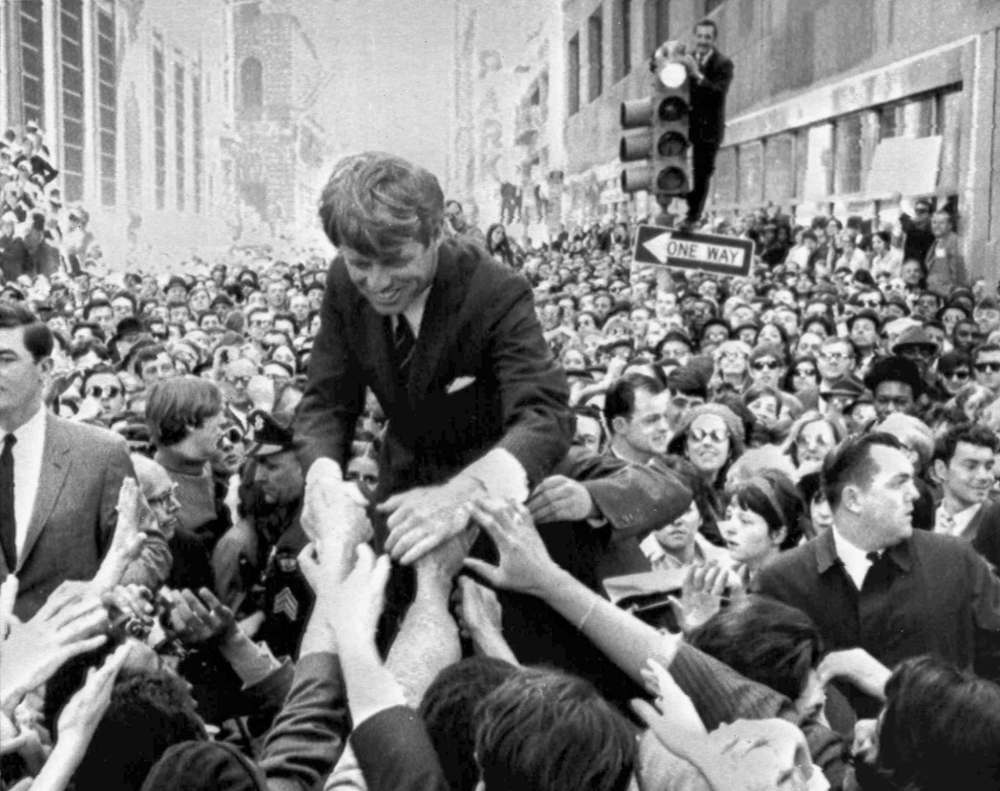
He was halfway through the kitchen when out of the shadows, dressed as a busboy, stepped Sirhan Sirhan, a 24-year old Palestinian who, as Larry Tye writes in his biography of RFK, “hated Israel (and) hated Kennedy for supporting Israel.” Sirhan had a .22-calibre gun and opened fire at Kennedy, hitting him several times. RFK slumped to the ground. He was rushed to a nearby hospital, but died from the gunshot wounds early on June 6.
It is hard to state with absolute certainty, but with his death the history of the U.S. was most likely sent along a different trajectory. Instead of Kennedy facing off against Nixon in the November election that year, it was vice-president Hubert Humphrey who became the Democrats’ nominee and lost to the Republican candidate.
That set in motion a cascade of events: a different and slower exit from Vietnam than Kennedy might have done; the Watergate scandal; Jimmy Carter as president, followed by two terms of Ronald Reagan, and perhaps a thousand other things. But, again, we will never know for sure how a second Kennedy as president might have acted.
The fascinating aspect of Robert Kennedy’s life and career is how much he changed as a politician. Not everyone believed it. Even when, as a senator from New York — he had been elected in 1964 — he announced he was running for president in mid-March 1968, the most frequently used adjective to describe him was “ruthless.” Though he was enormously popular, there were many Americans, including many Democrats, who resented him and accused him of trying to capitalize on the memory of his late brother.
Indeed, he could be ruthless, a trait he inherited from his overly ambitious father, Joseph P. Kennedy. As a young lawyer, RFK had briefly worked alongside Senator Joseph McCarthy and shared his paranoid fear of communists. Curiously, he continued his relationship with McCarthy long after the senator’s ignominious downfall.

Then, as JFK’s attorney general, he relentlessly took on organized crime and targeted Jimmy Hoffa, the notorious head of the Teamsters’ union. While both Kennedys supported Martin Luther King’s civil rights campaign and intervened more than once to free him from incarceration in jails in the Deep South, King did not completely trust the two brothers — and the feelings were mutual. So much so that Robert Kennedy, in arguably his worst decision as attorney general, acquiesced to FBI director J. Edgar Hoover’s request to employ electronic surveillance on King’s home, office and hotel rooms.
As a senator, however, Kennedy evolved into a true liberal champion of the underdog and downtrodden everywhere. He visited and offered words of support and promises of aid to impoverished African-Americans in the southern U.S., exploited farm workers in California, Indigenous leaders in South Dakota, victims of apartheid in South Africa and, most contentious of all in the midst of the Vietnam War, sympathy to the North Vietnamese enemy.
On April 4, 1968, the day King was killed, Kennedy was scheduled to speak in Indianapolis in a predominantly African-American neighbourhood. The city’s mayor and police chief advised him to cancel his appearance, but Kennedy refused. He told the crowd, which was justifiably angry, that “what we need in the United States is not hatred; what we need… is not violence and lawlessness, but is love, and wisdom and compassion toward one another.”
In the wake of King’s assassination, riots broke out in more than 100 U.S. cities, but not in Indianapolis. The African Americans there were inspired by and trusted RFK. He would still be an inspiration to Barack Obama four decades later as a leader who, as Obama said, “calls us to make gentle the life of a world that’s too often coarse and unforgiving.”
Now & Then is a column in which historian Allan Levine puts the events of today in a historical context.