

Pipeline collapse creates opportunities
Advertisement
Read this article for free:
or
Already have an account? Log in here »
To continue reading, please subscribe:
Monthly Digital Subscription
$1 per week for 24 weeks*
- Enjoy unlimited reading on winnipegfreepress.com
- Read the E-Edition, our digital replica newspaper
- Access News Break, our award-winning app
- Play interactive puzzles
*Billed as $4.00 plus GST every four weeks. After 24 weeks, price increases to the regular rate of $19.95 plus GST every four weeks. Offer available to new and qualified returning subscribers only. Cancel any time.
Monthly Digital Subscription
$4.99/week*
- Enjoy unlimited reading on winnipegfreepress.com
- Read the E-Edition, our digital replica newspaper
- Access News Break, our award-winning app
- Play interactive puzzles
*Billed as $19.95 plus GST every four weeks. Cancel any time.
To continue reading, please subscribe:
Add Free Press access to your Brandon Sun subscription for only an additional
$1 for the first 4 weeks*
*Your next subscription payment will increase by $1.00 and you will be charged $16.99 plus GST for four weeks. After four weeks, your payment will increase to $23.99 plus GST every four weeks.
Read unlimited articles for free today:
or
Already have an account? Log in here »
Hey there, time traveller!
This article was published 10/09/2018 (2697 days ago), so information in it may no longer be current.
On Aug. 30, the federal court of appeal blocked the approval of the Trans Mountain pipeline expansion, leaving Prime Minister Justin Trudeau and his government with a multibillion-dollar white elephant. Prospects for completing the project are grim.
Alberta Premier Rachel Notley, whose political fate hinges on completion of the pipeline, was… unhappy. She immediately withdrew Alberta from the federal carbon tax program.
The result is hardly surprising.
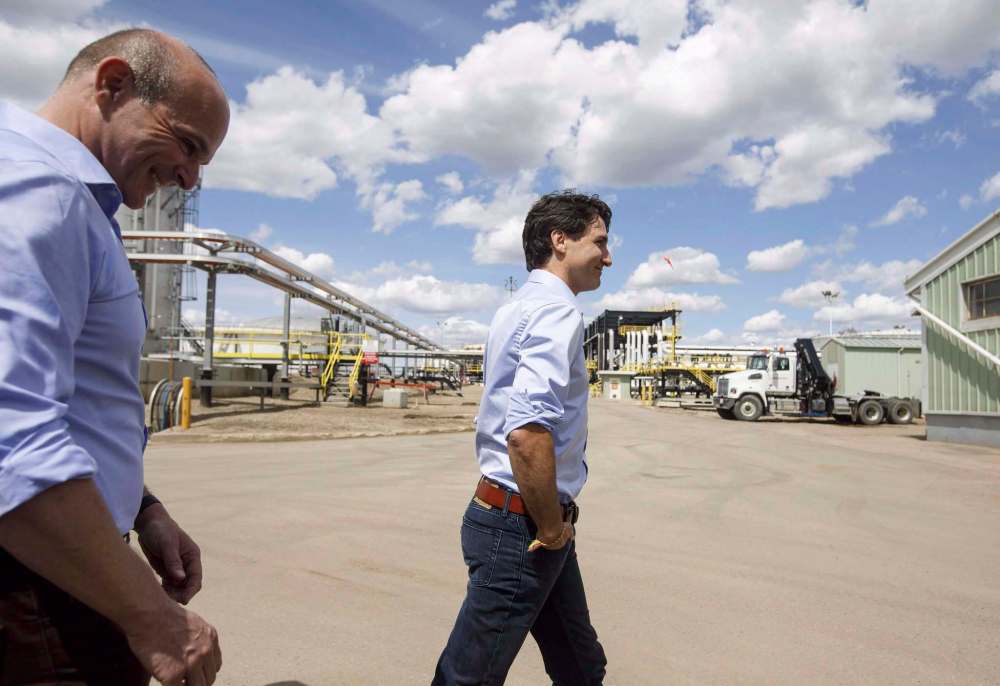
Trudeau’s climate policy has been conflicted from the start. On one hand, he committed to the Paris accord target — a 30 per cent reduction of our carbon footprint from 2005 levels by 2030. On the other hand, his government was facilitating a major expansion of heavy oil production in Alberta and Saskatchewan — a planned 60 per cent increase by 2035. The oilsands already account for one-tenth of Canada’s greenhouse gas production.
The math was never going to work.
Trudeau doubled down with the purchase of the existing pipeline for $4.5 billion and a further commitment of $9.3 billion to complete the expansion, or about $14 billion total. As climate policy, this is sheer insanity. Conservative Leader Andrew Scheer was little better, referring to our carbon-expensive heavy oil as “environmentally friendly,” a statement that is risible.
The big picture is this:
Globally, we need to move to a low-carbon economy to avert the worst effects of climate change. Nothing we can do now will prevent the global warming that is already locked in. But if we are to keep it to manageable levels, we need to reduce our greenhouse gas production by roughly five-sixths by mid-century. That is entirely doable and does not require wrecking the economy along the way.
We shall still need some fossil fuels going forward for many reasons, especially their non-fuel uses — including the production of plastics, rubber and textiles. If we need to continue oil production — and we do — then we should prefer it come from Canada instead of propping up despotic regimes that regularly abuse human rights.
While our heavy oil production is not virtuous today, we can make it more virtuous tomorrow by de-carbonizing its production. It is carbon expensive because of the profligate use of natural gas to extract the oil from the oilsands. That must end.
That natural gas needs to be replaced by renewable hydropower.
The money Trudeau plans to spend on Trans Mountain could pay for a hydro transmission line from northern Manitoba to Alberta with a spur line to Saskatchewan, and probably also an eastern connector to the Ontario power grid. In short, the beginnings of a national energy grid that would displace fossil fuels (mainly natural gas) from our electricity production.
Instead of freeing more of Alberta’s landlocked oil, we could free Manitoba’s landlocked hydropower.

The notion that we can continue to expand heavy oil production while combating climate change is fanciful. It makes about as much sense as investing in Blockbuster Video stores. Equally fanciful is the notion that we can shut down heavy oil production tomorrow without major economic wreckage. We can’t. And if we try, we will impair our ability to meet our climate change objectives.
The sensible middle path is to continue production at current levels and clean it up — both the carbon footprint and the ecological damage from bitumen mining. New production only comes online as current production comes offline.
Cleaning up the heavy oil production will, of course, increase production costs, which in reality is a hidden benefit. It serves exactly the same function as a carbon tax but is far more easily implemented politically. More expensive oil helps with the other side of a rational climate policy: reducing demand for petroleum products and providing the incentive to seek renewable alternatives.
Canada’s economic future lies in the development of our renewable energy resources. Manitoba’s hydropower could and should play a big part in that.
Scott Forbes is an ecologist at the University of Winnipeg.