

Big change unlikely in South African vote
Advertisement
Read this article for free:
or
Already have an account? Log in here »
To continue reading, please subscribe:
Monthly Digital Subscription
$1 per week for 24 weeks*
- Enjoy unlimited reading on winnipegfreepress.com
- Read the E-Edition, our digital replica newspaper
- Access News Break, our award-winning app
- Play interactive puzzles
*Billed as $4.00 plus GST every four weeks. After 24 weeks, price increases to the regular rate of $19.95 plus GST every four weeks. Offer available to new and qualified returning subscribers only. Cancel any time.
Monthly Digital Subscription
$4.99/week*
- Enjoy unlimited reading on winnipegfreepress.com
- Read the E-Edition, our digital replica newspaper
- Access News Break, our award-winning app
- Play interactive puzzles
*Billed as $19.95 plus GST every four weeks. Cancel any time.
To continue reading, please subscribe:
Add Free Press access to your Brandon Sun subscription for only an additional
$1 for the first 4 weeks*
*Your next subscription payment will increase by $1.00 and you will be charged $16.99 plus GST for four weeks. After four weeks, your payment will increase to $23.99 plus GST every four weeks.
Read unlimited articles for free today:
or
Already have an account? Log in here »
Hey there, time traveller!
This article was published 08/05/2019 (2513 days ago), so information in it may no longer be current.
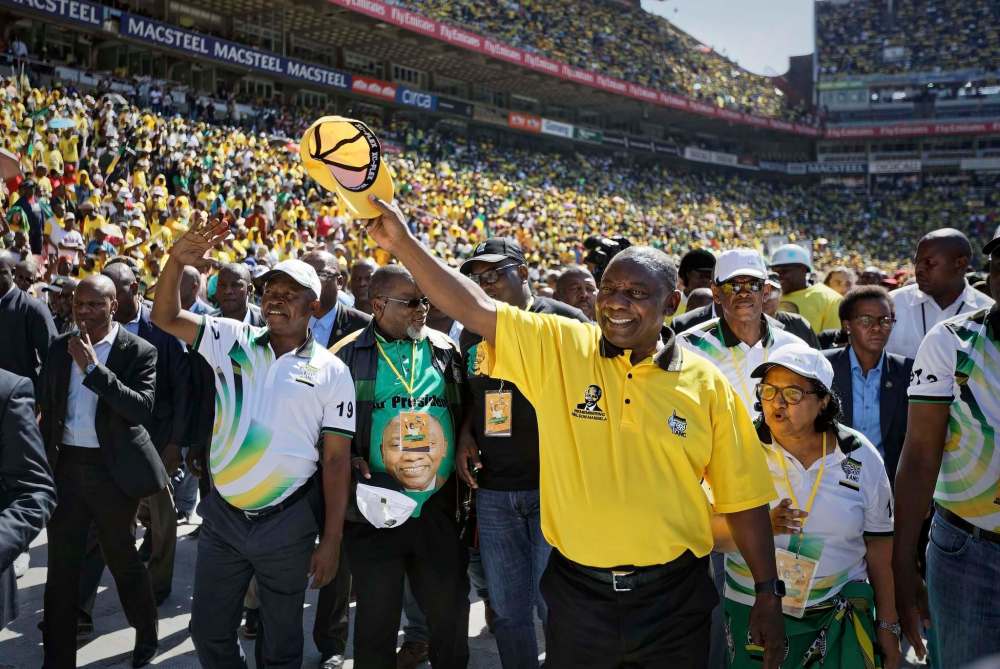
All the major contenders in today’s elections in South Africa held their closing rallies last weekend, and some striking things were said. As usual, Julius (Juju) Malema, the leader of the Economic Freedom Fighters party (EFF), won the prize for the most inflammatory statement.
Maybe he was more emotional than usual because his grandmother passed away last week, but at a huge rally in the Orlando Stadium in Soweto on Sunday, he actually urged police to start killing politicians.
“Go and shoot the real criminals,” Malema said, talking about the South African Police (SAP).
“If you want to shoot, go to Luthuli House and shoot Ace Magashule. If you want to shoot, go to parliament and shoot the house, which is full of criminals. Police officers, it is like you do not know where the thugs are. Come to me. I have a list.”
Magashule, who has run the province called the Free State for a long time and is now also secretary-general of the ruling African National Congress party (ANC), is indeed a thug. He is inexplicably wealthy, his critics in the Free State often have sudden and life-changing (or even life-ending) problems and he probably does deserve to be shot by somebody. But preferably not by a member of the SAP.
As for shooting up parliament, this is a serious breach of political etiquette in most democratic countries. But the EFF crowd loved it, and Malema gets a free ride from the media and the police when he says this sort of thing. Everybody assumes it’s just the way he talks.
And the EFF will at least double its vote in this election — though that would still leave it with only a 14 or 15 per cent share of the vote.
The bigger opposition party, the Democratic Alliance, still struggles to shed its old image as the party for well-meaning, middle-class white people. The current leader, Mmusi Maimane, concentrated his fire on the ANC, which has been in power since the end of apartheid a quarter-century ago.
“They were once our liberators, but today, we need to be liberated from them,” Maimane told the crowd.
It’s a pretty widespread sentiment, because not nearly enough has changed for the better for black South Africans in the past 25 years.
Like Malema, Maimane’s main target was the corruption that ran wild under the ANC’s last leader (and president of the country for nine years), Jacob Zuma. But the party is not radical enough to attract many people who are looking for major change, and its vote will probably fall (to only 21 per cent, according to the last opinion poll) in today’s election.
Which means the ANC may be able to win just enough votes (49.5 per cent in the last poll) to cling to power with a narrow majority. But it may also have to form a coalition for the first time, probably with one or more of the smaller parties (although Malema has said the EFF is also willing to join a coalition). And maybe things will really change, and maybe they won’t.
President Cyril Ramaphosa is not corrupt — he doesn’t need to be, since he is already a billionaire — and he does get some credit with the public for finally ousting the execrable Zuma. But he still faces huge resistance to root-and-branch reform within the ANC, many senior members of which are not ready to walk away from the trough yet.
His own dedication to reform is also in doubt. He promised to make campaign donations to political parties completely transparent, for example, and the law was actually passed — but he delayed signing it long enough to benefit from the famously opaque old rules one last time in this election.
This is billed as a “pivotal” election when South Africa finally turns a corner of some sort, but there is no good reason to believe it. South African economic growth is arthritic, running at below two per cent while other African countries like Kenya and Ethiopia rack up six to eight per cent annual growth.
True, South Africa is still a much richer country, but it doesn’t feel rich to the working poor and the 27 per cent who are unemployed. That’s higher than it was in the last years of the apartheid era, and higher than even 10 years ago, so it’s little wonder many people feel something akin to despair.

More kids are in school now, but the quality of public education has fallen even further, and it was never high. Millions of (very modest) new houses have been built, but the housing shortage is just as bad as ever. Public health services are in disrepair, there are frequent power cuts and even the climate seems to have turned against South Africa (although the water crisis in Cape Town is in remission).
Given all this, and the widespread perception that corruption is rotting the country, it is remarkable South Africans still have faith that their votes can change things.
But they do: in no national election since Nelson Mandela became president in 1994 has the turnout fallen below 73 per cent.
As long as it stays up there, you can’t really say the situation is hopeless. But sooner or later, optimism has to be rewarded with results.
Gwynne Dyer’s latest book is Growing Pains: The Future of Democracy (and Work).
Related Articles
South Africa votes with corruption, jobs as big issues
Advertisement Advertise With Us
Advertisement Advertise With Us