

Misogyny, violence persist 30 years on
Advertisement
Read this article for free:
or
Already have an account? Log in here »
To continue reading, please subscribe:
Digital Subscription
One year of digital access for only $75*
- Enjoy unlimited reading on winnipegfreepress.com
- Read the E-Edition, our digital replica newspaper
- Access News Break, our award-winning app
- Play interactive puzzles
*Billed as $5.77 plus GST every four weeks. After 52 weeks, price increases to the regular rate of $19.95 plus GST every four weeks. Offer available to new and qualified returning subscribers only. Cancel any time.
Monthly Digital Subscription
$4.99/week*
- Enjoy unlimited reading on winnipegfreepress.com
- Read the E-Edition, our digital replica newspaper
- Access News Break, our award-winning app
- Play interactive puzzles
*Billed as $19.95 plus GST every four weeks. Cancel any time.
To continue reading, please subscribe:
Add Free Press access to your Brandon Sun subscription for only an additional
$1 for the first 4 weeks*
- Enjoy unlimited reading on winnipegfreepress.com
- Read the E-Edition, our digital replica newspaper
- Access News Break, our award-winning app
- Play interactive puzzles
*Your next Brandon Sun subscription payment will increase by $1.00 and you will be charged $17.95 plus GST for four weeks. After four weeks, your payment will increase to $24.95 plus GST every four weeks.
Read unlimited articles for free today:
or
Already have an account? Log in here »
Hey there, time traveller!
This article was published 05/12/2019 (2355 days ago), so information in it may no longer be current.
Dec. 6 marks the 30th anniversary of Canada’s worst mass shooting — the L’École Polytechnique massacre, also known as the Montreal Massacre.
For me, the names and faces of the 14 women shot just because they were women are never far from my thoughts on Dec. 6 as numerous memorials are held in their memory: Geneviève Bergeron, Hélène Colgan, Nathalie Croteau, Barbara Daigneault, Anne-Marie Edward, Maud Haviernick, Maryse Laganière, Maryse Leclair, Anne-Marie Lemay, Sonia Pelletier, Michèle Richard, Annie St-Arneault, Annie Turcotte and Barbara Klucznik-Widajewicz.
Today, these women would now likely be in mid- or late career if they had been allowed to continue their education. One of them, Laganière, was a budget clerk at the school. Another, Klucznik-Widajewicz, was a nursing student. The rest were in engineering and, as most already know in this terrible tale, their killer, Marc Lépine, hated them because they were doing what he could not.
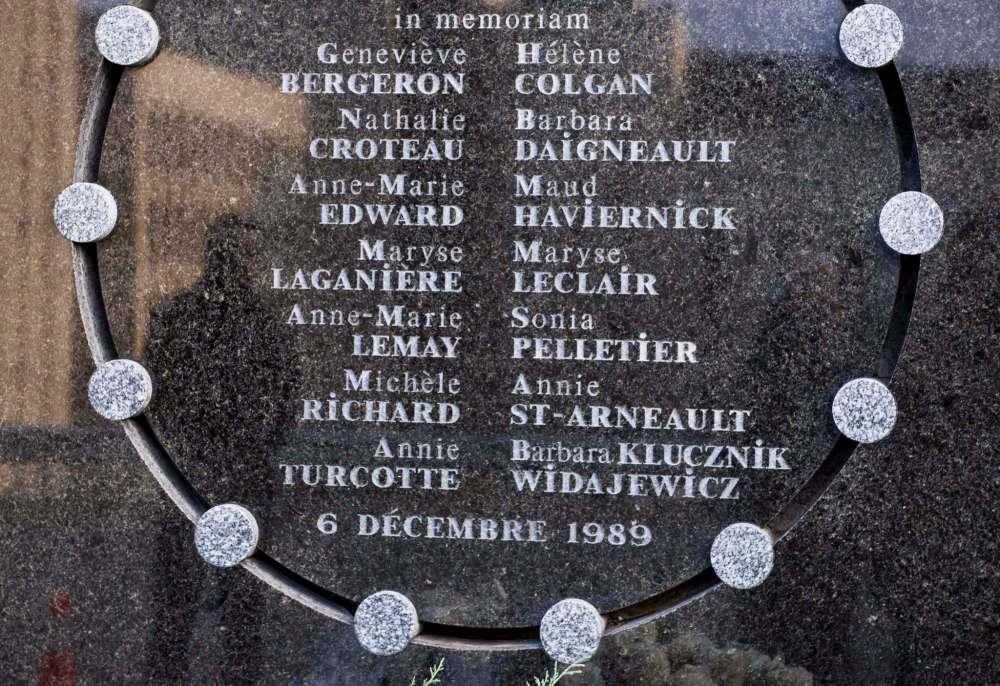
Lépine had been denied entry twice into L’École Polytechnique and rather than blame his own inadequacies, he blamed women — or, more specifically, feminists — when he took 14 lives and forever changed Canada’s view of itself as a safe place to live.
Dec. 6 now marks a National Day of Remembrance and Action on Violence Against Women. The federal government unveiled 16 days of action designed to address the fact that for women, girls and LGBTTQ+ individuals across our country, violence continues to be a daily reality. These actions include a social-media campaign and education tool kits for school-aged children about gender-based violence and the different forms it can take, as well as the white-ribbon campaign for men who pledge to be allies for women and stand against violence.
It might be easy to think we’ve come so far that a man like Lépine could never do this again, until Alek Minassian introduced in April 2018 another disturbing word into our vocabulary: incel — the involuntary celibates who, like Minassian, resort to violence because women do not respond to their romantic advances.
Twenty-six-year-old Minassian’s rage resulted in the death of 10 people in Toronto, after he drove a van into a crowded sidewalk on one of the city’s busiest streets. Another 16 people were injured. It was a deliberate act by an angry incel who blamed women for his shortcomings.
Entitled men blaming women doesn’t always end in overt violence. Sometimes, the violence manifests in much subtler ways, such as rhetoric, particularly in the world of politics.
“Climate-Change Barbie” is the insulting nickname Liberal MP Catherine McKenna had to endure for years while serving as climate change and environment minister in Prime Minister Justin Trudeau’s first cabinet. Someone else has that portfolio now, but it was still effectively McKenna’s when she discovered a sexist and vulgar obscenity was spray-painted on her campaign office window just days after she won re-election.
McKenna needed a security detail from the RCMP at one point, something cabinet ministers in Canada rarely require, due to concerns for her personal safety. But she’s not the only female politician for whom safety has been an issue.
Former Alberta premier Rachel Notley had the distinction of holding the record for the most threats of any sitting premier in that province. In documents released by Alberta Justice, Notley was shown to have been subjected, in 2016 alone, to 412 incidents of what is termed inappropriate contact and communication.
Twenty-six files were forwarded to police for review and possible investigation, and Notley also had the highest number of what were deemed medium threats: 19, compared to just three for former premier Ralph Klein and three for Jim Prentice. Allison Redford, meanwhile, had 16.
Threatening women as a way to make them back out of the space men have been allowed to dominate for years is a coward’s act. Using social media to attempt to bully them into silence is misogyny on a smaller scale, but still of the sort that provides the Minassians and Lépines among us someone else to blame for their shortcomings.

Tomorrow, I will remember 14 women, who like me in 1989, were ready to take on the big world. Back then, I was so sure that if I just worked really hard and did my very best, being a woman wouldn’t matter.
And 30 years later, I know that no matter how many times I repeat that lie to myself, it remains as untrue now as it was then.
Rachel Notley, Catherine McKenna and Alex Minassian are proof of that.
Shannon Sampert is a retired political scientist and runs the communications consulting company Media Diva.
s.sampert@uwinnipeg.ca
Related Articles
Polytechnique attack recognized as 'anti-feminist'

Advertisement Advertise With Us
Advertisement Advertise With Us
History
Updated on Thursday, December 5, 2019 8:38 AM CST: Corrects spelling of École