

No exit strategy for COVID-19
Advertisement
Read this article for free:
or
Already have an account? Log in here »
To continue reading, please subscribe:

Digital Subscription
One year of digital access for only $205*
- Enjoy unlimited reading on winnipegfreepress.com
- Read the E-Edition, our digital replica newspaper
- Access News Break, our award-winning app
- Play interactive puzzles
*First annual payment billed as $205.00 + GST for one year. This annual subscription will automatically renew at $233.00 + GST every 52 weeks (10% off the regular annual price of $259.35). Offer available to new and qualified returning subscribers only. Cancel any time.
To continue reading, please subscribe:
Add Free Press access to your Brandon Sun subscription for only an additional
$1 for the first 4 weeks*
- Enjoy unlimited reading on winnipegfreepress.com
- Read the E-Edition, our digital replica newspaper
- Access News Break, our award-winning app
- Play interactive puzzles
*Your next Brandon Sun subscription payment will increase by $1.00 and you will be charged $17.95 plus GST for four weeks. After four weeks, your payment will increase to $24.95 plus GST every four weeks.
Read unlimited articles for free today:
or
Already have an account? Log in here »
Hey there, time traveller!
This article was published 21/03/2020 (2313 days ago), so information in it may no longer be current.
Most of the countries in Asia, Europe and North America are in lockdown to slow the spread of the COVID-19 virus. This is the “suppression” strategy, and it should keep the death rate from going exponential for a while. The unanswered question is: what do we do next?
There is no exit strategy.
“This type of intensive intervention package (“social distancing” of the entire population, home isolation of COVID-19 cases, and household quarantine of their family members) will need to be maintained until a vaccine becomes available (potentially 18 months or more) — given that we predict that transmission will quickly rebound if interventions are relaxed.”
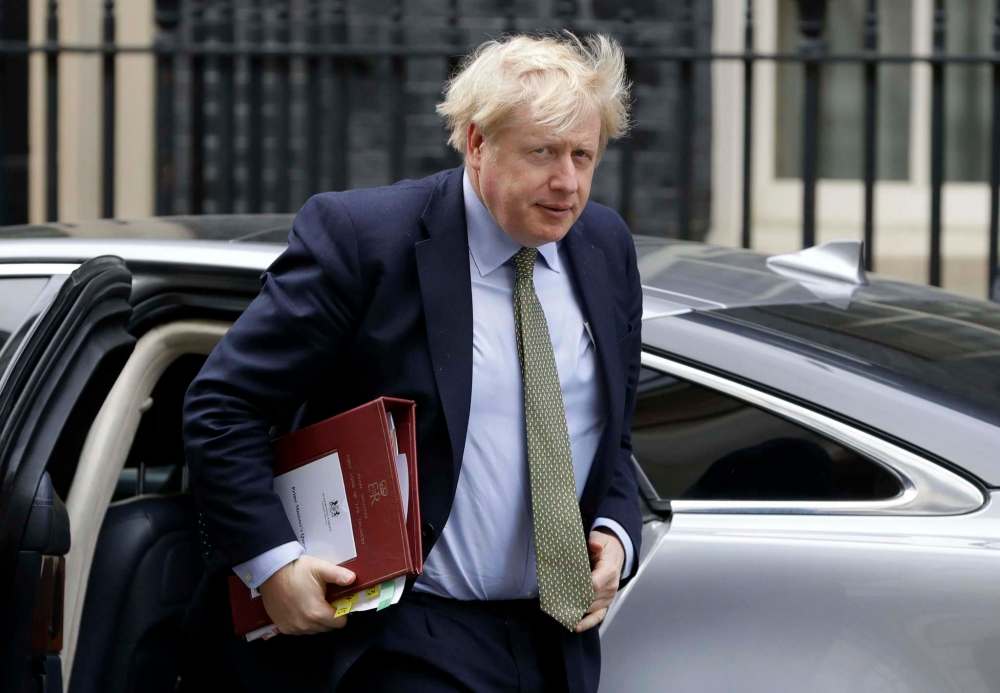
That’s from the executive summary of the key Imperial College London report that on Monday forced the British government to abandon its insane policy of letting the infections grow and hoping the population (or what was left of it) would achieve “herd immunity.”
The 30-strong Imperial College team estimated that an “unmitigated epidemic” — no closure of schools, shops, restaurants and bars, no household quarantines of suspected coronavirus cases and their families, no “social distancing” — would directly cause 510,000 deaths in the U.K. in the first wave of infections (now to July or August).
Infections would grow rapidly through March, and the demand for beds in intensive care units would exceed supply by the second week of April. At the peak of the first wave of infections in mid-May, demand for ICU beds would be 30 times greater than supply.
They did the same calculations for the U.S., and concluded that 2.2 million Americans would die in the first wave of infections. (This number was instrumental in jolting the Trump administration out of its “deny, distract and downplay” strategy last weekend.) Such huge caseloads would inevitably crash the health systems in both countries, causing further “secondary” losses of life.
So the team moved on to consider the “mitigation” model. This concentrates on “flattening the curve” of infections, which would peak in late June. Suspected cases of infection are confined to their homes and their families are quarantined, schools are closed, over-70s are required to self-isolate — but shops, bars, restaurants, etc. stay open, and the economy staggers on.
The mitigation policy’s outcome is slightly better, but the peak case load is still so high that it crashes the health system. Total deaths in the first wave are reduced only by half: i.e., a quarter-million die in the United Kingdom, and a million in the United States. So the Imperial College team moved on to examine the third option: “suppression.”
Suppression, or “lockdown” if you prefer, drastically reduces human contact in order to reverse the rate at which infections are spreading.
“Social distancing” applies to everyone, not just the over-70s, and almost all public venues except food shops and pharmacies are closed. It does the job — after a few weeks death rates drop sharply — but the economy also goes into decline: probably six per cent down or worse by the end of the year.
This is now the policy in most developed countries: mass death is no longer on the doorstep. The United States as a whole is still in “mitigation,” because it takes a long time to turn a supertanker like Trump all the way around, but New York and some other big American cities and states have already moved on to suppression.

It has all happened very fast, and governments are just starting to realize that we will be in this mode for a long time. In fact, unless this particular coronavirus fails to cause a second wave of infections next winter — it isn’t certain — we will probably be stuck in lockdown most of the time until an effective vaccine becomes widely available, probably no sooner than 18 months from now. August of 2021, let’s say.
In the meantime, the best we can hope for is a few breaks when new infections have fallen so low that the controls can be “relaxed temporarily in relatively short time windows” for a month or two. But the virus will still be at large in the population, and we’ll probably have to re-impose the controls as the number of infections starts to spike again.
Economically, it will be as big a hit as the Great Recession of 2008-09. Saving everything from shuttered shops, theatres and restaurants to passenger-starved airlines from bankruptcy will be a huge challenge. Keeping their laid-off employees out of poverty will be just as hard. There will have to be mortgage and rent holidays and maybe “helicopter money” (dropped from above by central banks).
But here’s a silver lining, if you want one: in every country we have collectively decided, without even an argument, that we care more about the lives of our fellow citizens than we do about the damned economy.
Gwynne Dyer’s latest book is Growing Pains: The Future of Democracy (and Work).