

Spring flood would compound pandemic fight
Advertisement
Read this article for free:
or
Already have an account? Log in here »
To continue reading, please subscribe:
Digital Subscription
One year of digital access for only $1.44 a week*
- Enjoy unlimited reading on winnipegfreepress.com
- Read the E-Edition, our digital replica newspaper
- Access News Break, our award-winning app
- Play interactive puzzles
*Billed as $5.77 plus GST every four weeks. After 52 weeks, price increases to the regular rate of $19.95 plus GST every four weeks. Offer available to new and qualified returning subscribers only. Cancel any time.
To continue reading, please subscribe:
Add Free Press access to your Brandon Sun subscription for only an additional
$1 for the first 4 weeks*
- Enjoy unlimited reading on winnipegfreepress.com
- Read the E-Edition, our digital replica newspaper
- Access News Break, our award-winning app
- Play interactive puzzles
*Your next Brandon Sun subscription payment will increase by $1.00 and you will be charged $17.95 plus GST for four weeks. After four weeks, your payment will increase to $24.95 plus GST every four weeks.
Read unlimited articles for free today:
or
Already have an account? Log in here »
Hey there, time traveller!
This article was published 01/04/2020 (2253 days ago), so information in it may no longer be current.
THE response of Canadians and Manitobans to the coronavirus pandemic has been extraordinary. We have set aside partisan politics. We have remained calm in circumstances that invite panic. Our response is being guided by science rather than belief. Neighbours are looking out for neighbours. The best of human nature, with a few inevitable exceptions, is on display.
Although we are able to suspend much of what in normal times constitutes daily life, nature — the life processes of our planet — soldiers on quite unaffected by all of this. If those processes add up to a major flood in the Red River Valley this spring, it will not be postponed due to the pandemic.
While we fervently hope that spring unfolds gently and gradually, we have to be prepared for the possibility that it will not. Past experience tells us that a major storm event or a rapid thaw can turn a placid spring melt into a destructive torrent. How do we respond to a major flood event and still preserve physical distancing?
Many First Nations communities are at risk. If it becomes necessary, how do we handle mass evacuations and the possible establishment of evacuation centres? Medical professionals and scientists, already overtaxed, need to work with Indigenous leaders and government to develop protocols to govern the physical interactions that occur in such an emergency. Perhaps this has already been done.
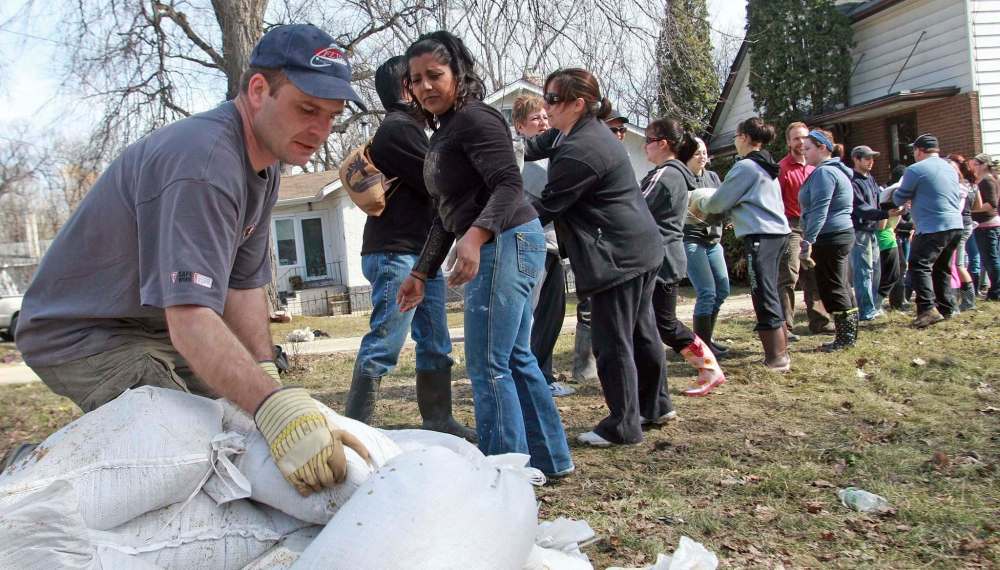
Flood fighting is, for the most part, activities that bring people together in groups large and small. Maintaining flood control works, sandbagging, earth-moving, information dissemination through call centres, planning, logistics, moving people from high-risk areas, maintaining and protecting essential public works — the list is a long one, indeed.
As the experience of the 1997 “Flood of the Century” taught us, volunteers are an essential ingredient to flood response. In fact — on a much smaller scale, of course — the mobilization and response to that natural disaster brought out many of the same virtues we are seeing displayed in our current public health emergency.
We could be faced with the perplexing problem of soliciting volunteers, asking them to come together at a time when we are advising them to stay apart. Those of us who are elderly and have had some experience in flood-fighting — a very useful cohort of volunteers in 1997, but at high risk during this pandemic — may have to decide, as will many others, whether personal safety outweighs social obligation. Hopefully, it does not.
We may be faced with the unprecedented dilemma of confronting two competing public risks involving two competing and conflicting responses; one calls for us to keep our distance, while the other may require us to mobilize in teams working closely together. This is an unpleasant choice. We hope it doesn’t happen, but must plan for the eventuality.

Much may have already been done. Plans may be in place that will mobilize the necessary response without substantially increasing the risk of virus transmission. If so, we should know what they are; if not, we should — and can, and must — collectively develop them. We are inventive creatures. If it is required, and we pray it is not, we can mobilize to effectively meet a flood emergency without compromising public health.
It will require discipline, but isn’t that what we’re already exercising?
We have seen over the past few weeks that our governments can rise to the challenge of an unprecedented public emergency. And governments have seen that we citizens can respond calmly and responsibly to that emergency. So government ought not to delay in initiating a candid dialogue with us about how we would confront a major flood during this pandemic. We can handle it.
Nature may turn out to be benign, at least this year. The dialogue may turn out to be just an interesting thought experiment. But if it isn’t, we will be ready.
Norman Brandson was deputy minister of the former Manitoba departments of environment, water stewardship and conservation from 1990 to 2006.
Related Articles
COVID-19 hampers sandbag production

Advertisement Advertise With Us
Advertisement Advertise With Us