

Manitoba NDP faces uncertain path
Advertisement
Read this article for free:
or
Already have an account? Log in here »
To continue reading, please subscribe:
Monthly Digital Subscription
$1 per week for 24 weeks*
- Enjoy unlimited reading on winnipegfreepress.com
- Read the E-Edition, our digital replica newspaper
- Access News Break, our award-winning app
- Play interactive puzzles
*Billed as $4.00 plus GST every four weeks. After 24 weeks, price increases to the regular rate of $19.95 plus GST every four weeks. Offer available to new and qualified returning subscribers only. Cancel any time.
Monthly Digital Subscription
$4.99/week*
- Enjoy unlimited reading on winnipegfreepress.com
- Read the E-Edition, our digital replica newspaper
- Access News Break, our award-winning app
- Play interactive puzzles
*Billed as $19.95 plus GST every four weeks. Cancel any time.
To continue reading, please subscribe:
Add Free Press access to your Brandon Sun subscription for only an additional
$1 for the first 4 weeks*
*Your next subscription payment will increase by $1.00 and you will be charged $16.99 plus GST for four weeks. After four weeks, your payment will increase to $23.99 plus GST every four weeks.
Read unlimited articles for free today:
or
Already have an account? Log in here »
Hey there, time traveller!
This article was published 05/06/2020 (2050 days ago), so information in it may no longer be current.
Speculation about the post-pandemic future of society is rampant. The crisis has required governments to intervene and spend mountains of money. Some left-of-centre commentators have argued that the neo-liberal, anti-government, low-tax and downsizing thinking that dominated political discourse for decades could be waning. That remains to be seen. The best prophets are usually just the best guessers.
So, this leads me to ask: “If there is more public sentiment supporting a positive role for government, what might this mean for the NDP in Manitoba?”
After nearly 17 years in government, the NDP was defeated soundly in the 2016 election, a setback caused mainly by a broken promise not to increase the provincial sales tax, and a cabinet revolt that nearly toppled premier Greg Selinger and generalized voter frustration with a party that seemed complacent and out of ideas.
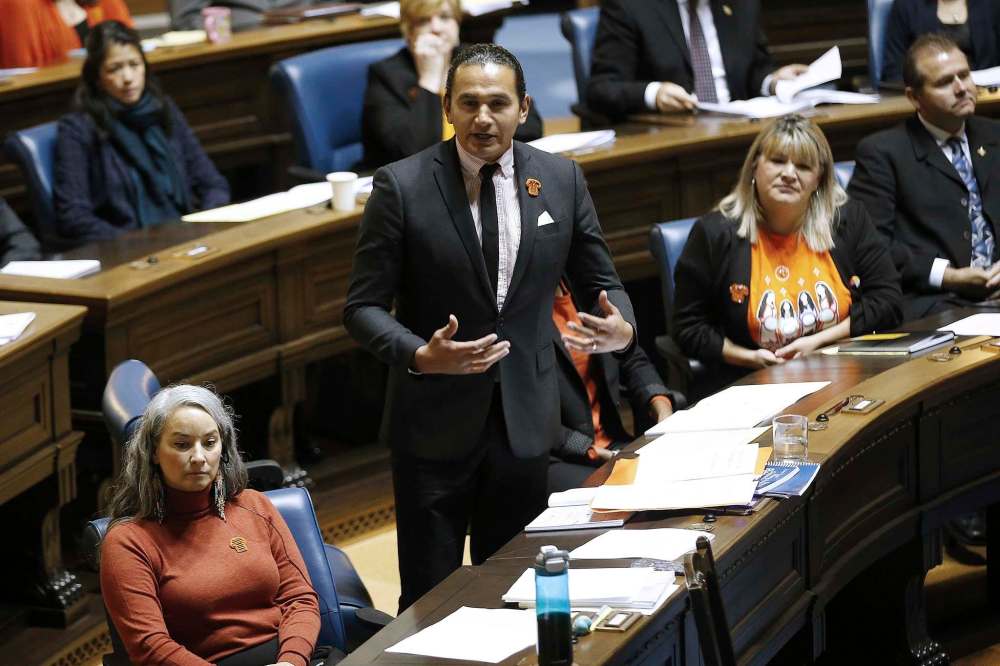
After Wab Kinew was selected leader in 2017, the NDP began a rebuilding process.
In the early provincial election held in September 2019, the ruling Progressive Conservatives were returned with another comfortable majority. The victory was achieved despite a tough and highly contentious budgetary strategy of downsizing, consolidations, restraint and layoffs. Focusing its campaign attacks mainly on the health-care changes, the NDP captured six per cent more of the popular vote and won six more seats than in 2016.
In the next election campaign, the NDP will likely focus strongly on how the province was left unprepared for the pandemic due to downsizing, and how the austerity agenda of the premier meant the provincial response to the economic fallout was slow and limited.
Defending his government, Pallister claims the former NDP government left a deep financial mess of deficits, debts and falling credit ratings that required drastic measures. Clearly, there is a philosophical divide between the two main parties.
Focusing specifically on the NDP, there has always been an internal tension between a historical social movement advancing social-democratic ideas and a competitive political-party orientation focused on winning power. After its historic first victory in 1969, the competitive party orientation came to gradually take hold.
After a decade in opposition, Gary Doer led the NDP to power in 1999 based on a moderate, pragmatic approach. However, his successor as leader and premier, Greg Selinger, was far more ideologically inclined.
Almost certainly there will be ongoing debate over how the NDP should define itself going forward. Some insiders will argue that to win the next election, the party must adopt a pragmatic, incremental policy approach. Others will insist that the party should capitalize on the recent sentiments favouring “big government” to advance a comprehensive, bold and ambitious social-democratic agenda.
In my opinion, this is a false and incomplete dichotomy in terms of the realistic choices open to the party. It will have to appeal to voters based on concrete, practical proposals that address contemporary issues and, at the same time, it must provide a broad vision of where it is going over the longer term.
In searching for a balanced approach, the toughest issue will be finding agreement over taxing, spending, deficits and debt. Disagreement on these fiscal policy matters caused a revolt within the NDP back in 2014. Increasing corporate or personal income taxes to gain revenues would probably not be politically feasible, except perhaps for a tax targeted at the wealthy. Reversing the current government’s actual and proposed sales-tax reductions to recover lost revenues seems unlikely, given earlier fiascoes on that front.
The NDP has always been a staunch defender of universal access to quality health care. Not surprisingly, therefore, the party opposed the closures, consolidations and layoffs in the health system introduced by the Pallister government. A decision by a future NDP government to reverse those actions, such as by reopening emergency rooms, would require careful consideration of what is affordable and whether another wave of disruption to the health system is advisable.

Climate change, the possibility of a universal basic income, Indigenous issues, justice reform and the future of Manitoba Hydro are topics on which the NDP will appeal to voters with policy positions distinct from those of the PCs.
The NDP has targeted its criticism of the government at the premier, believing he is personally in charge and lacks a strong connection with voters. Before the next election, however, Pallister is expected by some to resign and be replaced by a leader with less of an ideological edge.
Beyond policy and leaders who are capable of effectively personifying the party brand, election campaigns require organizational capacity and money, both of which are in short supply in the NDP these days.
The next fixed date election is not scheduled until October 2, 2023, so a lot could happen before then. Accordingly, this analysis represents, at best, an educated guess.
Paul G. Thomas is professor emeritus of political studies, University of Manitoba.