

Fox’s run beyond medal-worthy
Advertisement
Read this article for free:
or
Already have an account? Log in here »
To continue reading, please subscribe:

Digital Subscription
One year of digital access for only $205*
- Enjoy unlimited reading on winnipegfreepress.com
- Read the E-Edition, our digital replica newspaper
- Access News Break, our award-winning app
- Play interactive puzzles
*First annual payment billed as $205.00 + GST for one year. This annual subscription will automatically renew at $233.00 + GST every 52 weeks (10% off the regular annual price of $259.35). Offer available to new and qualified returning subscribers only. Cancel any time.
To continue reading, please subscribe:
Add Free Press access to your Brandon Sun subscription for only an additional
$1 for the first 4 weeks*
- Enjoy unlimited reading on winnipegfreepress.com
- Read the E-Edition, our digital replica newspaper
- Access News Break, our award-winning app
- Play interactive puzzles
*Your next Brandon Sun subscription payment will increase by $1.00 and you will be charged $17.95 plus GST for four weeks. After four weeks, your payment will increase to $24.95 plus GST every four weeks.
Read unlimited articles for free today:
or
Already have an account? Log in here »
Hey there, time traveller!
This article was published 31/07/2021 (1842 days ago), so information in it may no longer be current.
When coverage of the Tokyo Olympics seems too slick, too staged, too commercial, it’s refreshing to think back to a great Canadian athlete who was none of those.
Terry Fox didn’t compete within the structure of a sport, much less one recognized by the Olympic governing body. Yet his accomplishment is the essence of high-level athletic achievement.
This weekend offers an opportunity to compare Fox and Olympic athletes because of the coincidence of the Tokyo Olympics unfolding at the same time as Manitoba marks Terry Fox Day on Monday. Initially, it might seem an odd comparison. The performance of Olympians is measured by rankings within their category; Fox can’t be ranked because there’s not a category for what he did.
But the comparison can show what’s best about Fox and top-level Olympians — both share tenacious willpower that pushes their bodies and minds to their limits — and also how the pure ideal of the Olympics has become bloated with hype and marketing.
Even before they arrived in Tokyo, Olympic athletes were heralded with lavish media attention that often fawned. When Fox started his legendary run by dipping his prosthetic right leg in the Atlantic Ocean on April 12, 1980, he was almost anonymous. Even most residents of Winnipeg, where he was born and lived until he was eight years old, didn’t know the guy.
Olympic athletes are typically surrounded by teams of experts in sport physiology, conditioning, psychology, biomechanics and nutrition. Fox started his feat accompanied only by his friend Doug Alward, who cooked, drove a van along the route and, apparently, had a lively relationship with Fox that included quarrelling.
The 24/7 media coverage of the modern Games includes a barrage of shrewd advertisements from corporations trying to piggyback on the image of athletes, and many Olympians hope to monetize their athletic achievements and become product spokespeople if they get an offer. Not Fox. He rejected all companies that wanted him to endorse their products. All profits from his run went to cancer research.
There’s lots to celebrate about Fox, and many places do. And — this must be said — many places do a better job of it than Winnipeg, which can legitimately claim itself as the birthplace of this Canadian icon. Many places with little or no personal connection to Fox honour him in ways more prominent than what Winnipeg has done. His name is on 14 schools across Canada, 15 roads and highways, 12 parks and trails, and on stamps and coins. Valemount, B.C., named a mountain after him.
And Winnipeg? Our appreciation of the kid from Transcona is understated, to say the least.
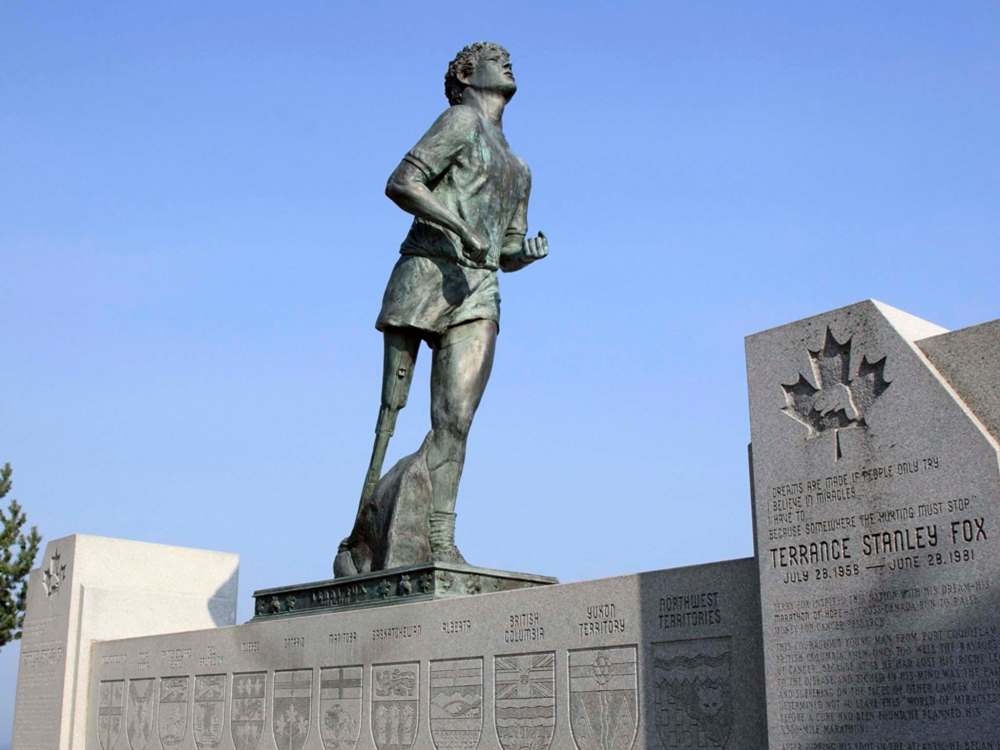
There’s a bust of Fox in Assiniboine Park, but it’s modest recognition compared to the bronze statue, three metres high, that is the hub of a park overlooking Lake Superior along the Trans-Canada Highway near Thunder Bay.
We should do better, considering Terry Fox’s parents, Betty and Rolland Fox, were true-blue Winnipeggers who raised Terry in the family home at 520 Gertrude Ave. before they moved to B.C.
An apt way to recognize the Fox family’s roots in Winnipeg would be to rename Wayoata School in Transcona, the school Terry attended for three years and which is still in use. This is not an original suggestion. Changing the name of Wayoata to Terry Fox School was previously proposed in 2005, but the proposal was turned down, owing to a misunderstanding that, to this day, remains head-shakingly preposterous.
Some trustees on the River East Transcona School Division board said they didn’t want to remove the Wayoata name because they believed it was an Indigenous word and they didn’t want to show disrespect to local Indigenous people. But the Free Press checked at the time with local Cree and Ojibwa speakers and academics; none of them knew of the word Wayoata.
There’s still time for the current trustees of River East Transcona to make it right. The Pallister government plans to eliminate school divisions, but before they lose their power, the trustees could change the school’s name to honour the former student who walked its halls and went on to become one of the greatest Canadians of all time.
Other ways to show hometown pride in Fox include erecting a full-blown statue. At a time when statues are being toppled because of historical wrongdoings, the reputation of Fox is as pure and white as the T-shirts he wore during his run.

A statue commemorating Fox would let Winnipeggers look up to a heroic figure who overcame adversity with gritty courage, who wouldn’t sell out to corporate endorsements and whose legacy has raised more than $800 million for cancer research.
There aren’t any Olympic athletes who can say as much.
carl.degurse@freepress.mb.ca
Carl DeGurse is a member of the Free Press editorial board.
w
Related Articles
What’s open, what’s closed on Terry Fox Day
Advertisement Advertise With Us
Advertisement Advertise With Us