

Education is a human right for all girls
Advertisement
Read this article for free:
or
Already have an account? Log in here »
To continue reading, please subscribe:
Digital Subscription
One year of digital access for only $75*
- Enjoy unlimited reading on winnipegfreepress.com
- Read the E-Edition, our digital replica newspaper
- Access News Break, our award-winning app
- Play interactive puzzles
*Billed as $5.77 plus GST every four weeks. After 52 weeks, price increases to the regular rate of $19.95 plus GST every four weeks. Offer available to new and qualified returning subscribers only. Cancel any time.
Monthly Digital Subscription
$4.99/week*
- Enjoy unlimited reading on winnipegfreepress.com
- Read the E-Edition, our digital replica newspaper
- Access News Break, our award-winning app
- Play interactive puzzles
*Billed as $19.95 plus GST every four weeks. Cancel any time.
To continue reading, please subscribe:
Add Free Press access to your Brandon Sun subscription for only an additional
$1 for the first 4 weeks*
- Enjoy unlimited reading on winnipegfreepress.com
- Read the E-Edition, our digital replica newspaper
- Access News Break, our award-winning app
- Play interactive puzzles
*Your next Brandon Sun subscription payment will increase by $1.00 and you will be charged $17.95 plus GST for four weeks. After four weeks, your payment will increase to $24.95 plus GST every four weeks.
Read unlimited articles for free today:
or
Already have an account? Log in here »
Hey there, time traveller!
This article was published 08/10/2021 (1688 days ago), so information in it may no longer be current.
International Day of the Girl (Oct. 11) and International Women’s Day (March 8) bookend each year as days to raise awareness about unique challenges for girls, to celebrate progress, and to reflect on what to do next. These annual events seek to galvanize the world to make positive change. Without them, people too easily forget or do little to stop and disrupt the rhythm of inequality.
The harm inflicted daily on Afghanistan’s girls is but one example. While recently thrust into the news by the Taliban’s takeover, women’s rights have been threatened and silenced for decades.
A huge stepping stone toward equality lies with access to education, and the approach is twofold.
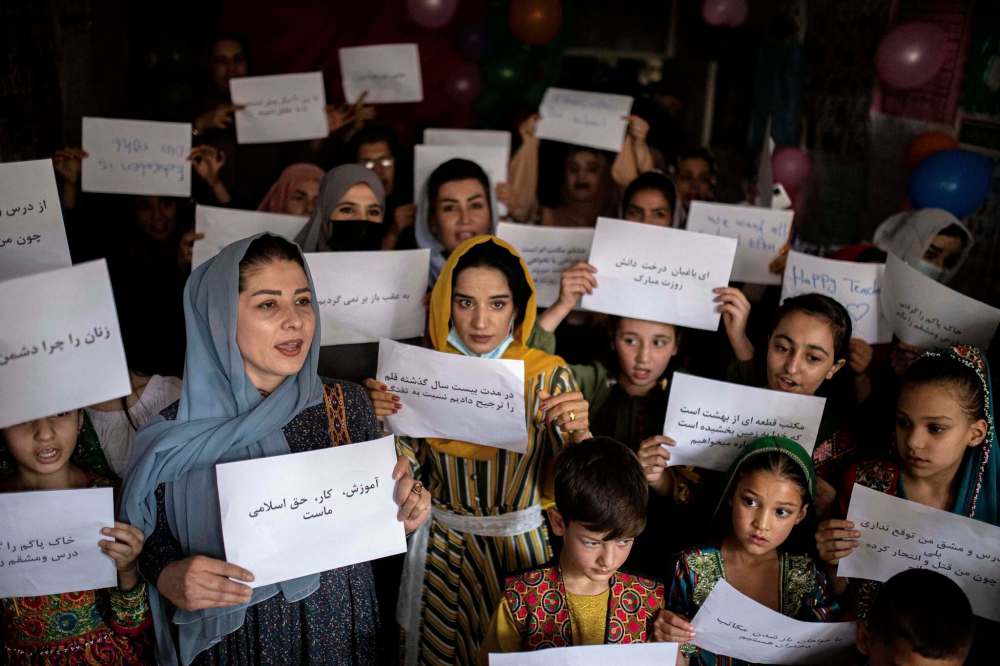
Education is a human right and a child’s most powerful tool to change their own world. It helps girls build healthy and prosperous lives, prevents them from forced marriages and early pregnancies, and enables them to dream fearlessly to reach their full potential. Meanwhile, on national and global levels, educated girls bolster economies, encourage political empowerment and foster changemakers today and in the generations to come.
Globally, however, 129 million girls are currently out of school. Gender inequality and poverty in developing communities prevents girls from accessing education. Gender-based violence, forced child marriage and responsibilities in the home keep girls away from school. Additionally, lack of access to clean water or sanitation makes it hard for girls to attend school when menstruating — an obstacle that doesn’t exist for boys.
Without education, poverty is amplified.
In marginalized communities, there are physical challenges to overcome before entering the classroom, too. Long walks through rugged terrain, steep hills, polluted waterways and violent gangs only scratch the surface of what young children face — an unimaginable path compared to the one that the majority of Canadian families are fortunate to take.
COVID-19 has heightened barriers to education in vulnerable communities, and it threatens to set back two decades of progress made in girls’ education. The pandemic is forcing many girls to stay home and support the family, doing chores and precarious labour. Once access has been temporarily removed, it’s harder to return to the classroom.
In stark contrast, a report by Statistics Canada found that for young Canadian women, participation in post-secondary school education increased to 32 per cent at the start of the 2020-21 academic year, up from 29 per cent a year earlier. Here at home, the unfavorable labour market opened a door for young females to continue education as an alternative economic option.
While access in Canada isn’t perfect, the hurdles are fewer. It’s at this intersection of addressing barriers to education amongst children in Canada and children in other countries that an absence of knowledge becomes clear. Children Believe recently conducted a survey and found that three in five Canadian parents want to make a positive impact for children around the world by helping them access education, but don’t know how.

Strikingly, 45 per cent of Canadian parents also want to help children gain access to education, but claim the barriers are too big to overcome.
As someone who has spent their life’s work in international development, I can say without reservation that no barrier is too big to overcome. At Children Believe, we have a goal to help half a million children access education by 2024. It’s ambitious, but not impossible. Over time and with enough education, empowerment and conversation, meaningful change will happen.
Just as it is a girl’s right to access education, it is our right as global citizens to help them. So, as we approach International Day of the Girl, I implore Canadians to consider the two paths to learning that exist in the world, and then consider the opportunities we have to blaze a new trail. Encourage others, donate to an organization if you can, sign petitions, have meaningful conversations and educate yourself and your children.
Together we can herald change for girls. Continuing to march to the drumbeat of inequality is not an option.
Fred Witteveen is the CEO of Children Believe, a non-profit with a 60-plus-year legacy that empowers children to dream fearlessly, stand up for what they believe in, and be heard.