

China has home-ice advantage and more Winter Olympics talent than ever before. This is about the athletes, after all
Advertisement
Read this article for free:
or
Already have an account? Log in here »
To continue reading, please subscribe:

Digital Subscription
One year of digital access for only $205*
- Enjoy unlimited reading on winnipegfreepress.com
- Read the E-Edition, our digital replica newspaper
- Access News Break, our award-winning app
- Play interactive puzzles
*First annual payment billed as $205.00 + GST for one year. This annual subscription will automatically renew at $233.00 + GST every 52 weeks (10% off the regular annual price of $259.35). Offer available to new and qualified returning subscribers only. Cancel any time.
To continue reading, please subscribe:
Add Free Press access to your Brandon Sun subscription for only an additional
$1 for the first 4 weeks*
- Enjoy unlimited reading on winnipegfreepress.com
- Read the E-Edition, our digital replica newspaper
- Access News Break, our award-winning app
- Play interactive puzzles
*Your next Brandon Sun subscription payment will increase by $1.00 and you will be charged $17.95 plus GST for four weeks. After four weeks, your payment will increase to $24.95 plus GST every four weeks.
Read unlimited articles for free today:
or
Already have an account? Log in here »
Hey there, time traveller!
This article was published 02/02/2022 (1675 days ago), so information in it may no longer be current.
BEIJING “If we want to make our country strong, we must first make sure our people have strong bodies.”
Sun Yat-sen, founding father of modern China
China has long extolled the virtues of physical fitness and athletics. Chairman Mao, who made an annual event of swimming the Yangtze River, even wrote an essay about it, “Sports in the Social Order.” Except much of Mao’s philosophy has since been disavowed, though his embalmed remains can still be viewed inside a dimly lit glass chamber in the middle of Tiananmen Square. Not that we’re allowed anywhere near Tiananmen Square during the Beijing Olympics.
Sports as existentialism aside, the core purpose of these Games is twofold: 1) To show off China as an economic colossus of one-party order, so preferable to democratic messes in the West; and 2) To rack up medals, the country’s bona fides as a sports superpower.
Four years ago in Pyeongchang, China came away with one (1) gold medal, nine medals in all — a most modest haul, loss of face even. So, the country’s sports authorities resurrected the Beijing 2008 playbook, initiated after winning the host bid for the Summer Games seven years earlier: cranking up the entire nation of 1.4 billion in assembly-line production of elite sportsmen and sportswomen, hiring internationally top-drawer coaches, building a vast network of training facilities (654 standardized ice rinks constructed, for example) and basically turning China into a winter sports nation with chops.
It worked 14 years ago, with the fruit of their sporting labour producing an unprecedented 100 medals, 48 of them gold, albeit three were subsequently stripped for doping. Wherever there’s Chinese will, there’s Chinese way.
Gracenote, the California-based global data analytics company, has pegged China’s medals loot for Beijing at 13, including six gold — which would certainly be the country’s best Winter Olympics ever — with silverware in figure skating, freestyle skiing, short track, snowboard and speed skating. While the pandemic forced many Asian competitors to forego major international competitions, resulting in a lack of data, China’s athletes have had the benefit of training at venues built or repurposed for these Games.
This Team China — largest ever assembled for the Winter Games at 387 members (176 athletes), marching into the Bird’s Nest Stadium on Friday night behind flag-bearers Zhao Dan (female skeleton racer) and Gao Tingyu (male speedskater) — might be quite formidable indeed.
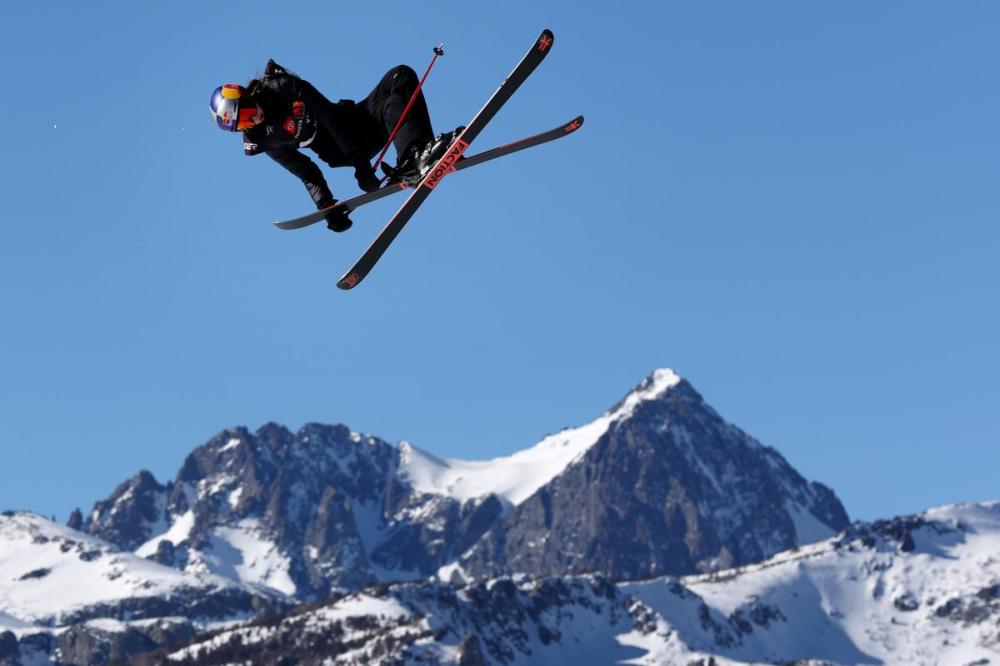
One of their most glittery stars is freestyle skier Eileen Gu, who will have the weight of the nation on her 18-year-old shoulders as she shoots for gold in big air, halfpipe and slopestyle. The U.S.-born Gu, who opted to compete for her mother’s China birthplace, is a student at Stanford University and as Americanized as it’s possible to be. But that part of her provenance will be ignored by the state. Gu’s stunning big air and halfpipe tricks take the breath away for style and audacity.
While China doesn’t have much of a historical record in the snow sports, Gu has emerged like a meteorite, becoming the first X Games rookie to take medals in three events at her debut and the first freestyle skier to win multiple world titles in a single year. In 2018, China grabbed three medals, but no gold, in freestyle and are expecting breakthrough domination gold at Zhangjiakou Genting Snow Park, with the veteran combo of Liu Jiayu and Cai Xuetong, both four-time Olympians, striving for halfpipe gold at home.
Their men’s aerial ski team swept the podium at Deer Valley in Utah last month, demonstrating again the medal contention, led by Wang Xindi, who took gold.
In snowboarding, Su Yiming this season became the first Chinese man to be crowned in the big air World Cup, after putting down a backside 1800 Indy and a frontside tail grab. “It has been my dream since my childhood to participate in the Olympic Games and strive for glory for my country,” he said. Of course, at merely 17 years old, Su is not far removed yet from that childhood.
It will be difficult to break the figure skating throat-hold enjoyed by Russia, Japan and the U.S. (at least for American men’s singles extraordinaire Nathan Chen, who will be going quad for quad with two-time and defending Olympic champion Yuzuru Hanyu). But China had developed a deep and rich pairs skating culture over the last decade, stacking atop the legacy built by legendary couple Shen Xue and Zhao Hongbo, who won the country’s only gold in the discipline at the 2010 Vancouver Games.
Sui Wenjing and Han Cong are two-time world champions, silver in Pyeongchang, just 0.43 points behind Germany’s Aljona Savchenko and Bruno Massot, well ahead of Canada’s bronzed Meagan Duhamel and Eric Radford. Compatriots Peng Cheng and Jin Yang finished fifth at the 2021 worlds. The top five pairs in the global rankings right now are either Chinese or Russian. Singles skater Jin Boyang, fourth in Pyeongchang, could find his way onto the podium with a standout performance amidst a tough field.
“Figure skating is a form of art, not just a sport, where there is always room for improvement,” says Sui. “We are pushing for every bit of extra chemistry between us for a better performance every time we hit the ice.”
Co-spearheading the charge for hardware is China’s powerful short-track speedskating squad, which will challenge Canada and South Korea for medals. Indeed, historically it’s been China’s strongest sport at the Games, copping at least one gold medal in every Olympics since 2002, when China collected its first-ever Winter Games gold.

The single gold earned by China in Pyeongchang came from Wu Dajing in notoriously unpredictable 500-metre short-track speedskating. The reigning champion and world record holder will be looking to match that result while teammate Ren Ziwei, who’s won three golds in this season’s World Cup series, has got a bead on gold in the men’s 1,500 metres, with retired six-time Olympic champ Viktor Ahn in his coaching corner. For these games, a 2,000-metre mixed team relay has been added to the program and China is favoured in the event.
China also has reasonable medal hopes in long-track speedskating. Ning Zhongyan, 22, has been the country’s most promising skater this season, winning two golds and two silvers on the World Cup circuit, while teammate Gao, bronze in Pyeongchang, bagged one gold and one silver in the men’s 500.
Apologies if this all reads like a laundry list. But the athletes, including the Chinese, will jump out and become boldface-known over the next fortnight, either for their spectacular successes or their agonizing defeats. They’ll take your breath away.
And then they’ll fade away in the rear-view mirror, for another quadrennial Brigadoon in the Winter Olympics.
Rosie DiManno is a Toronto-based columnist covering sports and current affairs for the Star. Follow her on Twitter: @rdimanno
Related Articles
Canada's Chinese community celebrates Olympics


Advertisement Advertise With Us
Advertisement Advertise With Us