

New leader faces daunting challenge
Advertisement
Read this article for free:
or
Already have an account? Log in here »
To continue reading, please subscribe:
Monthly Digital Subscription
$1 per week for 24 weeks*
- Enjoy unlimited reading on winnipegfreepress.com
- Read the E-Edition, our digital replica newspaper
- Access News Break, our award-winning app
- Play interactive puzzles
*Billed as $4.00 plus GST every four weeks. After 24 weeks, price increases to the regular rate of $19.95 plus GST every four weeks. Offer available to new and qualified returning subscribers only. Cancel any time.
Monthly Digital Subscription
$4.99/week*
- Enjoy unlimited reading on winnipegfreepress.com
- Read the E-Edition, our digital replica newspaper
- Access News Break, our award-winning app
- Play interactive puzzles
*Billed as $19.95 plus GST every four weeks. Cancel any time.
To continue reading, please subscribe:
Add Free Press access to your Brandon Sun subscription for only an additional
$1 for the first 4 weeks*
*Your next subscription payment will increase by $1.00 and you will be charged $16.99 plus GST for four weeks. After four weeks, your payment will increase to $23.99 plus GST every four weeks.
Read unlimited articles for free today:
or
Already have an account? Log in here »
Hey there, time traveller!
This article was published 04/02/2022 (1517 days ago), so information in it may no longer be current.
Erin O’Toole, we hardly knew ye! The former Conservative Party of Canada leader resigned on Wednesday following a caucus vote to eject him from the role, a mere year-and-a-half after becoming party leader.
O’Toole as leader was relentlessly disciplined and could be quite pragmatic. He did not lead the Conservative Party to victory in the 2021 election, but did have a respectable showing. Indeed, O’Toole, as was the case for his predecessor, Andrew Scheer, received more votes than Justin Trudeau’s Liberals but still lost anyway. He was eminently qualified to be both leader and prime minister.
So then why did his leadership come to such an abrupt end?
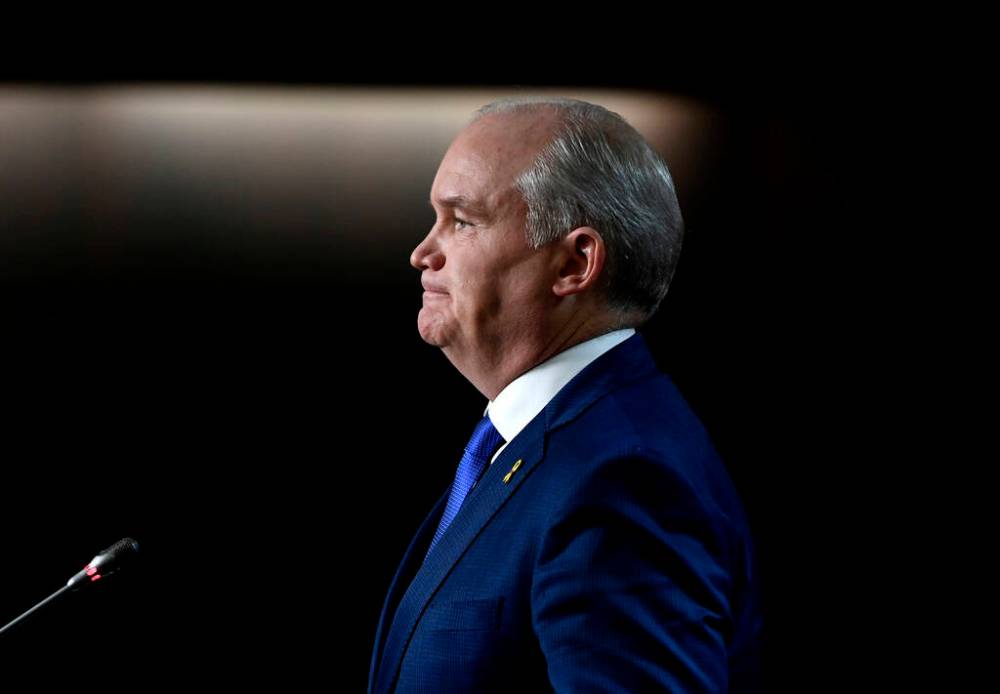
Not because he lost the 2021 election. Some commentators saw O’Toole’s defenestration as evidence the CPC is now a one-election party: leaders get one chance and, if they blow it, they’re shown the door.
I think things are a little more complicated than that. While losing in 2021 certainly caused tension and some rumbling in the party, O’Toole survived that. In part, this was because the rumbling was largely confined to party consultants who saw dollar signs in the possibility of a quick leadership race. O’Toole showed some spine, and the dissidents scattered.
Rather, O’Toole eventually lost his job as leader because he failed to effectively manage the party. This is a largely unseen part of the job, which involves maintaining control over a complex and multi-faceted organization while also keeping people throughout the party satisfied and, to whatever extent possible, working in a united fashion.
In particular, O’Toole failed to properly manage his caucus. He could not strike the proper balance between brandishing the stick and offering the carrot in dealing with his party caucus. It appears many MPs who pledged support to O’Toole after the election loss nevertheless voted to remove him on Wednesday. Eventually, it was the party’s elected MPs, not consultants or anyone else, who felled O’Toole.
There is an important lesson here: before any Conservative leader can hope to win an election, he or she must first master the party.
Consider the example of former prime minister Stephen Harper. Despite serving a lengthy term as prime minister, Harper was never beloved by the Canadian electorate. But he was very popular and very effective within his own party.
He somehow managed to bridge all the different divides within the Conservative Party. He kept a firm grip on the party bureaucracy, maintaining his influence over the party’s national council and its fundraising arm.
And, contrary to reports at the time that Harper ruled with an iron fist, he was open and generous with members of his caucus. Harper had learned from former prime minister Brian Mulroney, whose caucus management skills were legendary. Unlike Tory leaders before and after him, Harper never suffered a caucus rebellion.
With Harper having mastered the party, it was only a matter of time until the Liberals, as they always eventually do, caused themselves to fall from power. Harper lost the 2004 federal election, and took the result hard. But his mastery of the Conservative Party meant he survived that loss and continued on as leader. As a result, he was able to go on to win in 2006 after the Liberals had self-immolated in the sponsorship scandal.
And that’s the simple formula: if a leader can master the party, they can last long enough to eventually become prime minister. Very simple in theory but, given the complexity of the Conservative coalition in Canada, enormously difficult in practice.

The Conservative Party has, frankly, seen better times. It is divided across ideological and personal lines that seem to reinvent themselves with each passing year. Members of party factions are constantly finding new reasons and new ways to feud with one another.
The party’s organizational and fundraising apparatus has evolved in strangely decentralized ways that make it difficult for leaders to take control. And the influence of outside consultants — for whom the party’s electoral success comes a distant second to the number of zeroes in payments for the contracts they receive — is far too great.
Democracy requires vigorous competition for elected office, and the Trudeau Liberals have no right to score on an empty net. Too often, Conservatives themselves see their party not as a governing alternative to the Liberals, but rather as an arena within which to debate, settle scores or make some money. This state of affairs did not improve under O’Toole’s leadership; to the contrary, it likely became worse.
The party’s new leader will need to confront all this and gain mastery over the party if they have any hope of winning a federal election in the future. And CPC members would be well advised to keep this foundational qualification for the leader in mind when casting their votes in the coming leadership race.
Royce Koop is a professor of political studies at the University of Manitoba and academic director of the Centre for Social Science Research and Policy.