

The 401 is an 18-lane monster jammed with cars. Doug Ford’s solution to this traffic mess? Make it bigger
Advertisement
Read this article for free:
or
Already have an account? Log in here »
To continue reading, please subscribe:

Digital Subscription
One year of digital access for only $205*
- Enjoy unlimited reading on winnipegfreepress.com
- Read the E-Edition, our digital replica newspaper
- Access News Break, our award-winning app
- Play interactive puzzles
*First annual payment billed as $205.00 + GST for one year. This annual subscription will automatically renew at $233.00 + GST every 52 weeks (10% off the regular annual price of $259.35). Offer available to new and qualified returning subscribers only. Cancel any time.
To continue reading, please subscribe:
Add Free Press access to your Brandon Sun subscription for only an additional
$1 for the first 4 weeks*
- Enjoy unlimited reading on winnipegfreepress.com
- Read the E-Edition, our digital replica newspaper
- Access News Break, our award-winning app
- Play interactive puzzles
*Your next Brandon Sun subscription payment will increase by $1.00 and you will be charged $17.95 plus GST for four weeks. After four weeks, your payment will increase to $24.95 plus GST every four weeks.
Read unlimited articles for free today:
or
Already have an account? Log in here »
Hey there, time traveller!
This article was published 15/03/2022 (1660 days ago), so information in it may no longer be current.
There’s a monster in the north part of Toronto. We call it Highway 401.
It’s a grotesque behemoth. A vast, ugly expanse of concrete, with a twisty tangle of ramps. But it’s the traffic snarls that regularly jam it up that’ll really give you nightmares. Just endless lines of cars and trucks that prompt a powerful sense of existential despair. A daily dystopia.
Various provincial governments have spent the decades since the 401 was constructed in the 1950s trying to tame this beast. It’s never worked. It’s never even come close to working. The 401 was jammed with traffic soon after it was built, and has remained so ever since, even after a series of pricey expansion projects. It’s 18 lanes wide now near Pearson airport. Still though, each morning it quickly becomes a river of red brake lights.
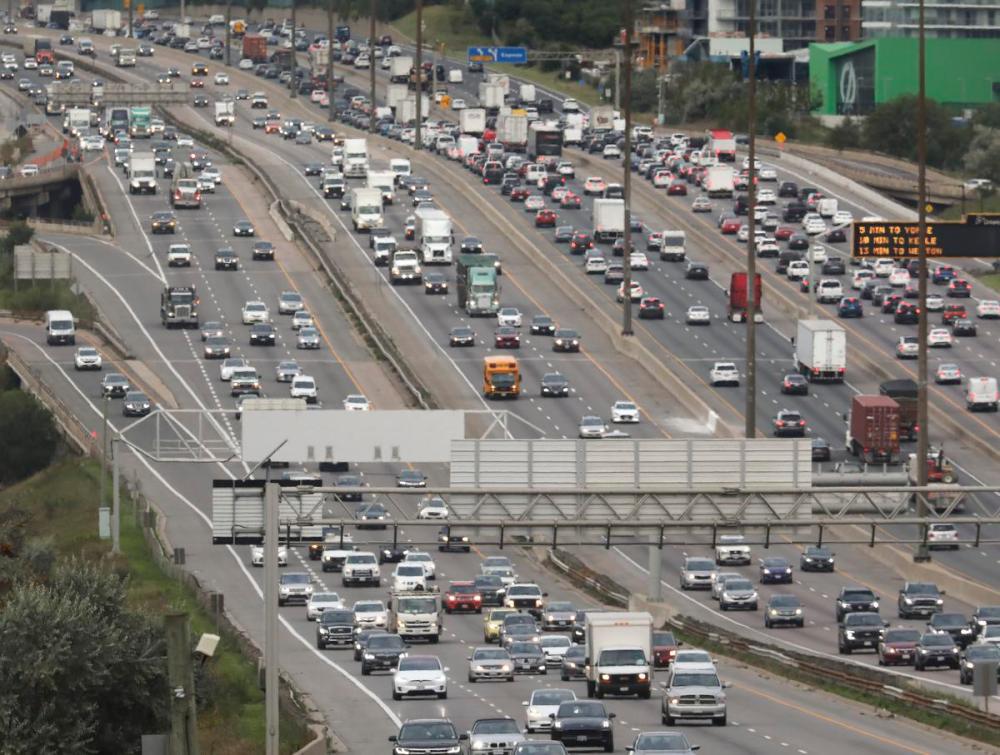
But despite decades of evidence that expanding the size of the 401 will not, in fact, work to fix traffic, Premier Doug Ford’s government seems poised to give it another try.
Last week, the Ford government released a flashy transportation plan for the Greater Golden Horseshoe. It states an intention to “work toward a major gridlock relief solution to add lane capacity in the central Highway 401 corridor between Highway 427 and Highway 404.”
The report warns that, without some kind of capacity improvement, average travel times for the approximately 416,000 vehicles — including 41,000 trucks — that drive the section of the 401 through Toronto each day will double by 2051, with the average speed reduced from 60 km/h to 30 km/h.
Sounds bad. But the report offers few details on how this “lane capacity” could conceivably be added. Which isn’t too surprising because it’s a challenge to come up with any ideas that seem even remotely credible. Is going from 18 to 20 lanes really going to make a difference? Even if it would, the highway is now hemmed in by neighbourhoods in many of its busiest sections, which means you’d need to knock down a bunch of houses.
More fanciful ideas have been talked about in the past, like building a second level of highway on top of the 401, or digging a tunnel underneath, but those just amount to a more expensive ways to add lanes.
And, really, it doesn’t matter how lanes are added. Unless traffic engineers can somehow guarantee that the new lanes won’t be filled up with more cars thanks to induced demand and population growth, there’s no reason to think these kinds of projects will make a dent in traffic. (Road pricing has shown to be effective at improving traffic flow, but the GTA would need better transit alternatives first. And a government that isn’t ideologically opposed to tolls.)
The really absurd thing about Ford’s new transportation plan, which lays out about $82 billion in transit and road projects through 2051, is the lack of ambition. It’s clearly intended to be more of a campaign document than a package of serious policy proposals. It’s supposed to be aspirational, with proposals that fire up voters ahead of the spring provincial election. But it offers so little.

Sure, there’s a couple of new transit ideas in here, including an expansion of the Ontario Line that would turn that line into a loop, and a transit line that follows the Highway 407 route. But there’s no promise to explore how transit could offer an appealing alternative to thousands of current and future Highway 401 commuters, or projections showing that the planned transit lines will convince a lot of car commuters to switch to trains or buses.
Instead, the plan seems to assume the share of Greater Golden Horseshoe commuters who get to work in single occupant vehicles — about 58 per cent — will remain basically the same in 2051 as it is today. The plan’s projections for greenhouse gas emissions show the government expects a whopping 90 per cent of emission reductions related to transportation will come from individuals switching to electric vehicles. Just one per cent of the reduction is projected to come from new infrastructure like transit.
It raises a lot of questions too about this government’s housing plans. Despite some encouraging talk from the Ford team about densifying neighbourhoods and building transit-oriented communities, a government that is planning for huge increases in the number of highway commuters is a government that is planning for sprawl.
It all adds up to a stunning lack of vision. In Ford’s Ontario of 2051, the vehicles may be electric but the traffic is as bad as ever. And the highway monster still reigns, because they’ll keep feeding it more cars.
Matt Elliott is a Toronto-based freelance contributing columnist for the Star. Follow him on Twitter: @GraphicMatt